Do I have your attention? Did that click-baity title work?
I hope so, because (I flatter myself) the tips I’m about to share are really, genuinely important if you want to write a book that resonates with the people who pick it up.
Best ever advice
The advice that changed my approach to writing – and which I came across at random on the internet – is this:
A story isn’t about what happens; it’s about how what happens changes the people in the story.
Apologies to all of you who’ve got thirty-point plot plans full of dragon battles or gruesome serial killings prepared – but those twisty, turny events you’ve dreamt up aren’t as important as you think they are. At least, they won’t be if you don’t make sure they mean something.
Character arcs – emotional journeys – are the beating heart of every story: the pulse that keeps readers turning the page. If you don’t tie some sort of character development to every dramatic scene you craft, what you’ll be left with is a sequence of ‘and then’ events that no-one really cares about.
Here, I’m going to offer my top tips for creating characters that will inspire readers to invest in them. I’ll also outline ways you can tie their progress to the external goings-on in your fictional world, ensuring that the big set-pieces you’ve imagined don’t fall flat.
Characters don't have to be likeable... but we need to understand them
I write commercial women’s fiction: romantic comedies where readers expect to find a protagonist they can root for. This doesn’t mean I have to write fault-free characters, though – and if you’re working in another genre, your scope for crafting someone dark and damaged is even greater.
However sympathetic (or not) you intend your main character to be, there must be credible reasons why they are the way they are. In other words: what’s their backstory?
You don’t have to know what they got for their fifth birthday or their favourite flavour of pizza, but you do need to know how they got to where they are at the opening of your novel – both literally and metaphorically.
Think about Mick Herron’s Jackson Lamb: a deeply unpleasant, uncaring alcoholic, washed up on the scrapheap that is Slough House. Not the deadbeat he at first appears, he remains a skilled agent whose instincts are sharp under pressure – but he’s drowning in cynicism (as well as Scotch) thanks to the deep emotional damage wrought by years of MI5 double-dealing.
Characters need to have problems
And lots of them! If everything is tickety-boo at the start of your story, there’s nowhere for your protagonist to go.
You don’t need your characters to be miserable, but you might want to show them discontented, frustrated, stuck in a situation that’s stifling them or in denial about the past. Whatever is troubling them, it should be connected to their backstory.
Your book’s inciting incident or catalyst is your first opportunity to link your plot (the ‘external conflict’ of your story) – to your character’s issues (the ‘inner conflict’). Make sure that whatever happens here deepens the challenge they’re already facing. In Jane Austen’s Persuasion, the temporary loss of her family home is bad enough for Anne Elliot – but it also sees her thrown back into the orbit of her lost love, Captain Wentworth.
Consider wants vs. needs
All of this said… your characters don’t need to recognise the pickles they’re in to begin with. In fact, it’s best if what they want – the thing they’re striving for as your book opens – has nothing to do with what they actually need.
For instance, your protagonist may be working towards a promotion, or to earn their family’s respect. Perhaps they’re desperate to win back an ex-partner or plotting revenge on an enemy. External goals like these, even if they’re achieved, shouldn’t fix the inner conflict characters are ignoring: the trauma rooted in childhood or the pain of their first love deserting them.
The job of your plot is to guide your character into confronting what’s really going on below the surface. That’s a process of realisation that should take in a variety of highs and lows along the way.
Marry external events to internal reactions
If you’ve outlined the main events in your book, you’ve probably got a list of key scenes you want to include. These will become true story beats when they’re clearly tied to their effect on your characters.
How do the events of your novel trouble or challenge your protagonist? How does each incident affect them specifically? Why is something worse for them than it would be for an average person? Personalise everything to raise the stakes for readers and make every plot point matter more.
This is the difference between a man being involved in a train crash, and him being involved while trying to get home to his dying wife so he can say goodbye to her. A powerful combination of event + emotion is always what you’re aiming for.
Employ tropes with authenticity
If you’re writing genre fiction, such as romance, there might be particular tropes you’re keen on: fake dating or the ‘Oh no! There’s only one bed!’ scenario, for instance.
These can feel predictable, but it’s possible for them to work brilliantly when you’ve done enough groundwork to make the events, and characters’ reactions to them, feel authentic. Ask yourself, ‘How would X reallyreact to this?’
In Mhairi McFarlane’s Cover Story, a newspaper reporter ends up fauxmancing a colleague because she’s desperate not to break out of the false identity she's assumed. It’s entirely believable because, by this point in the novel, readers know how badly she wants to expose the political corruption she’s already uncovered.
From 'a-ha! moment' to evolution
When does your character finally admit they need to deal with whatever false belief or emotional baggage they’ve been avoiding? What event in your plot sparks that realisation? This ‘aha! moment’ is a brilliant opportunity to tie the external to the internal.
Similarly, the climax of your novel might well involve external conflict – the final battle in a war, a dragon razing a city to the ground, a magical duel – but it will only matter to readers if it also sees your main character trounce the thing that’s been holding them back throughout your book.
Do they finally decide they’d rather pursue justice than revenge? Do they cast off the malign influence of a mentor who’s been leading them in the wrong direction? Do they dare to embrace the full extent of their own powers and save the day?
Whatever happens, the end of your book it will be far more memorable if it’s meaningful.
Want to learn more about mapping the emotional journey in your novel? Join me on 21 October for a Build Your Book Month event that takes an even deeper look at how to outline your story with a strong focus on your character’s inner arc.
In today’s blog post, I’m going to be sharing the PERFECT way to plan your plot. It’s the method that trumps all other methods. If you’re not using this method, you’re doing it wrong.
I joke. I joke. Don’t come at me.
If you’ve been around the writing world for any length of time, you’ve probably come across all sorts of advice about how to plan your novel. Some people swear by spreadsheets and scene-by-scene breakdowns. Others can’t imagine plotting a single thing in advance, insisting that creativity comes from discovery, not planning.
It can feel overwhelming, especially if someone claims a particular method is a game-changer and you try it, only to find it just…. doesn’t work for you.
Here’s the truth: there is no single perfect way to plan your plot.
And that’s not bad news. If you’re someone who came to this post hoping for a magical answer to your plot woes and feel disappointed, bear with me. The fact that there is no one perfect way to plan a novel is actually great news.
Writing is personal
Every writer has a different creative process. For some, plotting every beat in advance provides a safety net. For others, too much structure can feel like handcuffs. And a lot of us fall somewhere in the middle, enjoying a bit of guidance while leaving space for surprises.
The most important thing isn’t to force yourself into a method that doesn’t feel right, but to experiment until you find the approach that helps you get the words on the page.
Take me, for example. I’m editing my fifth book (fifth to be published, eleventy-billionth if you include the novels I tried to write before I got published), and even now I’m still experimenting with my process. I’ve tried hardcore plotting: My first and second books had spreadsheets that may have called my sanity into question. I’ve tried pantsing: My third book was written with a vague idea of the beginning and ending in mind. And I’ve tried doing a bit of both, which seems to work better for me, but even now I still experiment with how much plotting works for me.
We’re about to dive into Build Your Book Month, which has a snazzy tagline of ‘outline your entire novel in 1 month’. This headline can sometimes scare people. They think, ‘I’m not a plotter so none of this will be relevant to me’. But the way we’ve designed this month is not to force a particular method on you, but to explore different aspects of story that you should think about before or as you write, whether that’s mapping it out in a spreadsheet or just turning ideas over in your head.
Plotters, Pantsers, and everyone in between
Writers often divide themselves into two camps:
Plotters carefully map out their stories before writing. They might use beat sheets, the Three-Act Structure, or even a chapter-by-chapter outline. They like knowing where the story is headed and feel more confident when they can see the big picture.
Pantsers (short for “seat-of-your-pants” writers) dive straight into drafting without a clear plan. They thrive on discovery, letting the characters take the lead and uncovering twists as they write.
But a lot of writers actually live in the grey area between these extremes. Maybe you sketch a rough outline but let it shift as you go (this is what I do). Maybe you write the first act freely, then pause to outline the rest. The beauty is that there’s no wrong way to do it as long as it gets you writing. Maybe you plan out the direction of the story, but you do it all in your head before drafting that scene.
During Build Your Book Month, you’ll get to experiment. Want to see how character flaws can generate plot? That’s exactly what Liz Monument will cover in Designing Characters That Drive the Plot. Curious how multiple POVs could work in your novel? My Multiple POVs Without the Chaos workshop has you covered.
The point isn’t to pick sides. It’s to discover what blend of planning and discovery helps you finish your novel.
Why planning still matters (even for Pantsers)
Even if you resist the word “outline,” having some sense of structure can save you time, frustration, and endless revisions. Planning doesn’t have to mean spreadsheets and scene cards. It could be as simple as knowing:
Who your main character is
What they want
What stands in their way
Where the story is headed
Think of it as a map. You don’t have to know every street name, but it helps to know you’re driving toward Paris and not accidentally ending up in Prague.
That’s why Mapping the Emotional Journey with Laura Starkey can be a revelation. Even if you normally write by instinct. Because once you understand your character’s emotional arc, you’ll naturally make stronger choices about what happens next.
Flexibility is key
Here’s the thing: outlines are not set in stone. They’re tools. And tools are meant to help you, not control you.
If you’re a Plotter, give yourself permission to deviate from your plan if inspiration strikes. If you’re a Pantser, try jotting down a few key milestones so you don’t get stuck in the dreaded saggy middle. The most effective outlines are flexible enough to adapt as your story grows.
Build your own process
The real secret to plotting is building a process that works for you.
That might mean using Save the Cat’s 15 beats (which we’ve got a downloadable resource on for Premium Members), or creating your own shorthand version with three or four big turning points. It might mean writing your story on index cards you can shuffle around, or keeping a simple notebook with bullet points.
Your outline doesn’t have to look like anyone else’s. It only has to serve your writing.
The bottom line
There is no “perfect” way to plan your plot. There’s only the way that works best for you.
By the time we reach the final workshop, you’ll have explored different structures, tested ideas, and built up the raw material. That session ties it all together into a practical outline that feels like yours, not someone else’s.
So instead of chasing someone else’s idea of perfection, why not join us and discover your own?
Let’s face it - there’s nothing like a good plot twist. That delicious moment when your jaw drops, your brain short-circuits, and you immediately flip back a few pages muttering, “Wait, WHAT?”
Contrary to popular belief, plot twists are NOT just for crime writers. Whether you're working on a thriller, a romance, a fantasy epic, or even a literary darling, the plot twist is the literary version of a mic drop - and readers absolutely eat it up.
But why do we love plot twists so much? And more importantly, how do you pull one off without making readers roll their eyes so hard they sprain something?
Let’s twist again, like we did last chapter... (Ba du dum.)
Why plot twists are so addictive
Plot twists are the espresso shot in your story cappuccino. They jolt readers awake. They make people text their friends at 2 a.m. with “YOU NEED TO READ THIS BOOK.” They’re proof that the author is five steps ahead, cackling behind the scenes, and we love being fooled like that.
A good twist does three things:
Surprises the reader
Makes sense in hindsight
Changes the direction or emotional tone of the story.
When done well, twists make readers feel smart for spotting the clues - or wonderfully blindsided if they didn’t. Either way, it’s a win.
Plot twists across genres
You don’t have to write a psychological thriller to serve up a killer twist (though, let’s be real, they practically require one).
Here's how to tailor twists to different genres:
Crime / Thriller / Mystery
The plot twist is your bread and butter here.
Classic moves: The killer was the narrator. The victim faked their death. The detective was the criminal.
Pro tip: Leave breadcrumbs, but scatter them wide enough that readers miss the loaf. For more advice on pulling this off perfectly, be sure to check out our Crime Writing For Beginners video course with Graham Bartlett. Alternatively, if you’re after that extra level of support, consider our tutored Writing Crime and Thriller Novels course (starting 1 September)...
Romance
Yes, even swoony stories can twist the knife!
Twisty moments: The love interest has a secret past. That “adorable” meet-cute was orchestrated. The breakup wasn’t what it seemed.
Pro tip: Just make sure the twist doesn’t ruin the happy-ever-after (unless you’re writing a Nicholas Sparks-style tragedy… in which case, proceed with tissues).
Fantasy
In a world of dragons and dark lords, you’ve got room to get weird.
Magical twists: The chosen one isn’t who you think. The villain was protecting something all along. That magical artifact that they’ve been trying to rescue? Cursed.
Pro tip: Even in wild worlds, logic matters. A twist should still follow the rules of your universe.
Sci-fi
Twists in sci-fi can get existential.
Mind-benders: The AI is sentient. The alien planet is actually Earth. The time travel loop has already happened.
Pro tip: Your twist should spark a philosophical “Whoa...” and a plot “Aha!”
Literary & Historical Fiction
A subtle shift can hit just as hard as a big reveal.
Quiet gut punches: A character’s perception is proven false. A backstory unravels everything.
Pro tip: Here, it’s all about emotional resonance. Make us feel something deeply, even if nobody dies or time-travels.
How to pull off a killer plot twist (without killing your story)
1. Know the ending first
Start with the twist, then build the story around it. It’s much easier to foreshadow something when you actually know what you’re foreshadowing. If you’ve already written a decent chunk of your story and you want to add a twist in, you can do that too, but make sure you go back and pepper the foreshadowing in.
2. Play fair
Readers love to be tricked, but they hate being cheated. If your twist relies on information you never gave the reader access to, it’ll feel like a cheap shot. They need to be able to read back on what they’ve already read and think ‘Oh! How did I miss that?’
3. Layer the clues
Drop hints like a sneaky little breadcrumb trail. Some readers will catch them, others won’t—but either way, they’ll love looking back and realizing you totally warned them.
4. Hide the twist in plain sight
Use misdirection. Distract readers with a more obvious mystery so they miss the real one coming. (See also: every good magician ever.)
5. Let the twist change something
The best twists don’t just shock—they reshape the entire story. They change how we view the characters, the world, even the genre at times.
Look, writing a great twist is like performing a magic trick. You need timing, precision, sleight of hand, and a flair for drama. But when you get it right? Readers will never forget the moment their brain short-circuited - and they’ll come begging for your next book.
So go ahead. Lie to your readers (but nicely). Trick them. Flip the script.
Because at the end of the day, we all want to be fooled—just as long as the twist is earned.
We can choose the sequence of significant events that best grips the reader.
The arrangement of a timeline essentially occurs in three steps. Beats, stories, and plots.
A beat is a single event, as yet unconnected to the other events in the book.
A story is a collection of multiple beats presented in order.
A plot is the context that conveys why the beats belong together in the story, sequentially, if not chronologically.
How To Structure Your Story Timeline
Structuring your story timeline essentially gives you a sequential framework. There are four types of story timeline – linear, fractured, framed and real-time.
Linear Story Timeline
When story events are presented in the order they occur in, they create a linear story timeline. The story can contain a few flashbacks to provide some backstory, but the primary narrative is chronological.
The Harry Potter series by J K Rowling works with such a linear story timeline, with a few flashbacks that act as supporting information to the main story.
Fractured Story Timeline
When a non-linear timeline story is told with frequent back and forth between the past, present and/or future, it’s called a fractured timeline story. The beats of the story are not in the sequence they occur in.
Think the movie Memento. The ending of the movie is presented in colour at the beginning of the film, and the beginning of the movie is presented in black and white towards the ending of the film, with the complete story merging in the middle to make sense. This fractured story timeline helps the audience experience the protagonist, Leonard’s, memory loss.
Framed Story Timeline
When a story has one major flashback, with the narrator walking others through it, it’s called a framed story timeline. It’s a story within a story.
Emily Bronte’s Wuthering Heights is a classic example of such a narrative with the he-said-she-said nature of it adding to the gothic quality of the story arc.
Real-Time Story Timeline
A linear story with no breaks in terms of flashbacks or flashforwards can still be compelling. In fact, a real-time story is exciting because time in the story moves exactly as it does for the reader.
Take Scottish author Ian Rankin’s Inspector Rebus series, for instance. The characters in his novel age with the publication dates. Inspector Rebus, who is said to have been born in 1947, retires at 60 years of age in the 2007 novel Exit Music.
How To Create Your Story Timeline
Creating a story timeline can help keep your story free of plot holes and give you a sense of direction whilst writing.
Here’s how you can create your story timeline:
Age matters: Decide on the age of your characters and how old they’ll be when the story begins and ends. Knowing what portion of your character's life you want to include is key whether you're writing one novel, the first story in a series with separate timelines, or a multiple timeline narrative.
Set it up: Zero in on a primary location for the beginning, middle and ending acts, unless, of course, it remains the same throughout. The setting of your story will induce the mood for both you and your readers.
Inciting event: Knowing at which point in the three-act structure you want the inciting event to take place will help determine the overarching narrative flow.
Character’s goals: What is the goal of your main character(s) and why? This not only dictates each character arc, but also the plot’s narrative arcs.
Resolution: What is the event that your main characters are headed towards? The primary goal/obstacle is the whole point of your book, so deciding when and how to bring the resolution about is imperative.
How To Write A Multiple Timeline Story
When a story has two or more periods of time coming together, it’s called a multiple timeline story.
Kate Morton’s The Clockmaker’s Daughter is a good example of a narrative with more than one timeline.
If you’d like to attempt a story with two timelines or more, here’s how you can do it:
Decide on your primary timeline. It should ideally take precedence over the additional timelines you've planned for. An 80/20, or at least a 70/30 split is a good idea. This will keep your reader focused on what’s important.
Be clear about the story for each timeline. Your reader shouldn’t greatly prefer one timeline over the other. This is even more important if you’re writing a 50/50 split multiple timeline story.
Map out the beats of the different timelines separately and sequentially. This way, you won’t mess up or mix up plots, and you can then connect the dots between, and/or converge, your beats.
When and how do you want the multiple timelines to converge? Knowing your transition point is crucial when crafting the story arcs for multiple timelines. Look for the beats and characters that have the maximum impact in your story; those are the ones that lend well to the transition point.
Top Tips For Creating A Story Timeline
Here are some top tips for creating your own story timeline:
Knowing which type of story timeline is the right one for you is crucial. The type of plot/overall narrative arc you’re aiming for will help you decide this.
Make sure you have your three-act plot structure ready. This will help you flesh out your story.
If you have multiple point-of-view narration, create a timeline for each character and ensure they fit in neatly for your transition point.
Frequently Asked Questions
How Do You Write A Timeline Story?
To write a timeline story you need a clear three-act structure which includes details about your protagonist's age, your setting(s), and your key plot points.
What Are Time Markers In A Story?
A timeline is constructed based on the time markers of the story. Some of the time markers are the character’s age, the setting (e.g. season, time of day), duration of the story, and the three-act structure which dictates the story's shape.
Creating Story Timelines
The past, present, and future don’t always come in chronological order when you're weaving a tale. But they don’t have to get muddled up in our minds; they can be structured sequentially, if not chronologically.
Many writers find that creating a story timeline helps keep their plots clear, their character arcs solid, and their narrative structures strong.
No matter what writing stage you're in, having clarity on your story timeline will help you stay on top of the game.
When I think of falling action, I think of all of the scenes in Gladiator that come after Maximus Decimus finally has his revenge on the new emperor (warning Gladiator spoilers ahead!)
Maximus stabbing the emperor is the undoubtable climax- his long sought revenged is finally reached. Many important things happen after this; we still see his inevitable demise and a number of important scenes follow; yet these scenes are no longer part of the story's climax.
The scenes that follow, despite being dramatic in their own right, are slower and more satisfying, they lead us to the conclusion of the story. The main climactic moment has already occurred, which means that all of those scenes that follow are part of the falling action.
A story's falling action is the action that occurs immediately after the big climax has taken place and the action shifts towards resolution instead of escalation. The action is now no longer rising, instead it is now falling and taking us (the viewer/reader) onwards to the end of the journey. In short, it is everything that comes after the important questions have been answered.
In this guide you will learn how to better identify falling action and how to write it. Once you read this article you will be able to define falling action, understand the role it plays in story structure, and know the difference between falling action and rising action.
Let’s dive in!
What Is Falling Action?
Falling action in a story is, simply put, the action that comes immediately after the important climax has taken place. Note that some films or books might seem to have multiple climaxes (like in the Lord of the Rings finale where they seem to come one after the other.) However, there is usually one important main climax, which the rising action has been leading towards.
Keep in mind, though, that exciting things can still happen after the climax (like the volcano erupting in Lord of The Rings) and those scenes are still part of the falling action. All falling action leads to the story's resolution and the tying up of loose ends of the plot.
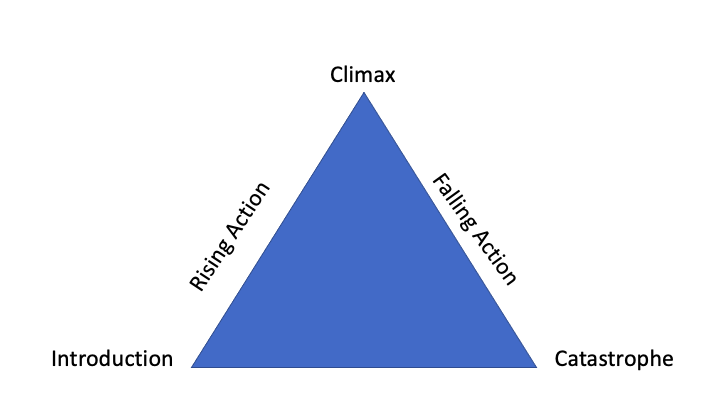
It’s hard to talk about falling action without talking about German author Gustav Freytag, who, through the illustration of his (Freytag’s) pyramid, argued that all stories can be reduced to one basic plot structure which consists of five stages: exposition, rising action, climax, falling action and dénouement.
Let’s break these down.
1. Exposition
The story starts with exposition, which breaks down the information the reader will need in order to understand the story best.
Who is this story about? Who is the main character? Who is the antagonist? What is their world like? What are their key relationships? What are the stakes? What is the time period? What are all the relevant details?
Once this is all established and the reader is invested, the inciting incident typically occurs in the story, which then moves things on to the rising action.
2. Rising Action
When the rising action hits, the plot usually quickens and starts to (as the name suggests) rise towards the climax. The tension in rising action will typically grow from scene to scene as plot developments lead us through the story and upwards to the grand climax. No matter how complex or unique a story is, it's likely to have rising action.
3. Climax
The climax is arguably the most important part of the story, though each part of Freytag’s pyramid is significant in its own way. A climax will tackle the story's central conflict, answer its main question, and will serve as the main turning point for the story.
Typically, it’s when the hero reaches their destination, or when they finally confront the villain. As the pyramid/plot diagram suggests it is the peak of the story - the action will no longer rise, and the stakes will not get higher from here. Once the story reaches the climax, the action will head towards resolution in the form of falling action.
4. Falling Action
As discussed throughout the article, falling action refers to all the scenes/plot points that come after the climax and lead to a resolution and the final “after” snapshot. (Refer back to the first heading for a more detailed falling action definition.)
Few stories skip falling action completely, but if you're writing a series of books, especially if they're in a genre which is rife with major conflict and plot twists, you may decide to leave some loose ends. In this case, it might be that your protagonist gets closer to solving the obstacles presented by the story's main conflict, which gives readers some satisfaction, but a few unanswered questions remain. This means your readers will have some closure, but will also be eager to read the next instalment of your series.
5. Dénouement
Dénouement is often confused with falling action and to be honest it’s easy to confuse the two. Dénouement is the very last bit of the story which shows the final resolution. It’s not so much the unthreading of plot lines that the falling action is but rather dénouement is the final say on how everything has been resolved. In Lord Of The Rings, it would be showing Frodo happily back in the Shire. Dénouement can also involve a tragic resolution too where things don't work out as well as your protagonist had hoped.
Dénouement hints at what’s to come, and show us how everything has changed for the main character and secondary characters and it leads us to the story's end.
The Difference Between Falling Action And Rising Action
The key difference between rising and falling action is that rising action follows an upward trajectory where it escalates in intensity in order to reach the climax. Falling action should, like its namesake, follow a downward trajectory and aim to give the viewer/reader relief from the climax.
Let's explore the importance of falling action.
Why Is Falling Action Important?
Falling action is important because if you ended a story on a climax there would be no emotional relief for the reader/viewer. The story, whether sad or happy, would have no satisfying end or closure. You’ve spent all this time getting your reader excited and invested; you cannot then just leave them at the peak.
The main reasons to include falling action in literature are as follows:
Ties up loose ends, especially in relation to the main conflict
Falling action serves the reader's curiosity, giving them satisfaction and closure
It provides extra time for a closing statement of themes and the core message
Wraps up side-storylines, or the stories of multiple characters
It gives the story time to wind down so you can head towards your closing image with purpose and intent
Examples Of Falling Action
Falling action can take many forms (in terms of style, format, genre etc). Here are five falling action examples from literature and film:
The Hunger Games By Suzanne Collins
In The Hunger Games, the falling action is everything that comes after Katniss wins the games. The main plot has been addressed and the action moves towards the resolution. Dénouement would be the scene that shows her life long after the Hunger Games have ended.
Harry Potter And The Sorcerer’s Stone By J K Rowling
In Harry Potter and the Sorcerer’s Stone, the falling action happens once Harry faces Voldemort. The time after that spent in the infirmary, and the house cup and all that follows is falling action.
Titanic
In the film Titanic, the climax would be the Titanic sinking and Jack and Rose being stranded. Once Jack passes and Rose decides to use her last morsel of energy to get the whistle, the falling action begins. Dénouement would be the very final scene when the old lady drops the necklace into the ocean.
A Christmas Carol By Charles Dickens
In A Christmas Carol, the falling action occurs after Scrooge wakes up and realises that he is still alive, and it is still Christmas, and that there's still time to change his trajectory. Everything that comes after this with him fixing all his wrongs is part of the falling action.
Matilda By Roald Dahl
In Matilda, the climax occurs when Miss Trunchbull is vanquished. Matilda skipping grades and Miss Honey’s life returning to normal is the falling action. Miss Honey becoming Matilda’s new guardian once her family has left for Spain could be considered dénouement, as it shows us Matilda’s new normal, and what her life is likely to look for the foreseeable future.
How To Write Falling Action
The three steps to writing falling action are as follows:
Identify all of the loose ends you would like to wrap up, arrange them in order of importance and in a descending pattern, (i.e. the action should be calmer and not rising.)
Consider the pace of the overall story in order to decide how your falling action should fit and how much room it will occupy on the page. Tip: make a checklist of the storylines /plot points/ jokes you would like to see wrapped up and tidied, and then check things off once you have included them in the falling action.
Loosely plan out your story structure so that you know roughly what the falling actionwill entail.
Once you know which beats you want your falling action to hit and in which order, and once you are clear on which plot points should be concluded, then you can draft the falling action just as you would any other section of your book or screenplay.
Frequently Asked Questions
Let’s address some of the most asked questions when it comes to falling action.
What Is A Falling Action?
Falling action is everything that takes place immediately after the climax. The purpose of falling action is to bring the story from climax to a resolution. It is one of the key elements in any story which will usually include an exposition, rising action, climax, falling action and denouement.
How Do You Identify A Falling Action?
In order to identify falling action try asking yourself the main plot point of the story, then identify when that plotline is resolved (i.e. when the hero finally confronts the villain), once you are able to identify the climax you can identify the falling action. Remember the falling action will usually revolve around resolution and de-escalation of the previous action, and will follow a downward spiral.
What Is The Difference Between Dénouement And Falling Action?
Dénouement is the final part of a story which usually shows you a glimpse into the main character's new normal. Like in the case of Matilda, dénouement often gives the viewer a snapshot of what’s in store for the MC in the future (Matilda will now happily live with Miss Honey). Dénouement is usually much shorter than the falling action. It’s often a commentary on the future of the world in the book as well, similar to an epilogue, a dénouement will explain where the world you've created, and your story's characters, will go from here.
Falling Action
It’s very important for writers to focus on their falling action and to really flesh it out in the perfect way for their narrative. It isn’t something to be overlooked or skipped. When keeping in mind falling action, you can refer to Freytag’s pyramid and try to visualise the way you first expose your story and the important details.
Then imagine the line going upwards with your rising action and try to pair that with emotions- first the reader is intrigued with your exposition and details of the story, then they should be excited and nervous with your rising action, the climax should hit hard and heavy and be the peak of the storyline, then the reader should feel a sort of detangling of threads with the falling action. Falling action should bring with it a sense of closure and relief.
Writing dystopian fiction can be a lot of fun. When the world feels bleak and hopeless, what better way to channel your frustration and anger than into a story where the world has changed completely — unrecognisably and for the worse.
But in order to create a dystopian world, first you need new and fresh ideas — which is where our writing prompts come in.
In this article, I will be sharing what dystopian literature is, and then taking a look at some fun ideas based on various dystopian genre categories.
So whether you are writing a dystopian novel, script, or short story, take a look at our 43 dystopian writing prompts and 17 ways to find inspiration, and see where these seeds of an idea take you!
What Is Dystopian Literature?
The Oxford dictionary describes the word 'dystopia' as: "An imagined state or society in which there is great suffering or injustice, typically one that is totalitarian or post-apocalyptic."
In literary terms, dystopian fiction is simply stories set in a future where our world has been drastically changed in some way.
Whichever dystopian genre you choose to write, whether fantastical or totally plausible, remember that the story must derive from a kernel of truth, and the main character needs to be suffering as a result of that change.
Examples Of Dystopian Novels
How is the future going to look in your next novel?
There are many different ways to show a changed dystopian society. In some dystopian novels, the change is small...
Perhaps it's an intimidating government regime, such as Orwell's novel, 1984, or climate change concerns, found in Atwood's Oryx And Crake.
Whereas in other dystopian novels the story may be set against a post-apocalyptic backdrop where zombies roam the streets, such as in M J Carey's The Girl With All The Gifts, or science and technology have taken over from civilisation, as found in Huxley's Brave New World.
The popular YA books series and movie franchise, The Hunger Games, explores the concept of young people saving our world and communities being split into factions, having to come together to overthrow a corrupt government.
Alternatively, you may choose to explore the idea of the human population diminishing and what that would mean for human life, such as in Bethany Clift's Last One at the Party and Christina Sweeney-Baird's The End of Men.
Regardless of how far-fetched or unbelievable your ideas are, you can still make a comment about the world we live in today through your dystopian stories.
43 Dystopian Writing Prompts
The joy of writing dystopian stories is that the ideas and possibilities are endless. You can be didactic and political, or you can send your readers on a magical, crazy adventure.
As long as your story is set in the future, in a world that is suffering or post-apocalyptic, you have yourself a dystopian novel.
Ready for some ideas to kick-start your imagination? Here we go!
How To Use Our Dystopian Writing Prompts
Because dystopia is such a broad genre, and the story possibilities are endless, I have put together 43 writing prompts categorised into 8 sub-genres.
Feel free to mix and match my ideas, add lots of your own details, or even take the line and put it into your story. However you choose to use these prompts, the important thing when writing dystopia is that you keep it fresh, exciting, and relevant to the market today.
Speculative Fiction
Speculative dystopian fiction adds a touch of magic and the impossible to a dystopian world.
In the not-too-distant future, scientists have created a pill that allows humans to fly. The only problem is that they have sold it to the wrong people.
Imagine a dystopian future where our dreams literally come true — including all our nightmares.
The government decides to eradicate money and go back to a bartering system, but some people have MAGIC to barter with.
The world has always been full of invisible people... but now everyone can see them.
World War
Every country changes after a war. What will happen in your dystopian version?
The adult human race has been wiped out because of war, only children are left. Will they survive?
A future where every country is at a nuclear standstill... which one will crack first?
Two countries at war fighting over the rightful heir to their throne discover she is actually a powerful witch.
Tim wants to avoid fighting in the Third World War, so creates a robot to take his place.
Post-Apocalyptic World
The world has ended... as we know it. What does it look like now?
Life expectancy has gone up and people are living for twice as long. But it's backfired!
1,000 years into the future and the new world looks completely different. In fact, humans have now evolved into... (?)
The world has ended and the only remaining humans are those who were cryogenically frozen. What are they about to wake up to?
Sammy has spent her whole life in just one village. It's not until she realises she's the only one left on Earth that she decides to see the world!
The only people who have survived the end of the world are the inhabitants of two small islands. Unfortunately, they hate one another.
The whole of America has been destroyed except New York City. Those left are completely unaware the rest of the country no longer exists until one person manages to escape the city walls.
The world has been divided into 4 regions - North, South, East and West - two are poor and two are rich. Every year every human on the planet has to enter the ultimate challenge to be allowed to stay alive!
Monsters & Zombie Apocalypse
It's finally happened - humans have become zombies and we have new monsters to fear. How will your story give a new twist to this fun genre?
On the first anniversary of the war that nearly ended the world, a small town pays respect to its fallen heroes... but then they all return home. Undead.
Science creates a GM meat substitute that eventually leads to people developing a hunger for human flesh.
Jeff is the only man who has survived the end of the world after a huge nuclear explosion — he and all the cockroaches that have now mutated to 100 times their size.
Thanks to a giant radiation leak every domesticated animal has become a feral predator. Ever seen how fast a cow can run when it's hungry?
Zombies have taken over the world, except... they're actually nicer than humans.
It's Halloween and the sweets are laced with a dangerous drug. The monsters in the street are no longer people dressed up.
A pandemic sweeps through an island forcing people to flee before the indigenous animals turn into monsters... including all sea creatures.
Natural Disasters
We've destroyed our planet and now it's fighting back. How does the world look now?
Global warming causes all the ice caps to melt and humans are forced to literally sink or swim in order to survive!
A meteor strike strikes the Sahara desert, uncovering a giant spaceship that has been hidden for hundreds of years.
Climate change has made the entire planet too hot to live on; only the Arctic is a safe place to live. The battle to claim the only inhabitable land has commenced.
Thanks to climate change and limited resources, humans have to choose between cannibalism or death.
The sea level is rising and the only water left on Earth is seawater.
Fires sweep through Europe, forcing everyone to flee to islands such as the UK and Ireland. The locals are torn between making room and protecting their own.
Alternate Universe
Maybe we don't know everything we thought we did about our planet and its place in the universe.
Scientists discover our world is not the only habitable planet in the universe. Russia, China and America battle it out to see who will be the first to claim this new planet as their own.
Sally discovers a portal where she is thrown into a world exactly like our own... except neither world war happened, the concept of money has been abolished, and Elvis never died.
Thanks to a new drug, a detective learns to solve crimes by going back to the past and watching the crime scenes unfold.
A woman in a coma is really happy in life until she wakes up and discovers the real world no longer exists, and she had imagined a whole life that never happened.
Corrupt Government
The world has changed and those in power are about to do something absolutely terrifying... or perhaps they already have.
The government has been secretly adding subliminal messages to TikTok to brainwash kids into joining a secret army.
Earth is about to be destroyed by a giant tsunami in five days... but the government is calling it Fake News. Can a team of kids convince the world to take cover before it's too late?
A corrupt government has come into power and convinced everyone that weekends should be abolished as it will make them more money. One union rises up and creates a civil war.
The new law states that a woman's place is in the home and that everyone with a womb must have two children before the age of 30 or they will face the death penalty. 10 years later, a group of women fight back.
A dangerous UK government comes into power, forcing every person in the UK to return to the country in which their maternal grandfathers were born, and forcing British people who live abroad to return to the UK.
Humans are slowly being replaced by identical robots and no one will believe Tom as he warns the remaining humans about it.
Artificial intelligence has taken over the art world - paintings, books and music have been created by machines for centuries - then one woman picks up a pen.
A scientist has discovered he can control the human mind - and starts by experimenting on his family.
Human body parts can now be harvested... one scientist decides to create the perfect human being.
In a quest to save the rainforest, a scientist discovers a plant that can communicate with humans and learns something that will change the world.
A man invents the perfect female robot whom he falls in love with... but the robot becomes sentient and tells him all the things that are wrong with him.
17 Ways To Find Inspiration
Watch the news. Take the latest shocking headline, think of the worst-case scenario, and develop the story around that little seed of an idea.
Look at old photographs of strange things.
Combine two or more dystopian novels and set them against a new background.
Create a modern-day version of an old classic.
Read up on world leaders from the past and imagine what would have happened if history had been different.
Create a fantastical version of things that have already happened.
Learn about the environment and how we can help the planet.
Ask friends what their worst fears are.
Base your characters on dark real-life figures from the past.
Read up on the lives of interesting historical figures.
Learn about space and predictions for the future.
Ask yourself 'what if...' and see where it takes you.
Look at the struggles minorities in our world have and think about what would happen if all of humanity suffered in that way.
Make Pinterest boards.
Read conspiracy theories.
Talk to people who fight for the rights of others.
Don't be afraid to push boundaries and ask difficult questions.
Frequently Asked Questions
What Are Examples Of Dystopian Stories?
There are many incredible dystopian stories. Examples include 1984 by George Orwell, The Hunger Games by Suzanne Collins, The Handmaid's Tale by Margaret Atwood, Brave New World by Aldous Huxley, Last One at the Party by Bethany Clift, and Station Eleven by Emily St. John Mandel.
What Are 3 Common Themes In A Dystopian Story?
Three of the most common themes in dystopian stories are the concept of control (exerted by the government, technology, religion etc), survival, and environmental destruction.
Step Into A New World Of Ideas
I hope you enjoyed these writing prompts and that they've inspired you to create a new and terrifying future world for your next novel.
And remember, whatever is happening in the world right now... it could always be worse!
Have you ever read a book that has kept you gripped throughout with its twisty or unique plot structure?
Or perhaps you have been enthralled by a character-led story, that has fully engaged you in the minds and imaginations of others?
In this expert guide, we will explore the differences between character and plot-driven stories, learn how to decide which one to use, and we'll provide some tips to ensure you are using these methods in the best way possible.
Hopefully, by the end of this guide, you will be able to recognise the difference between character and plot-led stories and be able to use these skills to make your writing even stronger.
What Is A Character-Driven Story?
In short, a character-driven story is one where the focus will be more on character development than on the plot.
In these stories, you are more likely to feel fully engaged with the character and become more focused on their personal journey.
In a character-led story, the emphasis is on the character's emotions and the reasons why they make the choices and decisions that they do.
How then, does this differ from a plot-driven story?
What Is A Plot-Driven Story?
In plot-driven writing, the story will be more focused on action, with a developed and exciting plot.
As a reader, you will be drawn into the action and the twists and turns of the changing circumstances that influence and motivate the characters.
So how do you choose between writing a character-driven story versus a plot-driven one?
Plot Driven Vs Character Driven: Choosing Between Them
The key difference between a plot-driven story and a character-driven one is that in a character-led narrative, the focus is more on the thoughts and feelings of the protagonist and the decisions that they make. Whereas, in plot-driven narratives, the action and occurrences that unfold will be the main point of focus.
When writing character-driven stories, the plot is the mechanism used to develop character, and in plot-led stories, the character is used to view and comment on the plot.
Very often the type of genre that you are writing will help you decide whether your story would work better as a plot-driven, or character-driven piece.
Many crime and thriller books tend to be plot-driven, as they are focused on the turn of events occurring around the character. Sci-fi and mystery books also tend to lean into the plot-driven space.
In literary fiction, the emphasis is often on character-driven stories which develop interesting and compelling characters.
However, it is important to remember that there are no rules to this and there are always exceptions.
Here are a few things that you might wish to consider when deciding whether your story should be plot-driven or character-driven.
What genre are you writing in?
What is your usual writing style – do you like to develop your characters in depth, or are you more drawn to the action and environment?
What are the overall messages and themes of the story? What would you like your reader to take away and learn? Something about the character’s growth? Or something about the events and actions that surround them?
What type of books do you most enjoy reading?
Plot-Driven Story Examples
Below are some examples of excellent plot-driven stories:
Gone Girl – Gillian Flynn
Gone Girl is a twisty, pacey thriller that relies on its dark and enticing plot to keep its readers on edge. Tension is built via external circumstances and the characters are very much influenced by the events around them.
The Lord Of The Rings – J R R Tolkien
The Lord of the Rings, like many fantasies, has wonderful world-building and a strong, engaging plot to keep readers engaged. Characters in this story are very much motivated and influenced by external driving forces and the imagined world they exist in.
1984 – George Orwell
1984 is another example of a book where extreme world events and external factors influence and drive the interesting characters of the story, leading them to make certain decisions and actions.
Tips For Writing A Plot-Driven Story
Focus on the external conflict. What are your characters striving for? What are they up against? What obstacles will they face?
Focus on the hooks. Where are the plot twists? How can your surprise your reader and keep them hooked?
Ensure the structure is tight and the plot points are marked out. In a plot-heavy story, you need to ensure that the story arc is carefully considered.
Character-Driven Story Examples
Here are some stories with character-driven plots:
Eleanor Oliphant Is Completely Fine – Gail Honeyman
This is a wonderful example of a book that truly focuses on a character’s development – exploring Eleanor's emotions and internal thoughts and using her moving backstory to drive the story forward.
Brick Lane – Monica Ali
Brick Lane is a wonderful character study, introducing a variety of vibrant and diverse individuals to the reader and exploring the complexity of real-life drama.
Breathing Lessons – Anne Tyler
Anne Tyler is an expert at writing character-led and emotive pieces of work. In this example, we can experience her character's emotional journey through both reflection and insight.
Tips For Writing A Character-Driven Story
Focus on the internal conflict. What is your character battling with emotionally? What are their goals? Fears? Desires?
Create a backstory to ensure that you truly understand your character and can make them more compelling and engaging to the reader.
Consider your characters’ motivations. What are they looking to achieve in the story? Will their desires be fulfilled?
Develop a strong voice. In character-led stories, we need to be able to connect strongly with the protagonist. Consider how you can make their voice distinctive and believable.
Frequently Asked Questions
What Is The Difference Between A Plot-Driven And A Character-Driven Story?
In a plot-driven story, the focus is on the action and activity surrounding the character, and a well-developed plot with external conflicts that challenge the main characters is crucial. In a character-driven story, the focus will be on the character's journey – their thoughts, feelings and emotions, and the inner conflict they are experiencing.
In short, when writing character-led stories – the plot is the device used to develop character, but in plot-led stories, the character is used to view and comment on the plot.
What Is The Relationship Between Plot And Character?
The plot is the device which moves the story forward, and the character embarks on their journey through these plot points – experiencing challenges (both external and internal) and obstacles along the way.
How Can You Tell If A Story Is Character Driven?
You can tell a story is character driven if it's mainly focused on the character’s internal conflict. You are more likely to experience character-driven writing in literary books and real-life accounts.
Writing Your Story
In summary, it is important, as a writer, to explore the nuances of both character and plot-driven stories to work out which one is the best fit for you. There are no hard and fast rules here. It may be that a character-driven story suits your need to explore the character more fully and produce internal conflict. Alternatively, you might be writing a story that relies on lots of external conflict and finely tuned action points – in this instance, a plot-driven story will possibly suit you best.
It's important to note that many stories work with a combination of character and plot-driven sections, where there's character reflection and development leading into moments of more plot-focused work. It might be that a hybrid model suits you better, and many books successfully use this method.
The best thing to do, as a writer, is to experiment and play. Get those words on the page. Plan your next scenes. How do you want your reader to feel, what journey do you want to take them on?
Ultimately, have fun working out if your story is plot-led or character-led. As long as it's a good story, that’s all that matters.
We’ve had a Cinderella who’s tormented by her stepmother and step sisters to do household chores, until her life changes upon marrying the prince. We’ve also had a Cinderella who chooses her dream of being a fashion designer over marrying the prince.
These are rather different, key plotlines to the same story of a damsel in distress.
Stories are essentially archetypes, or building blocks, upon which various plots can be structured.
Pretty much whatever story we come up with, chances are, someone’s already written it.
Does that disappoint you? Don’t fret. It doesn’t mean your story is unoriginal, only that an archetype already exists for the narrative you’re taking your story through. That isn't surprising when you consider the fact that human beings have been telling stories since the beginning of time.
When you think of a story you’d like to write, there are a few different ways it could go. Using a story type, consciously, is an excellent way to get started and stay true to and anchored in the authenticity of your plot.
In this article, we’ll not only help you understand what story types or plot lines are, but also guide you on how to use them consciously in your writing, and we’ll also look into the pros and cons of using them.
What Are The Main Story Types?
Many writers tout the brilliance of The Seven Basic Plots: Why We Tell Stories by Christopher Booker.
The book is an essential guide for beginners looking to startsomewhere and is an inspiration board for pros looking to feed their creative intellect.
Even if you have never heard of this book, you will have come across these seven story types- the master plots- simply by reading various stories.
Here are the seven main story/plot types:
Overcoming The Monster
Often, overcoming the monster isn’t literal.
It could be a psychological overcoming of inner demons. It might not even be the main plot, but rather the subplot used to worsen a situation for the character(s).
Whether the monster is literal or psychological, this plot type follows the arc of anticipation, frustration, and escape.
The characters anticipate the arrival of the monster and they dream of defeating it, only to find out, to their utter frustration, that it’s nearly impossible to do. When they try harder, things only get nightmarishly bad, before something they do clicks and they’re able to defeat or escape the monster.
Rags To Riches
Nearly every famous and inspirational person that ever wrote an autobiography or memoir has used their rags-to-riches story as the narrative in their book.
It’s one of the most relatable experiences – to be broke and then to gain success. Self-help gurus and life coaches frequently use this plotline to inspire and pump up the underdog.
The Quest
In the quest story type, the characters have a mission to complete – find an object/person or pursue an objective. And along the way, they’ll need to navigate obstacles, which is why adventure stories frequently fall under this category.
These challenges may be nearly fatal, and the characters have to overcome them in order to accomplish their objective.
Voyage And Return
In a voyage and return story, the protagonist is literally sent to a foreign place from which they will return wiser and stronger. The unfamiliarity of the foreign place induces challenges for the protagonist to tackle.
The idea here is to help the character grow into a more mature version of themselves, through varied life experiences in the new land. This type is featured in many stories.
Rebirth
This one sounds almost religious, doesn’t it? Though it is, indeed, a prevalent concept in many religions across the world, a rebirth story arc can simply be about a transformation the protagonist undergoes.
This is a narrative that focuses on the radical changes the character will have to make in order to have a good life and be happy. Even with a literal rendition of the rebirth storyline, the aim is still to get the character to change, grow and lead a better life this time around.
Comedy
Comedic plotlines are great tools for reflecting on the ways of society, no matter which century or decade, or which city or country we’re looking at.
Comedy is usually induced through subversion, exaggeration, absurdity, and confusion.
Tragedy
Tragedy is like the antithesis of the ‘overcoming the monster’ plotline. The protagonists set themselves up for an epic failure. They fail to overcome the monster, so to speak.
The main character decides that they must rise to a challenging situation, only for things to go wrong. The tragic story type is rife with emotional content and follows the arc of anticipation, frustration, and despair. Only, instead of an escape at the end, there’s pain and destruction.
Using Story Types: Pros And Cons
Story types are broad narrative categories that most stories can be pegged on. But they don't work for everyone.
If you do use them, it's important to remember that you can veer away from them as much as you like. It's your story!
Here are some of the pros and cons of using story types in your writing:
Pros
If you’re unsure what to write about, looking at story types for inspiration is a great start. They help you look at the big picture and the themes you could explore.
If you have your story type picked, then you have a general idea of the shape and the broadest arc of your story, which makes writing easier.
If you've lost momentum, and are eager to get writing again, story types can help you see if there’s a narrative you’ve not tried before.
If you've finished your book and want to pitch it to an agent, you’ll need to know the broader storyline and major themes you’ve written about. So, knowing your story type(s) is essential.
Cons
If you’re a seasoned author, story types might be a little too basic.
Story types can feel restricting if you plan your plot in detail before you write. Some aspects may feel forced and inauthentic to your protagonist. (Remember, story types are guides, feel free to make adjustments!)
Stories rarely ever contain just one narrative. Often, it’s a blend of many. Figuring out which one’s the master story type in your book can be confusing.
Examples Of Different Types Of Stories
Now that we’ve discussed what the seven types of stories can do for your writing, let’s explore a few examples.
The Pursuit Of Happyness
While Bram Stoker’s Dracula had the iconic vampire hunter Van Helsing slaying (the monster) Count Dracula, it might not always be so literal. It might not even be the main story type at play; it could be a subplot.
The memoirThe Pursuit Of Happyness is actually a single father’s rags-to-riches story, but throughout, the man tries to overcome his psychological ‘monster’ – fear of poverty and failure. His struggle to defeat his inner demons makes the story relatable and compelling.
King Richard
The 2021 film starring Will Smith, King Richard, does this rags-to-riches story of a classic underdog as humbly as possible.
It’s all too easy for this type of story to get corny, but the movie’s plot avoids this by staying true to the storyline; it focuses on Venus Williams, instead of Serena Williams, and ends at the beginning (rather than the pinnacle) of the tennis player’s stellar career.
Eat, Pray, Love
The iconic memoir Eat, Pray, Love by Elizabeth Gilbert has the subtitle ‘one woman’s search for everything’. This effectively captures the ‘quest’ story type the memoir is anchored to.
The protagonist travels around the world to shake things up and catapult herself into a more conscious life. The clarity in her writing is a reflection of how she’s anchored her story to the ‘quest’ narrative, making it a classic example of that story type.
The Midnight Library
Matt Haig’s The Midnight Library is arguably the most soulful rendition of the ‘rebirth’ story type. Metaphysically so.
Forlorn and hopeless, Nora Seed attempts suicide. In her near-death state, her soul goes into a library of all the lives she could ever live and she ultimately chooses the one that’s right for her. This rebirth narrative is candidly human and introspective.
Dark Matter
The thriller Dark Matter by Blake Crouch follows the ‘journey and return’ story type. The protagonist is content with his life, albeit wistful about not being ‘successful enough’.
He is catapulted into his worst nightmare when that wistful thinking lands him in a life where he’s a celebrated particle physicist, but his wife is not his wife and his son was never born!
This ‘journey and return’ narrative has you going on a mind-bending tour of the infinite possibilities resulting from longing and the fear of missing out.
Night
Elie Wiesel’s Night is perhaps one of the most gut-wrenching memoirs ever to be written about the Holocaust. That it is based on the ‘tragedy’ story type is a given; after all, it’s a sombre memory of the narrator Eliezer.
Though the protagonist manages to escape the concentration camp in the end, there isn’t any true relief. He emerges traumatised and grief-stricken.
The tragedy really comes through in the memoir’s rhetorical question: how do you deal with the failure of humanity, when you are its victim?
The Hitchhiker’s Guide To The Galaxy
If you haven’t read The Hitchhiker’s Guide To The Galaxy, then you haven’t lived!
The 20th-century author Douglas Adams paired science fiction with the ‘comedy’ story type to explore the idiocy and selfishness of the human condition.
When a character, who is abducted by his inter-galactic travelling friend, realises billions of people on earth have died to make way for a galactic freeway, but faints when he realises that there’s no such thing as McDonald’s anymore, you know this book is going to be entertaining.
How To Use Story Types As Inspiration
Using different types of stories consciously in your writing is a great way to get some momentum. Here's how you can utilise the seven story types:
If you are struggling to structure your book at the conceptual stage, then, all you need to do is figure out which one is your overarching story type, which one is your subplot, and what major themes you’ll be exploring under them.
Eg: In Eat, Pray, Love, ‘quest’ is the overarching story type, ‘journey and return’ is the subplot, and eating-praying-loving are the major themes. The structure of this book is truly off the charts!
Combine two story types in an unlikely genre.
Eg: The Hitchhiker’s Guide To The Galaxy clubs ‘comedy’ and ‘overcoming the monster in the science fiction genre. What an unlikely combination and delight!
Once you have figured out which story types are best for your book, try using different character's perspectives for inspiration:
For ‘overcoming the monster’, play the faithful sidekick
For ‘rags to riches’, play the fairy godparent
For ‘the quest’, play the life coach
For ‘voyage and return’, play the travel assistant
For ‘comedy’, play the matchmaker
For ‘tragedy’, play the grief counsellor
For ‘rebirth’, play the initiating priest
Top Tips
If at the planning stage, the story types feel restrictive, that’s a good thing. This will keep you from overthinking and make things simpler. You can always add complexity later on!
If you feel your story has more than one story type, then you’re probably right. All you need to do is figure out which one is the main story type and which one is the subplot.
Frequently Asked Questions
What Are The 7 Types Of Stories?
The 7 types of stories are ‘overcoming the monster’, ‘rags to riches’, ‘the quest’, ‘voyage/journey and return’, ‘rebirth’, ‘tragedy’, and ‘comedy’.
What Are The Elements Of A Story?
In the broadest sense, a story is the bigger picture and the plot its finer details. A story generally consists of an overarching story type, a second story type as its subplot, two or three major themes, a clear voice, and character development.
How Do You Write A Good Story?
A good story is more in the planning than the inspiration. Looking into the seven types of stories is a good way to shape your ideas.
Then you can start writing, honing in on the key elements, and editing your story as you craft a book you can be proud of.
Story Types
Creative work of any kind can benefit from having a framework. Story types are vital for anchoring your plot.
Whether or not you know the finer details of your plot yet, if you know the story types you’re going to use, you’re sure to have a strong foundation.
As readers, we want stories to keep us intrigued and excited. So as fiction writers, we often ask ourselves what makes a book unputdownable.
The answer to that is ensuring your story is full of twists and turns - in other words, are there enough compelling turning points in your story to keep readers guessing and turning the pages?
Every character in fiction reaches a decisive moment where they are forced to act - a crossroad which is destined to take the story in a new direction. But what is the best way to introduce those moments to your story and where do you place them?
In this guide, I will be explaining what the turning point of a story is, with plenty of literary examples, and will outline a step-by-step process to help you incorporate turning points in your novel.
What Is A Turning Point In A Novel?
A turning point in a story is a moment in the plot when a character must make a decision that will change the course of the story.
Every turn involves decisive change and either helps with character development or keeps the story moving. The choices the characters in your story make will change the direction of the plot and, in turn, their future.
Sometimes that decision is theirs alone, and sometimes external factors or events may force their hand. Every turning point in a story - whether it's an obstacle, a choice or a decision - should be a point of no return.
Case Study
Before you start coming up with your own ideas, it helps to study well-known stories as examples. Let's focus on a fun classic.
The Wizard of Oz is full of turning points. Dorothy is on a literal journey, after all, and that yellow brick road is full of twists, turns and crossroads. No matter how much a character tries, they mustn't be able to go backwards.
After all, had Dorothy been able to return to Kansas as soon as she'd landed in Oz, there would be no story!
Meeting the Witch of the North, being given her ruby slippers, following the yellow brick road, meeting her new friends, having to steal the Wicked Witch of the East's broomstick, getting trapped in the castle, discovering that the wizard isn't real - these are all turning points in the story.
Some of these moments create character development, some move the plot forward, and some add to the tension - but either way... there's no way back... so let's keep going.
How Does The Turning Point Affect The Whole Story?
If a turning point in your book doesn't effect the whole story, then it's not a turning point - it's just a choice.
The first and major turning point in most books is the inciting incident; what some writers refer to as 'the call to adventure.'
If we return to Oz, we will see that Dorothy's main turning point is that she's been magically transported from her mundane life on a Kansas farm to the colourful and magical world of Oz.
The original movie version makes that turning point incredibly helpful for viewers to spot as they literally turn her old black and white life into technicolour splendour.
Arriving in a new world, having accidentally killed a witch with her house, and then agreeing to follow the yellow brick road in order to return home is the major turning point in the story. Without that there is no story.
Much like in The Wizard of Oz, you need to ensure that the turning points in your novel affect the overall story. If, at any point, the character can make a different choice or the event has no effect on character arcs, then it's not a turning point.
How Many Turning Points Are In A Novel?
A traditional story has five turns, most of which move the action from one scene to another.
First of all, let us look at the three-act structure and how a story has a beginning, middle and end (and how the turning points can help readers move from one to the other).
Every Story Has Three Acts
Act One
In act one we meet the main character and the rest of the cast. We see what life was like before the inciting incident (ie what they have to lose or need to change). We then see the character presented with the first turning point - the crux of the story - the catalyst.
In The Wizard of Oz, act one ends with Dorothy finding herself in the fantasy world of Oz. The tornado that got her there was an external driving force and a turning point. Straight away she wants to go home (who wouldn't?) and that's when she meets a good witch and is told about the yellow brick road.
The choice to follow the yellow brick road is Dorothy's call to adventure, her literal first step on her journey to reach her goal.
In any story, after some deliberation, the main character must choose to go forward with that decision and that takes them to act two.
This takes you to a complete change of scene.
Act Two
Act two is when most of the action happens. This is the part full of adventure, trials and tribulations, the biggest obstacles, new characters, conflict, and lots of lessons learned.
Within act two we should see turning points that confront the protagonist and help their character arc develop.
In Dorothy's case, she meets the cowardly lion, the scarecrow with no brain, and the tin man with no heart. She has scary run-ins with the Wicked Witch of the West, and, when she finally reaches the Emerald City, discovers that the wizard is a fake.
This is another turning point, which leads us to the next act...
Act Three
The final act is when all feels lost and the goal of the story is slipping through the protagonist's hands. Then the hero makes a decision which should be the culmination of all they have learned on their journey, helped by their self-realisation and a new-found strength.
This is when Dorothy has to escape the witch and kill her, tells her friends they always had the courage, brains and compassion they were seeking, and realises she also had the power to go home all along.
Now we can clearly see how a story has three acts, let's look at the five turning points within those acts (and remember this applies as much to novel writing as it does to screenplays and playwriting).
Five Classic Turning Points:
1. The Inciting Incident
This is the first plot point. Without this part, there would be no story.
Dorothy lands in Oz, meets a good witch and takes the dead witch's red shoes.
2. A Goal
This is the whole point of the story, the part when the hero decides what they want and what they must do to get it.
Dorothy must follow the yellow brick road to the wizard in order to get home.
3. The Midpoint
The hero goes from knowing what they want, to realising what they need. They may, and should, still waver and struggle a little, but we're heading towards the climax and all is going well.
Dorothy has finally found the wizard! He tells her that to get home she must steal the Wicked Witch's broomstick. She heads for the castle... and gets captured.
4. The Dark Night Of The Soul
This is where the bad guy gets the upper hand and our hero reaches rock bottom - when they (and the reader) think they will fail. The falling action.
It's at this point that we reach the 'final push' when the hero must dig deep and use all their strength, knowledge and resources gathered on their journey to take action.
Dorothy sees a vision of her Aunt Em and finds the strength to get back home.
5. The Climax
This is the final plot point which leads to the falling action and then the very end (the denouement). This is the part of the story where the turning point decides whether the hero wins or loses.
Dorothy returns to the wizard, discovers the truth, and realises her ruby slippers could have gotten her home at any point.
Without that last turning point, the story would not be complete.
What Makes A Good Turning Point?
Although the above is quite formulaic, the turning point can happen at any time in the story.
The most important thing to remember is that the turning point changes everything - whether it literally changes the direction the hero is going in, provides a new perspective, reveals crucial information, or changes the trajectory of the story.
Before we learn what a turning point should include, let's look at the type of turning points that exist.
Here are five turning points that you may find in a good story.
5 Different Types Of Turning Points
Every single one of these turning points either moves the plot forward, teaches the hero something, or develops their character arcs. And don't forget - there's no going back!
Here are some examples...
The Opportunity
Most stories start with an opportunity (often the inciting incident) which leads to a turn in the story.
Harry discovers he's a wizard and gets invited to wizard school.
Frodo is tasked with taking the ring to Mordor,
The Realisation
The hero learns something, or they figure something out, which forces them to make a decision.
Romeo falls in love with Juliet then realises she's a Capulet.
Dorothy discovers that her shoes could have gotten her home all along.
The Sacrifice
The main character sacrifices themselves to achieve their goals or save someone they love.
Katniss volunteers for The Hunger Games in place of her sister.
Ariel gives up her voice to become human.
The Leap Of Faith
Our hero takes a gamble and hopes it pays off.
Cinderella goes to the ball.
Macbeth meets three witches and believes their predictions.
The Choice
The protagonist has an opportunity to change their situation.
Aladdin rubs the lamp.
Pi jumps into the lifeboat with all the wild animals.
What A Turning Point Should Achieve
Most stories include a number of major turning points which affect the rest of the story, keep the reader intrigued and drive the plot forward.
But what are the rules to writing great turning points? What should they achieve?
For example, the hero shouldn't choose to chase an elephant and ride into town on its back unless the elephant, and the town, are crucial to the storyline (even if it makes for a fun visual).
The Character Should Be Challenged
Don't make it easy for them. All main characters need to confront obstacles and face pinch points that will determine their future and move the story along.
The Little Mermaid wouldn't be much of a story if she got her human legs but also kept her voice and was able to easily explain her situation to the prince.
Changes The Course Of The Plot
Every story needs conflict.
That doesn't mean every story needs a battle or fight scene; the conflict can be emotional or spiritual, but the hero needs to find resistance. Which means every story turn must change the course of the action and move the plot forward.
If Romeo hadn't agreed to go to the party, he wouldn't have met Juliet. If he hadn't killed her cousin, he wouldn't have been banished. If he'd received the message from the priest he would have known she was faking death and he wouldn't have taken his own life.
It's the sweet irony and frustration of twists and turns in a story that keeps the reader turning the pages and the viewer in their seat.
The highest tension leads to decisions and choices that drive the plot forward and deepen the hero's experience.
If a turning point doesn't lead to excitement of some kind, then the reader won't care... and nobody wants that!
What's The Difference Between A Turning Point And A Plot Twist?
One changes the course of a story (a turning point) and the other is a reveal/shock factor (a plot twist).
Here are some examples from Romeo And Juliet...
A turning point can be a plot twist: Romeo discovering Juliet is a Capulet.
You can have a twist that isn't a turning point: Tybalt kills Mercutio.
And a twist can lead to a turning point: Romeo gets his revenge, kills Tybalt, and is banished from Verona.
See how you can combine the two and keep the pace of the story going, without having so many twists and turns that you exhaust the reader or lose credibility.
What's The Difference Between A Turning Point And The Climax?
A good turning point can be found at any point of the story, whereas the climax is only ever at the end. The climax itself doesn't have to be a turning point, often it's a natural conclusion, although you can have a turning point leading up to the climax that changes everything.
As mentioned above, the 'will they won't they' aspect of Romeo And Juliet keeps the audience guessing all the way through.
The climax is Romeo learning that his love is dead and killing himself, with the added twist of Juliet waking up, seeing he's dead, and killing herself too.
But the final turning point is that the grief felt by both the Montages and Capulets brings the warring family together in a way love never could.
That's what makes this play not a love story, but a tragedy.
5 Tips For Writing Great Turning Points
It Must Be Earned By The Character
Don't make the turning point convenient for the plot. The hero must reach the point of no return through hard work, sacrifice and character building determination.
Katniss has to be physically and mentally strong to beat her opponents in The Hunger Games. Her realisations are turning points, but she suffers a lot to reach them.
It Develops The Character Arc
A character doesn't grow and develop in just one scene. Their journey needs to be both physical and metaphorical.
Ensure your turning points help the characters learn something about themselves - by the end of the story they should be a very different person to the character in chapter one.
Frodo doesn't return to the Shire the same little Hobbit he was when he left the comfort of home with his best friend.
Think Ahead
Your turning point has to weave the story together, so it makes sense to plot and plan ahead. Ask yourself how your hero is going to get from one part of the story to the other.
Give them a goal, send them on a journey, decide how they will achieve that goal - then add all the turning points that will decide the course of the story.
Don't worry about the details at this point of plotting, simply ask yourself whether they need to make a choice, a sacrifice, learn something new, or realise something.
Don't Force It
Although each turning point should up the stakes and keep readers on the edge of their seats, never force a turning point into a scene if it doesn't fit.
Great pacing means also having quiet moments in a story where nice things happen and everything is going to plan, as well as sections full of rising action, obstacles and decisions.
As long as you know your character well and they have a goal, some of the turning points may evolve naturally as you write the novel.
No Turning Back
I've said it once, and I shall say it again - there should be no way the character can return to the old status quo!
Cinderella doesn't have the choice to have a quiet night in instead of going to the ball; her Fairy Godmother wouldn't have allowed it. Romeo has no choice but to leave Verona when he's banished. And Katniss can't change her mind about taking part in The Hunger Games.
Your story can only go in one direction after each turning point... and that's onwards!
Frequently Asked Questions
What Is A Turning Point Example?
A turning point in a story is a moment in time when something occurs that causes a shift or an irrevocable change in direction.
In literature, that turning point may be a call to adventure, a choice they are given, a sacrifice they make, a realisation or a decision.
What Is The Turning Point In A Scene?
A turning point in a story can occur at any moment - whether that's within an act, a chapter, or a scene.
In any story, the change from one scene to another is often caused by a change in direction (this can be seen visually on stage or in a movie).
A great example of this is when Alice falls down the rabbit hole, the scene (and her surroundings) change dramatically. Or when Charlie wins the golden ticket and visits the chocolate factory - a completely different world to the one he was familiar with. Or when Romeo decides to join his friends at the Capulet party - again, the scene changes and so does the course of his life.
In most of these cases it's a transitionary moment from act one to act two, but that scene change can occur at any point of the story with many other turning points ahead.
What Is The First Turning Point?
The first turning point is the inciting incident.
This is the part of the story where the hero goes from living their normal existence to setting off on a quest/adventure/seeking a goal following a choice or external occurrence that forces them to step into a whole new world. This new world isn't always literal- unless you're writing fantasy- but it is generally outside of their comfort zone.
It's this initial push, that first turning point, and gets the story going.
Your Turn
As novelists we are always striving to be better writers, because there is always something new to learn when it comes to structuring and planning a novel. So I hope this guide to turning points has been helpful.
Next time you are reading a book, or watching a movie or play, see if you can spot each turning point. Are they all irreversible? Are they believable? Do they develop the character? Have they kept you glued to the page/your seat?
If so, ask yourself how you can strengthen your own story and what journey you will take your character on.
After all, without turning points your hero's journey is going to be one very long, straight, and boring road... and where's the fun in that?
According to storytelling legend Robert McKee, ‘nothing moves forward in a story except through conflict’.
Yet conflict is something we tend to avoid in everyday life — so it can feel strange to subject our beloved characters to the strife that comes with dramatic conflict, especially for new writers.
The good news? Your discomfort isn’t for nothing. In fact, a central conflict is the first and foremost ingredient in writing compelling stories. The aim of this guide is to show you how to include it in your writing.
In this article, we’ll cover:
The definition of the term 'central conflict'
The different types of central conflict: internal, external, and the various subcategories
Our tips and tricks for creating a central conflict
Frequently asked questions
So, what is a central conflict, and how do you use it to craft a propulsive narrative in your stories?
What Is Central Conflict?
Central conflict is when a main character’s strongest desire is met by an equally strong internal or external obstacle.
The best way I’ve seen this explained is in Immediate Fiction by Jerry Cleaver (who as you might guess, is all about getting stories moving, fast). Cleaver states, ‘to create conflict, the kind that’s needed to move story, you must have two elements — a want and an obstacle’. In other words:
Want + Obstacle = CONFLICT
Simple, right? However, there is one condition. The character’s ‘want’ and ‘obstacle’ both have to be strong, so strong that they’ll fight tooth and nail to beat each other. If either the want or the obstacle is weak or unbalanced, the conflict will be too, and the driving force of the story will suffer.
Apply this idea to any classic story, and you get the central conflict definition above. But why is central conflict so important?
At a micro level, your main conflict is the problem your character is trying to solve, starting with the story’s inciting incident and resulting in their actions (or inaction). So, conflict in a story guides your plot.
Zooming out to a macro level, your character’s actions in the face of their want and obstacle are what drive the narrative. It’s why your main character should own the central conflict: because they’re in the driver’s seat of your narrative, and as readers, we view your story’s progression through them.
Why does this matter? Well, Cleaver’s got a nifty equation for that too:
Conflict + Action + Resolution = STORY
A major central conflict is one of the core elements of successful storytelling. Conflict forces characters to act, and these actions show us who they are, what they value, and how they think — particularly in adverse situations.
Without conflict, nothing happens, and we get bored. There are no stakes, no reason for readers to invest their time or emotions, and no payoff. Without conflict, we disengage. So, we need the push-and-pull of a main character propelled into action against a staunchly opposed force. It’s what gets and keeps us reading.
The Different Types Of Central Conflict
Central conflict can be divided into two categories: internal and external conflicts.
External conflict is when a main character is set against another character, society, technology, nature, or even powers like fate or supernatural forces.
In contrast, internal conflict is usually a form of self-conflict, which sees a character in opposition with themselves.
Internal Conflict
Character Vs. Self
When the central conflict of a story is between the main character and themselves, it’s often with their own mind (eg. a moral conflict), or specific to mental health (trauma, addiction etc).
Internal conflict is often used to shape the narrative of a literary or dramatic character in novels where the focus is on character development over plot.
In the case of speculative fiction, these internal conflicts can even be within sub-genres like werewolf tales, where characters may fight against their full-moon affliction.
There's often one main internal conflict in a story, which is generally only resolved at the very end.
Examples:
A classic example of character vs. self as a central conflict is Hamlet, where the play’s titular protagonist wrestles with deciding whether to fulfil his dead father’s wish and kill his murderous uncle.
Another is Rule of Wolves by Leigh Bardugo, where Nikolai is the charming king with a demon inside, and Zoya is his beautiful but bitter army general, wrestling with childhood trauma as a young woman. This is a good example of dual points of view wherein characters’ internal conflicts contrast.
External Conflict
Character Vs. Character
The character vs. character central conflict is a tale as old as every tale ever; it’s why we love hero underdogs and love to hate dastardly villains.
In many cases, this acts as the story's central conflict. And while this conflict is routinely depicted as the fight between good and evil, it’s also used to depict opposing forces in everything from romantic dramas, to soap operas, and crime thrillers (think the textbook serial-killer antagonist).
Examples:
Scott Lynch’s The Lies of Locke Lamora is a character vs. character conflict where master thief Locke swears vengeance on the gang boss who murdered his childhood friends.
In the Throne of Glass series by Sarah J. Maas, the protagonist, Celeana/Aelin faces off against four villains. This gives the seven-book series the room to pursue each conflict, with other characters also layering their own.
Character Vs. Society
An obvious example of this central conflict is a character working against a dystopian government or institution eg. the law, but it can also include pressure from societal norms and traditions, or alternatively, taboos. The protagonist in these scenarios is usually an outsider; a rebel who sits apart from the collective, resisting society’s demands to uphold the status quo — sometimes violently.
Examples:
A classic example is 1984 by George Orwell, where Winston’s job is to rewrite history in a chillingly-envisioned London, under the control of the totalitarian government, The Party.
Brandon Sanderson’s The Final Empire is another epic fantasy. Here, the Skaa live in misery as slaves under the thousand-year-old Lord Ruler’s empire, until a rebel escapes his prison and starts a revolution.
Character Vs. Technology
In a character vs. technology central conflict, the enemy is science and progress, or the pursuit of it eg. inventions (like robots or artificial intelligence) evolving beyond human control.
These stories entertain philosophical questions of morality, humanity and consciousness, and religion, with scientists often accused of ‘playing God’. As technology continues to advance, such tales can feel topical, even cautionary.
Examples:
In Mary Shelley’s Frankenstein, the primary theme of creation is told through Dr. Frankenstein, where character vs. technology is his conflict; this is in contrast with the major central conflict for the monster (character vs. society).
I, Robot by Isaac Asimov is an influential collection of short stories within this conflict, and also science fiction. He defines the Three Laws of Robotics that protect humans, and then pushes them to their limits.
Character Vs. Nature
When your character’s battle is with the environment, weather or wildlife, it’s a nature conflict. In the past, this was often centred on the sea or deserted islands, with the challenge of survival against an untamed, unbeatable force. For a main character struggling alone, you can also layer external and internal conflict.
Examples:
In terms of classics, you can’t go past Herman Melville’s Moby Dick, where Ahab’s obsession with the whale that claimed his leg drives him to set sail to hunt the animal down, at all costs.
Another sci-fi example is The Martian by Andy Weir, which sees astronaut Mark stranded alone on Mars, struggling to survive until Earth’s next mission touches down on the red planet.
Character Vs. Fate
Character vs. fate is a well-trodden central conflict, beloved in Greek myth with stories of characters, deities and prophecies.
As a conflict, it’s effective at exploring determinism vs. free will for protagonists on seemingly pre-ordained paths. Can they escape their fortune? Will they try? Or will they just wait for fate to claim them, like in the old Greek tragedies? These questions captivate us still.
Examples:
The Wheel of Time by Robert Jordan is a high fantasy example of character vs. fate, where Moiraine searches for the prophesied Dragon Reborn, humanity’s weapon against the Dark One.
The concept (and conflict) in Kristin Cashore’s ‘Graceling’ is that Katsa is born with a killing Grace — a rare, exceptional skill — and must rebel against the king exploiting her fate for a deadly advantage.
Character Vs. Supernatural
A favourite for writers of speculative fiction, the supernatural conflict is all about the unknown (or partially known). This is where stereotypical ideas of ghosts, witches, vampires, werewolves, zombies, gods (and demons), superheroes, and aliens come out to play in the arena of the strange or inexplicable.
Examples:
Jennifer Saint’s Ariadne is a feminist retelling of the Greek myth of Theseus and the Minotaur, also adding gods and demigods to the plot.
The Expanse series by James S. A. Corey is set in a world where humanity has colonised the solar system. And while there are lots of different conflicts, Captain Jim Holden’s is with a mind-bending alien.
How To Create A Central Conflict For Your Story
If you’re already writing, perhaps one of the above main conflicts stands out clearly. But if you haven’t started yet, think about the nugget of an idea you want to pursue. Is it a character, a plot type, or a setting? Going back to want + obstacle, what is the obstacle to a potential main character’s desire that sounds like one of the central conflicts? Go with the most explosive want + obstacle for surefire conflict.
Here are 6 more tips and tricks for creating a central conflict:
Big Obstacles Make For Big Stakes
It’s not just about your main character achieving their desire. It’s also about their opposition — the obstacle — doggedly persisting. What’s at stake if your character doesn’t get what they want? Ideally, the opposition winning, with extreme consequences.
Align (Or Misalign) The Conflict With Your Protagonist’s Wants
Say your central conflict is your character vs. fate. What if they don’t believe in destiny, actively seeking to act against it? This layer of character vs. self will add tension and weight to their decisions, and make your story more interesting.
Vary Your Characters’ Attitudes Towards The Conflict
Your secondary characters won’t always align with your protagonist on how to solve your major conflict. In fact, they may argue about courses of action or even take matters into their own hands ie. layering character vs. character conflict.
Things Have To Keep Getting Worse
An excellent way to do this is by staggering your conflict’s development throughout your plot points. If you’re using something like Christopher Booker’s ‘The Seven Basic Plots’, it’s easy, as each plot has a framework for ratcheting up the tension as you progress.
Your Central Conflict Must Be Worthy Of Your Themes
This is about not minimising conflict — because when you finally know what your story is about, your conflict will need to be complex enough to carry the themes you’re addressing. Make your central conflict strong, and make it difficult.
Don’t Just Layer Conflict, Layer Obstacles
Take a cue from real life: there’s often more than one obstacle to achieving something; smaller, less important obstacles, but obstacles all the same. So, brainstorm what else could stop your main character from getting what they want, and add these in, too.
Frequently Asked Questions
What Is An Example Of Central Conflict?
An example of central conflict is Brandon Sanderson’s The Final Empire (and the rest of the books in Mistborn Era One). The ‘character vs. society’ conflict in this epic fantasy sees the Skaa living in misery as slaves under the thousand-year-old Lord Ruler and his evil ministries, until a Skaa rebel named Kelsier escapes the empire’s prison and starts a revolution.
How Do You Identify A Central Conflict?
To identify a central conflict in a story, ask yourself what the main character’s biggest challenge is: what do they overcome by the end of the story? If the answer is themselves, the central conflict is internal (character vs. self). Otherwise, it’s external (character vs. character, society, technology, nature, fate or supernatural).
What Is A Central Conflict And Climax?
A central conflict and climax refers to a story’s inciting incident, its central conflict that advances the plot’s points, and how the story’s climax is resolved. Here, the central conflict is defined as when a main character’s strongest desire is met by an equally strong internal or external obstacle.
Crafting Central Conflicts
As you’ve learnt throughout this guide, central conflict really is the first and foremost ingredient to writing captivating stories. So, ensure that what your character wants and the obstacle to obtaining it are strong, balanced, and directly opposed for a central conflict that hooks readers until your very last page.
Engaging your readers is probably your most important job as a writer. You could be telling the most original, heartbreaking or funny tale ever written, but if your reader isn’t engaged, they will cast your characters and their journey aside.
Luckily we are able to break down storytelling into its simplest form - plot points - and once you have mastered these, everything else should fall neatly into place.
As writers, we know that every story needs a structure, and there are many variations of story structure out there, but it’s the plot points that will pull your readers in and keep them engaged until the final page.
This guide will talk you through the importance of plot points and how you can ensure your writing uses them well. I will walk you through the differences between each of them one at a time and show you how to use them.
So let’s get started!
What Is A Plot Point?
A plot point is a moment in your story that impacts the character or the direction of the story in some way. It’s a major turning point. It’s a door that once your character has walked through, there is no going back.
Plot points are what give your story momentum, moving the story forward and taking your reader with it.
A plot point is defined as ‘a particularly significant part of a plot of a work of fiction.’
Even if your novel is quiet or literary, don’t ignore the importance of your structure. A plot point can be used as a device to shock your reader, to send them in a direction they didn’t see coming, or it can be a gentle nudge. Either way, it must form part of your character arc.
The Importance Of Using And Identifying Plot Points
I’m sure we’ve all read books that have felt a bit flat on the page or even a little disjointed. These are the ones you are likely to have put down and we don’t want that for your novel. By breaking your story down into its basic plot points you will be able to see where the action comes from; or doesn’t, in some cases.
You want to ensure that what is happening in a particular part of the story is more interesting than what has come before it. This gives your story momentum.
Each plot point should bring more complication, more driving force, and get the reader invested in its resolution. And each plot point links your story, creating that narrative arc that is needed.
A novel that is connected with events that happen as a result of what has come before is one that your readers will love. Unconnected events will put your readers off.
But more importantly, events and major turning points in the story must all grow out of the character’s desire. This is where plot points differ from your overall plot.
So now we know what a plot point is, let’s dive a little deeper.
Plot Points Vs Plot
Plot points are key moments in your story that relate specifically to your protagonist and their individual journey. The plot, on the other hand, refers to a series of events that connect together to make your overall story. The plot also encompasses multiple characters, themes and subplots.
Let’s have a look at an example of plot vs plot point. In Me Before You by JoJo Moyes we see the burgeoning relationship between Lou and Will - it is central to the plot. But the relationship itself is not a plot point.
Instead, if we take the moment when Lou moves in with her boyfriend and she quickly realises that she doesn’t love him, this is a plot point. This is Lou walking through that metaphorical closed door and taking her journey in a different direction. It takes her closer to Will, which in turn will lead to her awakening and embracing the opportunities that life might bring. This is a perfect example of great plot point events linking together and creating a character arc.
Now let’s look closely at each plot point in turn.
The Key Plot Points In A Basic Story Structure
There are so many versions of basic story structure out there, but most are just a variation of the following, and all hold the same principles at their heart. Using a standard three-act structure, here I will break down each element that your story requires to engage and propel your readers.
Hook
The hook is something that is unique to your story, your story world, and your characters, and is usually made clear to the reader in the opening scenes. A hook must grab their attention and make them want to read on.
First Plot Point
The first major plot point, also known as the inciting incident, is the moment that throws your character’s status quo into disarray. It’s a calling or a threat that takes them down a path they wouldn’t otherwise have taken, and so ahead lies a rocky road of uncertainty and discovery for your character.
First Pinch Point
At this point in your plot, your character will likely face a decision as a result of the first plot point, usually in the form of a dilemma that they will react to.
In most cases, your character will still be reacting to what is happening around them, but this plot point will lead you into act two where your character will learn more about themselves. It is also referred to as the awakening.
Midpoint
This is one of the most crucial points for your character. The midpoint is where your character changes in such a way that there is no turning back for them. They stop reacting and start acting - they have agency. It is their moment of enlightenment.
Final Pinch Point
Here, the stakes will be raised for your character as they respond to their newfound agency. Things likely won’t be going to plan for them but this pressure point will force them to form a new plan that will lead into your final act as we climb that insurmountable hill towards the climax. This is also known as their death experience, where they leave their old self behind.
Final Plot Point
Also known as the ‘all is lost’ moment, the final plot point will show your character having tried and failed in their quest. But you couldn’t possibly leave your character there! This is their moment to transform. And so on we go into their final try - into the climax.
Resolution
This is where you bring your story full circle - climax, realisation and resolution. Your character may have won, or they may have lost. But importantly, they will have changed and grown. To test this, simply ask yourself - if I took this character as they are now and put them back at the beginning of the story, would they do everything the same? You need the answer to that to be absolutely not!
Plot points, as shown above, are the catalyst for change in your character. And this is exactly what your readers are here for.
Plot Point Examples: We Have Always Lived in the Castle by Shirley Jackson
I’m going to use one of my all-time favourite novels to demonstrate these key plot points in action. We Have Always Lived in the Castle by Shirley Jackson falls more into literary fiction where plot points can be harder to recognise, but let’s give it a go…
Hook
Shirley Jackson is a bit of a master and she hooks you from paragraph one with this amazing opening:
My name is Mary Katherine Blackwood. I am eighteen years old, and I live with my sister Constance. I have often thought that with any luck at all I could have been born a werewolf, because the two middle fingers on both my hands are the same length, but have had to be content with what I had. I dislike washing myself, and dogs, and noise. I like my sister Constance, and Richard Plantagenet, and Amanita phalloides, the death-cup mushroom. Everyone else in my family is dead.
We Have Always Lived in the Castle by Shirley Jackson
Are you hooked? We learn so much about this strange narrator in this paragraph and she leaves us with that killer, nonchalant final sentence. As readers, we need to know everything about this girl.
In the opening chapters, we learn that Merricat (Mary’s nickname) lives with her sister, Constance, and her sick Uncle Julian. The rest of Merricat’s family were poisoned and Constance was tried for their murders but found innocent.
Everything about this story centres around the conflict in Merricat to keep herself and Constance hidden from the rest of the world. She wishes the locals dead and she would happily remain in the safety of their home and grounds for the rest of her life.
First Plot Point
Two women visit the house for tea and suggest to Constance that she reenters the world.
This is the inciting incident. Constance is open to this idea and everything that Merricat is trying to preserve is threatened.
First Pinch Point
Their cousin Charles arrives at the house and Constance lets him in.
Charles is a very real threat to Merricat and her world. Constance is drawn to him and he convinces her that she has done wrong by hiding the family away. Merricat asks him to leave, but he refuses.
Midpoint
Merricat tips Charles’ smoking cigar into the trash can in his bedroom, setting the room on fire.
This is the moment Merricat acts rather than reacts.
Final Pinch Point
When the fire is extinguished, the locals attack the house, breaking everything inside.
They surround the sisters and only stop their attack when it is announced that Uncle Julian has died. Merricat and Constance escape to the creek, where they finally acknowledge that Merricat poisoned their family. This is Merricat’s ‘all is lost’ moment. It looks like her actions have led to the destruction of the thing she is trying to preserve the most - her home and sanctuary.
Final Plot Point
Merricat and Constance return to what is left of their home.
They board up their home, entombing themselves in its burnt shell. The locals, in their guilt and fear, bring food each day and leave it at their door.
Resolution
The sisters are safe and happy in their home having rejected the outside world.
I am doing this novel a disservice by reducing the climax to one line because there is so much more nuance on the page, but ultimately Merricat has got what she wanted - she has isolated herself and Constance from the world. She no longer needs to leave home for groceries and face the abuse of the locals. She is alone with the sister she loves and who accepts her despite knowing what she has done. Her final line says it all:
‘Oh Constance,’ I said, ‘we are so happy.’
How To Use Plot Points In Your Writing
You will have read so many stories in your lifetime that it is likely you are already aware of how plot points are used, even if just subconsciously. All stories contain them, no matter how literary or experimental. But spotting them and understanding them is what will elevate your writing.
As mentioned earlier, the most important thing about plot points is the relevance they have to your main character. They must be linked to your character’s motivations and desires, their wants and needs, and their overall change. Spend time thinking about this before you write anything. Ask yourself these questions:
How will my protagonist change?
What are they like now and what will they be like at the end?
What will happen to my protagonist that will lead to that change?
What are the antagonistic forces they will face and overcome?
For a real deep dive into plot points and character arcs, I would definitely recommend Inside Story: The Power of the Transformational Arc by Dara Marks.
Without being too formulaic - because who wants to zap creativity? - plot points can act as a great template on which to write. They are signposts on your writing journey.
Figuring out your main plot points, and deciding when your plot points occur, at the outlining stage is definitely the easiest way.
I’m a pantser, but I will always hold these key moments and turning points in my head (or write them down if I am feeling wild!) as I am drafting.
As you're writing, having some idea of what your next plot point will be can be really helpful, as it gives you something to build towards and can lessen the amount of writer's block you experience.
Frequently Asked Questions
What Is A Plot Point In A Story?
A plot point is a moment in your story that impacts your character or the direction of the story in some way. It links directly to your character arc, giving them conflict to overcome on their journey to enlightenment and change.
What Is A Plot Point Example?
A plot point example from Jojo Moyes' Me Before You, is when Lou moves in with her ‘safe’ boyfriend before realising that she doesn’t love him. This pushes her closer to Will who, in turn, shows her that life shouldn’t be ‘safe’ and that she should go out into the world and live it.
How Many Plot Points Are In A Story?
The number of plot points in a story varies, but most agree that there are seven main plot points - hook, first plot point/inciting incident, first pinch point, midpoint, second pinch point, second plot point, and resolution.
Plot Point Crafting
Plot points are key to engaging your readers. They are also key to achieving both narrative and character arcs. Think of each plot point as a bolt linking one part of your story to the next and you will take your readers on an unputdownable ride that they will strap themselves in for.
A premise refers to the core structural elements of our story. In simpler terms: a summary of what our story is about.
In this article, we will discover how to craft and distil our story’s premise so that we have a strong sense of its purpose and direction, allowing us to relay this to our readers.
Constantly referring back to a good premise when we begin to pen our books is the key to creating the best story that we can, ensuring we stay true to the plot and our mission statement. It's an important part of the writing process.
A focused and well-defined premise continues to deliver, opening many doors for us as writers once we have typed those magic words, THE END…
What Is A Premise?
The literary definition of a premise is the principle idea behind a work of fiction. It is the first impression statement that tells our potential audience - reader, blogger, agent, publisher, publicist, bookseller, librarian, influencer, or movie producer - what our story is trying to do.
Getting it right is crucial if we want our book to be noticed and shouted about, especially in today’s highly competitive publishing industry where we are up against the clock - quite literally - now that platforms such as TikTok are encouraging us to think of those precious first seconds of audience exposure.
As the saying goes, ‘you only get one chance to make a good first impression’.
Premise In Fiction
A solid premise should express the plot of your story in a one or two-sentence statement.
A story premise is often shorter than an elevator pitch (or logline), albeit quite similar. Its job is to succinctly highlight the major story elements, which is why it can be done effectively in just a single sentence.
Obviously being able to explain a story's essence in as few words as possible is a skill that requires honing. Luckily for us, there is much to learn from those who have crafted their premise before us, so let us zoom in on the core structure elements in the stories we are already familiar with.
What Should A Premise Include?
When writing fiction, a solid premise should include a number of important elements pertaining to story structure.
To start with, we obviously need to divulge something majorly important about the main character so our readers have an immediate impression of them (and reaction to them - hopefully an empathetic one!).
Typically, this will highlight their desires or needs.
But we also need to let readers glean the protagonist’s objective. Then we need to tell our audience the primary obstacle or situation our characters are facing (the more extraordinary, the better) and finally, we need to impart the unique selling point of the story.
Sometimes you can express the foundational idea in just a short sentence, other times it takes a few more words.
All of which can sound a little overwhelming, so let’s read on to see how those who have trod the literary path before us have pulled their premises off:
Charlie And The Chocolate Factory By Roald Dahl
The premise:
Charlie Bucket wins one of five golden tickets to tour a magical and mysterious chocolate factory run by eccentric candy maker, Willy Wonka. With the help of his diminutive co-workers, Wonka reveals the real reason for offering the lucky children the tour, after each of them shows their true colours.
Immediately we are invested in the plot. This example of a premise tells us so much in so few words, painting the picture of a Technicolour roller coaster of a story - whether we are going to read the book or watch the film version.
Yet those of us who are familiar with the story will also know its plot contains large bursts of action. If our own story is equally busy, it’s important that we pare down the bare essentials of its plot in a similar fashion so we can effectively communicate the premise.
This may take a number of attempts but practice makes perfect.
Eleanor Oliphant Is Completely Fine By Gail Honeyman
The premise:
Socially outcast Eleanor Oliphant is beguiled with a singer, and believes she is fated to be with them.
In this concise example of a story premise, once again, we are told so much and the unique selling point of the plot really shines through, making us want to dive into the book immediately.
Similarly, we can play about with our own premise to see if our story’s hook works best in a one or two-sentence statement.
Bridgerton, Season Two (Based On The Books By Julia Quinn)
Now let’s look at Netflix and the popular second series of Bridgerton.
The premise:
The Duke (Anthony Bridgerton) finally comes of age and maturity, eager to find himself a suitable wife. During his courtship with Edwina, he finds himself at constant loggerheads with her older sister, Kate, whose interference threatens to make him lose his head and his heart.
Inevitably, if we are writing a romance featuring a love triangle, we will need to mention both love interests in our premise. The sequence of events which takes Anthony from Edwina’s arms to Kate’s is complex but we don’t need to flesh the premise out with those details, lest we turn it into a plot…
The Body By Bill Bryson
The premise:
An exploration of the body, its functions, and its remarkable ability to heal itself.
Non-fiction books require a strong premise too. Diverging from his customary travel fiction, Bill Bryson’s The Body literally ‘does what it says on the tin’. This is the kind of precision you are aiming for; a snappy, punchy premise that relays everything. Of course this depends on the complexity of your story, and the genre you write in, but when it can be achieved, it should be.
The One By John Marrs
The premise:
What if science could eradicate the need for dating by setting people up with their perfect DNA match?
Last but definitely not least, let’s look at the premise for John Marrs’ sci-fi psychological thriller, The One. Sometimes a premise can be a simple (and tantalising) question. Sometimes a premise doesn’t require you to mention the main character, particularly when if you write in certain futuristic genres, or if your book is bursting with personalities who all share an equal spot in the limelight.
The One’s premise is as intriguing as it gets, appealing to an impressively wide audience, and it very cleverly achieves that just by asking ‘what if’?
‘What if’ is a popular storytelling exercise technique to get the creative juices flowing and we can put it to good use when crafting our premise too. It’s definitely worth us posing the ‘what if’ question in relation to our premise when we first get that seed of an idea about our story. Writing is also about breaking the rules (once we have learnt them) so why not see if we can craft our book’s premise in the form of a question?
It’s a powerful way for our story to be remembered, and in Marrs’ case, it led to a highly successful adaptation of his book via Netflix.
How To Write A Perfect Premise
As with mastering any writing skill, penning a solid premise takes practice - and then some. In fact, as per the premise examples above, often the best way to polish your technique is to learn from those who have done so before you by deconstructing the premise of their stories and labelling those different parts of the equation, looking at how everything fits together.
Some basic rules will always apply, however:
All Premises Should Begin With A Theme
When we write about the things that interest us, we are already halfway there. Bringing your unique point of view to a story helps make your premise stand out from the crowd.
Writing To Market
On the other hand, there is much to be said about writing to market. It’s always good to consider the themes that are trending so you can figure out how you can take advantage of those popular tropes and weave them into your story’s premise.
Keep It Simple
You should also aim to explain your book’s premise in as few words as possible. Asking yourself questions about your story before you start to write your premise is also a really useful exercise. That way you can that you've included all of the main details in your one or two-sentence story statement.
Characters’ Motivations Should Be Plausible
Even if you have an unlikable protagonist, their flaws should elicit a degree of empathy from readers. Often you can only hint at this in a one or two-sentence premise but with practice, it can be pulled off.
Writing A Premise In One Sentence
Whether you are writing a query letter, or sending your agent a summary of your latest book, being able to write a premise line is key.
This sometimes means conveying the central idea in just one sentence - a little like an elevator pitch.
If you can sell a story idea to an agent in one breath, then that means they too can sell it to an editor, who can hook distributors and media, who in turn will convince readers to buy it.
Can Your Premise Sell Your Idea?
Explaining a clear premise in a condensed way is also a good test for a writer as to whether an idea is viable or not.
If you tell a friend what the book is about in one line and they want more...you already know you're on to a possible bestselling novel. And if they don't care...then why will anyone else?
So How Can You Tell A Whole Story In Just A Single Sentence Summary?
Let us look at the one-line summaries of some famous works of fiction and see if we can recognise them from just one sentence. These are all about children having a difficult time, yet each premise is completely different! (Answers at the end.)
A Victorian orphan escapes the workhouse and joins a London street gang, learning how to steal from the rich; yet little does he know his long-lost family are one of those rich people.
An Indian boy loses his family when their ship sinks, trapping him on a life raft with a medley of dangerous animals.
A smart young girl, raised by uncaring parents, discovers she has magical powers which she uses to teach her tyrannical headmistress a lesson.
An orphan, treated terribly by his aunt and uncle, discovers he's a wizard and that a magical school awaits him; but he's also the key to overcoming the wizarding world's most evil lord.
A group of school boys are marooned on a deserted island with no adults to look after them; left to their own devices they prove humanity always resorts to brutality and violence.
A diary of a Jewish girl hiding from the Nazis during WW2, showing us all that even during the hardest of times love is all that matters.
A Black American girl learns the importance of speaking up when her best friend is unlawfully killed by the police.
A teenage girl and boy, from warring families, fall in love; but instead of bringing everyone together, their relationship leads to a huge feud and eventually their death.
(1. Oliver Twist, 2. Life of Pi, 3. Matilda, 4. Harry Potter, 5. Lord of the Flies, 6. Diary of Anne Frank, 7. The Hate U Give, 8. Romeo And Juliet.)
Frequently Asked Questions
How Do You Find The Premise Of A Story?
One of the best ways to build your premise is to start with the seed of an idea.
This might be a theme, plot, protagonist, setting or inciting incident. Once you have this you can begin to construct your story’s mission statement.
Getting feedback from fellow writers and/or avid readers is a great way to know if you are on track, or if tweaking is needed. If you can impart your book’s message in one or two sentences and leave your readers wanting to dive straight into the story, you are pretty much there.
But even at this point, you may like to experiment with a few different versions of your premise until you know you have drilled it down as succinctly as you possibly can.
Does Premise Mean Summary?
A premise can be described as a summary, but only insofar as it is a one or two sentence outline of the main narrative of the book.
It should be short, hooky, and to the point. It is longer than an elevator pitch (or logline) but it still needs to effectively inform your readers so they know what they can expect from your title and genre.
A successful premise will encourage a reader to guess at the plot almost immediately, lighting up their imagination before they have turned page one.
What Is The Difference Between Premise And Plot?
The premise deals exclusively with the concept of the book, whereas the plot tells us what happens in the book.
The plot is far more detailed as it covers all the main events that make up the story. Whereas the premise will typically feature the main character and their objective, the main hurdle to be overcome, and the story’s USP.
Knowing Your Story
No matter where you are in your writing journey, a well-written premise can be a game-changer career-wise, particularly in the traditional publishing world where time is money, and agents and digital publishers are typically inundated with submissions.
You can write an amazing story, and you can polish your manuscript until it gleams, but if you can’t capture the essence of your book in a short and powerful statement, the chances are your query will be missed. That’s how competitive the industry is.
Similarly, a great premise helps us immensely as indies too. If we are working with the question style premise mentioned in an earlier paragraph, we can weave this into our blurb, creating an enticing opening to our online sales pitch.
And you can better distil the essence of your story by using your premise when you talk about it in video or TikTok-style marketing, too, reeling viewers in within seconds - and hopefully keeping their attention long enough to buy your book.
Mastering a solid premise then, is time extremely well-spent. Whilst there are never any guarantees in the book world, it will only increase your story’s chance of being spotted… and snapped up. However that acquisition may happen.
Think about your favourite book for a moment. How does the story begin?
I would venture to guess that the storyline sunk its claws in from the very start. Maybe it was a heart pounding action scene. Or perhaps, a moral dilemma. Or did the main character’s first lines suck you right in?
Whatever occurred to pique your interest in those opening pages, it’s known as a hook, and it’s an essential component used in all forms of storytelling. From fiction writing (novels, flash fiction, short stories), to non-fiction writing (narrative essays, academic research papers, memoirs), and other forms of writing (poetry, advertising) hooks are crucial.
In this article, I will describe what a hook is, and provide some top tips for writing them well, with examples. So, if you’re a writer who is interested in learning how to create a hook that will grab your reader’s attention and never let go, read on!
What Is A Hook?
So what is a hook exactly?
Just as the name implies, it’s a literary technique used to capture (‘hook’) the reader’s attention in the opening of a story. In fact, as mentioned above, hooks are necessary for all types of writing, and they are designed to gain the readers’ interest so that they want to read on.
There are a number of ways an author can create a good hook, and different techniques work for different kinds of writing.
Ready to learn more? Let’s dive in.
How To Write A Hook
Coming up with a truly compelling hook takes some thought and effort, but it isn’t rocket science. Think about what makes your story interesting. Is it the characters? A mystery? An unusual setting? Once you’ve settled upon the answer to this question, begin crafting your hook around that.
Story hooks work by reeling in the reader and making them want to learn more. Therefore, a good hook will create some sort of question (or better yet, multiple questions) in the reader’s mind. They will simply have to keep turning pages to find out what happens next.
With that in mind, here are 10 tips for writing a great story hook:
1. Startle The Reader With Your First Line
By using a startling or intriguing first line, you can take the reader by surprise and get them excited to delve into the story. For example, in my young adult novel, Not Our Summer (2021), I opened with this:
Where does someone even get a bright green casket like that?
Not Our Summer by Casie Bazay
This sentence serves a dual purpose: it gives readers an immediate clue about the setting, and it also shows that the character is just as shocked as the reader probably is upon seeing this oddly coloured casket.
To write your own startling first line, consider a character confession, a surprising observation, or maybe pose a not-so-ordinary question. Have fun with it and see what kind of attention-grabbing first line you can come up with.
2. Start With Action
This is probably the most common way to get a reader engaged with a story right away. Of course, there are varying degrees of action and not all involve high-speed chases or explosions. However, by dropping readers into the middle of a tense scene, you are likely going to pique their interest.
Here is a great example from Fahrenheit 451 (1953) by Ray Bradbury:
It was a pleasure to burn.
It was a special pleasure to see things eaten, to see things blackened and changed. With the brass nozzle in his fists, with this great python spitting its venomous kerosene upon the world, the blood pounded in his head, and his hands were the hands of some amazing conductor playing all the symphonies of blazing and burning to bring down the atters and charcoal ruins of history.
Fahrenheit 451 by Ray Bradbury
A fireman instigating a fire rather than putting it out? Now that, my friends, is interesting.
There are a number of ways to devise your own action-centred hook, and it certainly doesn’t have to be a fire. Your protagonist might be escaping from someone or something. Or getting into an argument. Or witnessing a crime. If needed, you can use a flashback or non-linear story structure to employ this type of hook, but the possibilities are endless.
3. Form An Emotional Connection
If you can’t drop your reader into an action scene, consider hooking them with an emotional one instead. Showing a character’s intense emotional response will help the reader connect with them on a sympathetic level, and this type of connection will lead readers to be interested in what happens to that character for the rest of the story.
Take this opening scene from Monster (1999) by Walter Dean Myers for instance:
The best time to cry is at night, when the lights are out and someone is being beaten up and screaming for help. That way even if you sniffle a little they won’t hear you. If anybody knows that you are crying, they’ll start talking about it and soon it’ll be your turn to get beat up when the lights go out.
Monster by Walter Dean Myers
This passage causes the reader to immediately sympathise with the protagonist. We are no doubt concerned for this person’s wellbeing and we want to know more about the situation we’ve presented with.
By utilising emotions such as embarrassment, sympathy, fear, anticipation, surprise, or excitement, you can help readers instantly connect with your characters and become more invested in their story.
4. Begin At A Life-Changing Moment
Another great technique is starting with a life-changing moment for your protagonist. This is usually a moment that thrusts the character into the story’s conflict, aka the inciting incident. But once readers experience this life-altering moment with the character(s), they will likely have no choice but to keep reading.
Here is a perfect example from Metamorphosis (1915) by Franz Kafka:
As Gregor Samsa awoke one morning from uneasy dreams he found himself transformed in his bed into a gigantic insect.
Metamorphosis by Franz Kafka
A gigantic insect? I don’t know about you, but I simply need to know what’s going on here!
Think about your novel’s inciting incident and consider using it right in the beginning of your story to get the reader interested in the literal or metaphorical journey your character is about to take.
5. Create Intrigue About The Characters
Every good book needs interesting characters, and you can intrigue your reader right away by alluding to a character’s lies, secrets, or scandals. On the other hand, maybe there is something unique or special about your main character—like the protagonist in the middle grade novel, Wonder (2012) by R.J. Palacio:
I know I’m not an ordinary ten-year-old kid. I mean, sure I do ordinary things. I eat ice cream. I ride my bike. I play ball. I have an Xbox. Stuff like that makes me ordinary, I guess. And I feel ordinary. Inside. But I know ordinary kids don’t make other ordinary kids run away screaming in playgrounds. I know ordinary kids don’t get stared at wherever they go.
Wonder by R.J. Palacio
This opening paragraph leads us to sympathise with the main character, August, but we also want to know why it is that other kids run away screaming when they see him. The author creates intrigue right away with this opening.
There are many ways to similarly create intrigue about your own characters. Capitalise on what sets them apart from others and the things which would make a reader want to get to know them more.
6. Start At A Moment Of Confusion
Confusion leads to questions, and in a novel, questions are often a good thing. If the protagonist is experiencing a moment of confusion in the opening scene, reader questions will abound.
In the young adult novel, That Weekend (2021)by Kara Thomas, the story starts with the main character awaking in the woods, alone, injured, and confused. As a reader, you are dying to know what happened and also why it is that she can’t remember anything.
Of course, not every character is going to wake up with amnesia, but you can start your story by placing them in a scene where they are unsure of what’s going on around them. This will no doubt serve to pique reader curiosity.
7. Draw In The Reader With A Strong Voice
Technically speaking, voice is the stylistic mix of vocabulary, tone, point of view, and syntax that makes words flow in a particular manner. Plainly speaking, it’s what gives third-person POV novels their character and first-person protagonists a distinct personality. The best thing about writing with a strong voice is that it, alone, has the ability to pull the reader into the story.
For example, Maverick’s opening scene in Concrete Rose (2021) by Angie Thomas:
When it comes to the streets, there’s rules.
They ain’t written down, and you won’t find them in a book. It’s natural stuff you know the moment your momma let you out the house. Kinda like how you know how to breathe without somebody telling you.
Concrete Rose by Angie Thomas
Right away, we get a feel for who Maverick is as a character; we also want to know more about what he’s alluding to in these first few lines.
If you’re a newer writer, play around with voice until you find one that works well for your character and/or the story you’re telling. Then, strive to amplify that voice in your novel’s opening to create an intriguing and effective hook.
8. Introduce Something Ominous
Alluding to something mysterious or foreboding right off the bat is another method of hooking the reader. Between Shades of Gray (2011) by Ruta Sepetys follows the Stalinist repressions of the mid-20th century as well as the life of Lina as she is deported from her native Lithuania to a labour camp in Siberia. It opens with this line:
They took me in my nightgown.
Between Shades of Gray by Ruta Sepetys
This simple statement plays into our sense of fear. We also have questions: who took her? Why was she taken? And what did they do with her?
If your story has ominous undertones, consider starting it in a similar manner. Give readers a piece of information that spooks them, yet also lures them into the story.
9. Stay Away From Description
Also important in hook-writing is knowing what to leave out. It’s best not to start out by describing mundane actions such as waking up, eating breakfast, or getting dressed—unless those situations reveal something surprising or intriguing about the character. Also remember that you don’t have many pages in which to hook your reader. While descriptions can be lovely, they aren’t always interesting. Instead, it’s best to stick with in-the-moment action, dialogue, and narration, especially in those initial pages.
10. Once You Have Your Reader’s Attention, Hold Onto It
A great hook will get your reader’s attention, but your job as the author is to hold onto it. Too many unanswered questions can lead to frustration, while answering every question right away gives readers no reason to read on. It’s a careful balance, this attention-holding technique, but the best way to handle it is by answering some of the questions created by your hook while introducing new questions to keep the reader in suspense.
Going back to That Weekend by Kara Thomas: in the book the character has awakened, confused in the woods, but when a stranger and her dog find her, the protagonist learns where she is. She also remembers that it’s prom weekend and that she had gone to her friend’s cabin for the weekend—however this friend as well as the friend’s boyfriend are nowhere to be found. With this, the author establishes an even bigger mystery that both the character and reader want to solve.
Writing Hooks
When it comes right down to it, hooks are all about engaging the reader from the get-go. We want readers to be invested in our stories and eagerly turning pages, right? Fortunately, there are a number of ways in which to do this. Play around with your story hook and change it if needed; just make sure that, in the end, you go with one that works well with the story you want to tell.
By keeping the above tips in mind and using the examples as references, you should be well on your way to creating a strong and effective hook for your own story.
Have you ever read a book and thought, ‘’Wow, that was such an interesting backstory’’ or ‘’I love how that explained why the protagonist did x?’
Well, the shrewd amongst you may recognise this interweaving of information and expansion of a backstory as the subplot of a novel.
Let’s dig deeper and delve into what a subplot means, the different types of sub-plot and how you can write a compelling sub-plot (or two) within your own narrative.
What Is A Subplot?
A subplot is otherwise known as a minor story or a secondary plot which often runs parallel to the main plot. It can be about your main character(s) or about another character whose narrative interacts or impacts their narrative. If, like me, you like to personify writing concepts, think of your subplot as your main plots’ loyal and supportive (but less glamorous) companion. It’s there in the background, being relied upon to move the narrative forward and help the main plot reach its full potential.
The story subplot is a highly underrated writing device. In fact, many new writers concentrate so hard on perfecting their main plot that their sub-plots are often neglected, which can make their whole story fall flat. Therefore, it’s important to recognise from the outset (i.e., when plotting your novel), that the possibilities of a well-crafted sub-plot are endless. Not only do they make the story more interesting and complex through the weaving in of multiple themes, but they can also allow you to develop characters further, cement a character’s motivation, create a plausible and rich backstory and/or increase tension and suspense within the story by creating obstacles and hurdles for your main character to overcome.
In short, a subplot is a story within a story.
Types Of Subplots
As mentioned previously, a subplot can be used in many ways with many different objectives. In a compelling, tightly woven novel, you may not even recognise the sub-plot as it will be expertly integrated into the main plot. And often, a sub-plot may have more than one purpose.
Let’s explore some of the different ways to use a subplot.
Mirror Subplot
A mirror subplot occurs when a secondary conflict mirrors the main conflict but doesn’t match it. Your main character will usually learn a valuable lesson from a mirror subplot, which will help them resolve their own issue. For example, in a rom-com, a mirror subplot could be the main character’s best friend also falling in love at the same time, but her love interest turns out to be a two-timing so-and-so. This may help your main character lookout for all the signs of infidelity in her own potential conquest.
Romantic/Declaration Of Love Subplot
This is by far the most popular type of subplot across all different genres because it shows a more sensitive, relatable side to the main character and will inevitably help the reader empathise with or understand the character’s actions better. The important thing to note is that it doesn’t have to be a romantic interest, instead, it could be the relationship between a character and their family member, or the blossoming of a new friendship. For example, in a crime or thriller book, this subplot could be a serial killer’s relationship with their mother (in the past or present), which may help a detective anticipate their next move.
Parallel Subplot
Parallel subplots are often referred to as B-plots, C-plots and so on. In fact, some writers argue that whilst they are related to subplots, they are in fact not subplots at all as they function independently of the main plot. Parallel plots often involve interactions between secondary or tertiary characters, but they still relate to the underlying theme of the novel. For example, if your novel is about a woman’s journey of grieving the loss of her partner - a parallel plot could be about another person going through a similar loss, who at some point in the narrative guides your protagonist to find joy and hope in life again.
If you are creating a parallel plot, it’s important to ensure that it doesn’t stray too far from the main plot as there is a risk of it no longer supporting/enhancing the main story.
Conflict Subplot
Conflict subplots seek to do what they say on the tin – add conflict and tension in your novel. They’re also a brilliant vehicle for in-depth characterisation as they allow you to show how a character overcomes certain conflicts. Be cautious about how, and where, in the story conflict subplots interact with the main plot because they have the potential to slow the main plot down.
Expository Subplot
Expository subplots are a great way of adding in backstories – such as a character’s past or childhood, which explains the main plot. Do be careful with this one though. Don’t throw in everything about your character (i.e., what he or she ate for breakfast in 1975 or the name of their childhood best friend’s dog), only the information that your reader needs to know and what is significant in driving the main plot forward.
Complicating Subplot
Subplots that complicate the situation for your protagonist are great ‘in action’ plot points to keep the reader turning the pages. For example, say your protagonist has arranged to meet their love interest at Grand Central Station when the clock strikes midnight, a complicating subplot could be their demanding job that causes them to work late, adding tension and higher stakes regarding reaching the station on time.
Foil Subplot
A foil character in a novel is used by writers to contrast or reflect another character – often your protagonist – by highlighting their traits, appearance, personality or morals. In literature, a foil can take the form of an antagonist, but that isn’t always the case. The uniting theme is that the foil character and their journey shine a spotlight on your main character and their journey.
Foil subplots work in similar ways by literally foiling the plans of your main character. So, for example, your novel could show two different characters tackle the same problem in completely different ways, which at its core helps the reader identify the key personality traits of your protagonist and their narrative.
Bookend Subplot
A bookended subplot essentially frames the main narrative – it’s introduced at the outset and then pretty much left alone until near the end when it’s resolved as part of the main plot.
A real, ‘oh yeah’ satisfying moment!
Narrative Subplot
This subplot design will often take the form of an otherwise throwaway incident or scene that then spirals out of control. Either the character is involved in the scene, or the impact of the scene is so significant that it becomes its own subplot, which then infiltrates the main plot.
Subplot Examples In Literature
Let’s move on to look at some examples of subplots in literature.
Gone Girl – Gillian Flynn
The main plot of the story is the relationship between Amy and Nick after Amy goes missing. But in true testament to Flynn’s skill as a writer, there are multiple sub-plots tightly woven into the fabric of this novel, many of which you may not even recognise. For example, the relationship between Amy and her high-school boyfriend, Desi, which acts as both a complicating and a conflict subplot.
Americanah - Chimamanda Ngozi Adichie
This award-winning novel tells the story of a young Nigerian woman, Ifemelu, who immigrates to the United States to attend university. The underlying themes of the novel are identity, race and belonging but there’s a romantic subplot seamlessly woven into the story regarding her relationship with Obinze, highlighting the importance of love and belonging.
The Woman In The Window – A J Finn
The main plot of the story begins when Dr Anna Fox witnesses a murder from her bedroom window. But a large part of the novel delves into Anna’s backstory as to how she came to be agoraphobic and what happened to her husband and daughter, which works well as an expository subplot.
How To Write Subplots
Now we’ve discussed what a subplot is and the different types, here are my five top tips for weaving a subplot into your narrative.
Ensure that your subplot(s) plays second fiddle to the main plot (and continues to do so throughout the novel). Remember that your subplot is there to compliment and enhance the main plot, not to overpower it. If, while writing, you find your subplot taking over, maybe have a think about reworking the narrative and making your subplot your main plot.
Experiment with your subplot to make your narrative more interesting. For example, if your main plot is in third person present POV, consider writing the subplot in first person past POV.
Don’t leave a subplot hanging. There’s nothing that infuriates a reader more than a subplot that’s not wrapped up and not tied to the main plot by the end of your novel. To avoid this happening, make sure you give your subplots a narrative arc (i.e. a beginning, a middle and an end).
Use subplots to avoid a flat middle. If you find that your main plot starts to drag by the middle of your novel, consider using a subplot to add drama, suspense and action.
Don’t leave your subplot until the last minute. Subplots that are written as a second thought or in a mad rush are easy to spot. Consider how you can maintain that depth and authenticity of character throughout the narrative arc.
What Subplot Suits Your Story Best?
I hope by now that you see the value of subplots in driving a story forward and are brimming with inspiration as to how you might add some exciting subplots to your novel. Before choosing what type of subplot your book needs, consider the topic, the genre, and (of course) the plot itself.
Often, working on your characters first and getting as deep with them as you can, can lead to all sorts of subplot ideas regarding their motivation, their past or any secrets they may be hiding.
And my final piece of advice – don’t get carried away.
Take a step back and take a look at your story structure first, considering where your subplot can seamlessly be woven in without jeopardising your main plot. You may want to do this by writing out Post It notes with each chapter and plot point written on it and moving things about, writing your story arc on a whiteboard, or using a plot-building function on Scrivener or other similar writing programs.
And if you get stuck, simply pick up your favourite book and see how the author has woven their stories together. After all, reading is one of the most invaluable ways of learning how to write well – so if your favourite author can make it look easy, then you can do the same too!
Do you want to know the secret to masterful, climatic storytelling that keeps readers turning the pages until the very last sentence?
In this guide, I’m going to show you that a carefully structured and robust plot is really all you need to make the most of your narrative arc.
What Is Rising Action?
The rising action is the second of six essential plot elements, which comes right after the opening of a story, otherwise known as the exposition. It is usually made up of a series of events that lay down breadcrumbs, ask questions, and set roadblocks and conflicts that must be overcome. It also creates tension and suspense, which leads right up to the third essential element, the dramatic climax. For example, in a suspense or crime novel, the rising action could be the protagonist going on a journey to solve a mystery or crime. But in a romance novel, the rising action could be the characters’ journey to falling in love.
Some writers believe that the success of a story hinges on the effectiveness of the climax, but I vehemently disagree. Without a strong rising action (essentially, the fuel that powers your narrative, keeps it moving and prevents it from stalling) the climax will inevitably fall short or seem unbelievable.
In fact, I would go as far as saying that the rising action is your story.
Let’s delve further into the components of the rising action and how it fits into a traditional story structure.
How Rising Action Ties Into Your Story Structure
The rising action is one of six, essential plot ingredients that make up the basic story structure.
Let’s remind ourselves what they are.
Exposition. This is the beginning of the story (the opening chapters). It sets the scene and introduces the main character(s) and their dilemma. You will also get a feel of the underlying themes of the story here. For example, in Suzanne Collins’ The Hunger Games you are introduced to Panem, a North American country consisting of the wealthy Capitol and 13 districts in varying states of poverty. You also find out that every year, children from these districts are selected via a lottery to participate in a televised death match called The Hunger Games.
Inciting Incident. An inciting incident is an event that launches the main premise of the story. It typically occurs within the first one-third of a book. For example, in The Hunger Games, the inciting incident is the main character, Katniss Everdeen, volunteering as tribute and taking her younger sister Prim’s place.
Rising Action. As mentioned above, the rising action is the ‘meat’ of the story. It’s where most of the action occurs. To continue with our example, the rising action in The Hunger Games kicks off immediately after Katniss Everdeen volunteers as tribute. The reader is taken on Katniss’ journey in the games, the challenges she faces, the alliances she makes and her inner and external conflicts that she must overcome to survive.
Dilemma/Crisis. The dilemma/crisis is often confused with the climax of the story, particularly as they come hand in hand (or one after the other). Essentially, the dilemma is the do-or-die moment of the story. A final, life-changing decision for the protagonist. The Hunger Games presents Katniss Everdeen with a continuous moral dilemma, which is tested to the max when her competitor Peeta announces a "fake" story of his burgeoning love for her. But as the two grow closer, this moral dilemma is weighted with emotion as Katniss learns that the rules are changed so that there can only be one winner. Will she sacrifice herself to let Peeta live, or will she kill the person she cares for to be able to return home to her sister?
Climax. This is when the building tension reaches a breaking point, and the conflict is resolved once and for all. For example, in The Hunger Games, this is where Katniss and Peeta threaten suicide rather than fight one another to the bitter end. This is quickly followed by the falling action.
Denouement. This is otherwise known as the resolution, and pretty much does what it says on the tin. It ties up loose ends, answers unanswered questions and shows the main character in their new normal, inevitably changed by the events of the story.
Freytag's Pyramid
Another way of plotting your story is by following Freytag's Pyramid, which is the brainchild of nineteenth century playwright and novelist, Gustav Freytag who realised that all his favourite playwrights (including non-other than Shakespeare himself) followed the same distinct, five act arc, which could be plotted into a pyramid structure.
This structure is by no means perfect and is in some ways at odds with how modern-day writers plan their stories. But if you are a visual person, it’s a great starting point on which to build and develop your story because it enables you to see, at a glance, the value of rising action in driving your protagonist towards the top of the pyramid (aka the climax). Its structure differs slightly from the one I described above, but it touches on the same points.
Examples Of Rising Action
Now that we have grasped what the rising action is and how it fits into a narrative, let’s take a look at some well-known novels to see the different ways rising action has been used.
Example One: External And Internal Conflicts
Conflict is one of the most crucial ingredients of rising action. It is what will make your story unputdownable.
No matter what genre your story sits in – be it crime, romance, science fiction, literary or fantasy – I guarantee you that your protagonist(s) will encounter some kind of conflict. Because let’s face it, no one wants to read eighty to one hundred thousand words about a main character leading a dull, monotonous life. Heading to the office. Doing their housework. Dropping the kids off at school. Readers want to witness the main character going through real-life trials and tribulations that they can relate to. Getting stood up on a date. Witnessing a murder. Facing the death of a loved one.
No Honour by Awais Khan is a stunning novel about sixteen-year-old Abida who falls pregnant and is forced to leave her rural Pakistani village for the dangerous streets of Lahore. And Jamil, her father, who risks his own life to find her.
From this brief synopsis, we can immediately identify the inciting incident as Abida’s pregnancy and escape from the village. The key rising actions – being Abida and Jamil’s intertwining external and internal conflicts- stem directly from this event and drive the dual narratives forward. Abida faces the external conflicts of an abusive husband and keeping her newborn baby safe, while internally being plagued by her youthful innocence. Jamil is weighed down by guilt and fear for his daughter, while navigating the inevitable obstacles of finding her in a city with over eleven million people.
Now, consider your own story and write down what external and internal conflicts your protagonists might face on their journey.
Example Two: Roadblocks
Roadblocks are concrete crises or obstacles that prevent the protagonist(s) from reaching their goal. Obvious examples can be found in the crime/thriller genre with main characters being injured or kidnapped. But you can find roadblocks in other genres too.
For example, in Beth O’Leary’s uplit debut The Flatshare the protagonists, Tiffy Moore and Leon Tworney, save on rent by sharing the same bed in the same flat but never meet due to their working shifts and routines.
As they learn how to communicate via notes left for one another, they soon realise they are falling for one another. The more they try to meet, the more obstacles stand in their way, until the reader is on the edge of their seat hoping the unlucky couple will get their happily ever after.
Now look at your own novel. What roadblocks might your characters face as they strive towards their end goal/purpose?
Example Three: Tension And Suspense
I can think of no better author to demonstrate the use of rising action to create tension and suspense than Agatha Christie, and her world best-selling mystery novel, And Then There Were None.
And Then They Were None follows ten strangers who are lured to a remote British island under false pretences. The inciting incident of the novel occurs at the outset as the guests realise that their host is not there to greet them. Then when they sit down to dinner, a mysterious recording is played to the guests on a gramophone accusing each of them of murder. This dramatic incident triggers a series of rising actions, as one by one each guest is killed, and the remaining guests must find the murderer before death catches up with them too. Rising actions are utilised to perfection in this novel to create an intense, claustrophobic environment with a 'ticking time bomb' narrative.
But remember, you don’t have to keep killing people off to create tension and intrigue. For example, rising actions can be the revelation of secrets and lies on a family holiday or children trying to sabotage their recently widowed mother’s new relationship.
Can you think of other ways you might use rising action events to keep suspense and tension alive?
To create a strong rising action for your story arc, think carefully about where your main character is now (both physically and psychologically) and where you want them to end up. Reflect on who they are as people (their inner conflicts), the actions they are likely to take, and any challenges (external conflicts) they are likely to face along the way.
Some Final Thoughts On Rising Action
I hope I’ve managed to convince you that there is no magic involved in compelling and climatic storytelling, but rather that it is all lies in a well-developed plot.
Once you have the concept for a story, instead of diving right in, take a step back and flesh out how the events might play out, bearing in mind that you need a lot of plot points to keep your reader engaged for the full length of a novel.
Think of your rising actions as the building blocks of the story, a chance for you to develop and refine your plot, flesh out your characters and really get under their skin to establish their strengths and weaknesses. Raise the stakes with dramatic turning points. Add subplots to throw the reader off the scent. And create tension and intrigue that propels your narrative towards the climax.
Remember, this is your story and these are your characters. This is your chance to push them to their limits.
And most importantly, have fun with it. Because when an author enjoys putting their characters through hell, the readers will enjoy cheering them on and watching them win!
Are you trying to write a festive novel but have run out of ideas? Or perhaps you need some snowy inspiration for your Christmas short story. In this article we will be sharing lots of fun Christmas writing prompts to kick-start your winter writing – plus we’ve also asked top Christmas book authors for their inspiring tips.
Why Write Christmas Novels?
Christmas is a magical time of year. And for many of us who experience it during the darkest, coldest months, it can be the only fun and joyous occasion of the entire season. That's why Christmas novels are so popular. There’s nothing cosier, on a bleak winter’s day, than huddling under a blanket with a mug of hot cocoa and a book full of festive cheer, plus all the nostalgia and decadence that goes with it.
That’s not to say all Christmas books have to be romances or women’s fiction. The great thing about writing with Christmas in mind is that it can be applied to any genre – from festive chillers and thrillers, to horror stories and gruesome tales that take place during the most magical time of the year.
Read on to discover some great Christmas writing prompts, plus top tips from leading authors of festive books. Although bear in mind that these are adult writing prompts – so may not be suitable if you’re looking for December writing prompts for your classroom or children!
20 Christmas Story Starters And Festive Prompts
The great thing about writing a Christmas short story, novel or novella is that no one expects anything too serious in winter. So let your imagination run wild! As long as you include plenty of festive fun, nostalgic traditions, and a sprinkle of magic then you’re on to a winter winner.
Here are our twenty Christmas story ideas and prompts, split into four different Christmas genres….
Christmas Rom-Com
A teacher is putting on a school nativity play. She don’t get on with the new teaching assistant and things start to go terribly wrong…until they realise love is blooming among the mistletoe.
She hates Christmas day at her parents as all they ever talk about is how she is single and childless. Except this year they’ve invited the neighbours – along with their three very different (and very attractive) sons!
Her boyfriend dumped her on Christmas Eve, so she jets off to an exotic hot country to forget all about the festive season. But the local waiter refuses to let her remain sad and grumpy.
Ever since his cat, Snowy, was run over on Christmas Day Tom has hated Christmas. This year he decides to stay home alone…until a cat appears on his doorstep. A cat belonging to his crazy new neighbour.
Single mother, Carol, has to attend ten different Christmas school events for her three children and she’s at the end of her tether. Then she realises the same handsome man is at all of them too. Coincidence? Or fate?
Christmas Romance
She’s gone on a trip to Lapland to get away for the winter as the man she has always loved is getting married over Christmas. But when she’s snowed in at a secluded log cabin only the rugged local Finnish guy can help her.
She’s so frustrated with her annoying parents on Christmas Day that she goes on a long country walk, steps into a secluded old chapel, and finds herself face to face with a very handsome man. The only problem is she’s gone back 100 years in history.
Christmas day 1998 was perfect because Danny, the boy next door, shared his first kiss with her. Guess who just moved in next door to her new house?
Ivy has built a snowman. Not only has he come to life…but she’s fallen in love with him. Will their love last longer than the winter?
She’s new to the village and is struggling to make friends. She’s thinking of going back home for Christmas, until the community pull together to convince her to stay…all orchestrated by one very special someone.
Christmas Thriller
A mother and father wake up one Christmas morning wondering why it’s so quiet. Where are the kids? They go into their room and the beds are empty, the stockings untouched. The window is open and the cookies have been eaten. Next to the carrot is a note.
They thought renting a little cottage in the secluded countryside would be romantic for Christmas. Until they discovered a body.
Nancy is overjoyed to be invited to the lavish New Year’s Eve party that the McPartlans throw every year. Except this year it’s different. This year, every hour on the hour, a new guest is discovered dead.
Sally wants to stay home alone for Christmas. But someone has trapped her in her house, and now she can’t get out even if she tries.
Christmas shopping on the high street is crazy. Holly is convinced she’s seen a store Santa bundling a woman into the back of a car. But no one believes her…until the woman turns up dead.
Christmas Horror
Father Christmas is real, but he’s not entering your house to leave gifts. It’s something a lot more sinister.
Santa’s elves are real and they are living inside the walls of your house.
When Harry kissed Anabelle under the mistletoe he didn’t expect her to grow fangs.
Christmas day in a secluded log cabin is ever so romantic…unless you discover someone is trying to kill you.
No one can hear you scream when it’s midnight, you’re in the middle of nowhere and the world is muffled with snow.
For added fun, why not mix and match some of these ideas or change their genres. Let’s see what wondrous seasonal ideas you can come up with!
10 Top Tips For Writing Seasonal Stories By Successful Christmas Authors
1. Seek Out Other Christmas Book Writers Writing At The Same Time As You
A Christmas Club, if you wish! it's a great way of batting over and back in terms of keeping you in the flow and reminding you of those little things that might not be exactly obvious when writing out of season.
Faith Hogan, author of On The First Day Of Christmas
2. Recreate The Sensory Atmosphere Of Christmas
You may want to light some scented candles that smell like Christmas trees, enjoy freshly baked mince pies, make the room dark and put up fairy lights etc. Even watching a Christmas movie or seeking out snowy landscapes (or other seasonal landscape depending on where you are in the world) on Youtube can help too.
Beth Kempton, author of Calm Christmas and a Happy New Year: A Little Book of Festive Joy
3. Plan Well Ahead!
I start my Christmas novellas as early as February!
Victoria Connelly, author of Christmas with the Book Lovers
4. Follow Your Favourite Christmas Book Author On Social Media
Reach out and tell them about what you're writing, they may be able to give you more tips! It’s always good to expand your circle of writers in the same genre as you!
Faith Hogan, author of On The First Day Of Christmas
5. Research Christmas Traditions From All Around The World
Our Christmas novella is set in Lapland, and because our books are paranormal romance we created some fun monsters inspired by Finnish folklore, and added plenty of local Christmas customs too. Think outside of your own experiences and talk to people who have other wonderful and (sometimes creepy) customs.
Caedis Knight,author of Goblins of Lapland
6. Make Notes Throughout The Winter
If you have a long lead time, make notes about your mood and emotions throughout the winter (or look back at old journals). Rereading them will help if you then have to write out of season.
Beth Kempton, author of Calm Christmas and a Happy New Year: A Little Book of Festive Joy
7. Give Them What They Came For
People who buy Christmas novels expect to see certain things. So give it to them! Make sure to describe the beautiful tree, the hot chocolate, the ice skating, the kiss under the mistletoe. Don't try and be clever by adding a twist to what they're expecting...it may fall flat.
Caedis Knight,author of Goblins of Lapland
8. Listen To Lots Of Christmas music
I wrote my last Christmas book during a heatwave, at the height of the pandemic. I listened to a lot of Christmas music to get me in the right frame of mind.
Rachel Wells, author of Alfie The Christmas Cat
9. Make a List (And Check It Twice)
Make a sheet with five columns for each sensory aspect of Christmas and jot down everything you can think of that's Christmassy - from what you smell, see and hear, to what you expect to see at Christmas. This also helps with setting and plot.
Rosie Blake, author of How To Stuff Up Christmas
10. You can Never Be TOO Christmassy!
Add all the festive cheer fun and heartwarming cheer you possibly can. there's no such thing as too much when it comes to this time of year!
Emma Jackson, author of A Mistletoe Miracle and One Kiss Before Christmas
Ten Top Tips From Author Isabella May
We asked Isabella May, author of deliciously adorable Christmas rom-com, Twinkle Twinkle Little Bar, to share what it takes to write festive foodie fiction.
Here are her 10 tips on writing an unforgettable Christmas story:
1. More Is More
This is Christmas we are talking about so there's no such thing as too many decorations appearing in your story.
2. Read And Watch Christmas Books And Movies
Don't try to emulate what others have done but look at the many festive tropes that are out there and try to bring your own fresh angle.
3. Immerse Yourself In The Tastes And Smells Of Christmas
It may seem a little extravagant but eating that Christmas pud that's been lying in wait since FOREVER in the kitchen cupboard and/or buying yourself a fragrant pine-scented Yankee candle, will turbo boost your festive thoughts and lead to some great plot ideas.
4. Think Snow Globe Community Spirit!
The most successful Christmas books have all the characters united in festive fizz... eventually. 'Tis the season of goodwill, after all.
5. It's Back To The Senses Again
Dust off the Wham/Cliff Richard/Mariah Carey and play all the Yuletide jingles. You'll cringe at first but honestly, this is another tried and tested way to get in the spirit and up your daily word count.
6. Think Of Christmas Past
No, not in a Scrooge way... but reminiscing on the highlights of your own Christmas holidays from childhood can shape and inspire so many scenes in your book.
7. Fact Check
It's easy to get carried away with the celebratory side of Christmas when we are knee-deep in a glowy, hygge, and twinkly-light festooned story, so we need to be certain that the Italian festive foodie delights we've just added to our MC's dialogue really are typically served in December (and spelt correctly).
8. Research Your Destination Well
Nobody is saying you can't set your story in Iceland (complete with those tantalising views of the Northern Lights) but if you haven't been to the location of your Christmas book's setting, you'd better do some serious armchair travelling (and talking with locals who are native to the area, if possible) to give your readers the most authentic portrayal of the place.
9. Keep It Light
The best Christmas stories are fluffy, frivolous and entertaining. There are always exceptions to the rule, but generally speaking, bookworms turn to festive fiction for escapism/to get themselves in the Christmas spirit when their own may be flagging. Always remember, Christmas can be a hard time of year for many people. Avoid sensitive and/or trigger warning subjects. Readers want to be uplifted and entertained. Your goal as a writer is to give them that warm fuzzy feeling from tip to toe; a hot chocolate hug in a book.
10. Once You Start Writing Christmas Books, Know That It's Almost Impossible To Stop!
Readers have a VORACIOUS appetite for Christmas books and this genre is growing by the season. It's fine to dabble but your fans will expect an annual festive work of fiction from you (if you first went down with the joy of a Bailey's on ice), so it's best to have a word with your inner Grinch before you commit to typing your very first Christmassy word...
Christmas Title Ideas
And finally, no Christmas book is complete without the perfect title. But how do you choose one that demonstrates it’s a Christmas book in your genre, yet isn’t a title that’s been used a million times already?
Here are our top ten title tips!
1. Look At Other Festive Books In Your Genre
Check for consistencies and see how many words they use. Thrillers tend to be 2-5 short words and really self-explanatory (ie The Christmas Killer, Alex Pine), whereas Christmas romance and romcoms can have longer, prettier, and more intricate titles (ie One More Christmas At The Castle, Trisha Ashley).
2. Describe The Story
Unless you are writing literary fiction, it helps to have a title that makes it very clear what the book is about. So if your book is about Christmas on a desert island, then call your book something like ‘A Desert Island Christmas.’
3. Use Lyrics From A Christmas Song Or Hymn
‘All I Want For Christmas’ is a popular book title for romance novels, as is ‘Silent Night’ for thrillers and horror books. So get original and have fun seeing what matches the theme of your book. For instance, you may write a book about two best friends and call it ‘Holly And Ivy’ or a rom-com set in the 50s called ‘Rocking Around The Christmas Tree.’
4. Don’t Be Scared Of Puns
Christmas is the cheesiest time of the year, so don’t hold back from getting corny if need be. You may name your rom-com novel about reindeer farmers in Finland, ‘Looks Like Rain, Dear,’ or your Christmas horror ‘Santa Claws Bites Back’. These are all silly suggestions, I know, but you get the idea. A much classier example is Isabella May’s Christmas novel ‘Twinkle Twinkle Little Bar.’
5. Make It Clear That It’s Part Of A Series
If you’re writing a series of books, your cover designer will no doubt ensure that they all look the same but different – so do make sure the titles match too. Nancy Revell has done that with her Shipyard Girls books (Shipyard Girls Under The Mistletoe, Christmas with The Shipyard Girls and A Christmas Wish For The Shipyard Girls).
6. Use The Word ‘Christmas’ In The Title
This may sound simple, perhaps too simple, but it works. If you’re writing a modern Cinderella retelling, calling it ‘A Cinderella Christmas’ means people who are looking for a Christmas book that’s like Cinderella, and type those words into Google or Amazon, will find your book more easily!
7. Keep It Simple
People looking for a festive read are rarely interested in anything too complicated or highbrow. Depending on the genre, choose a title that reflects the mood of the book – but keep it simple. Instead of calling it ‘The Haunted Mind and Festive Regrets of Peter Cumberbatch’ you could simply call it ‘Ghosts of Christmas Past’.
8. Use Words Associated With Christmas
If your book is more literary or a thriller, and you don’t want readers to think they’ll be getting a cutesy festive read, then use words associated with Christmas that are a little more serious: Snow, Winter, Snowflake, Midnight, Night, Cold etc.
9. State Where The Book Takes Place
If you’re writing cosy Christmas romance or women’s fiction, ‘Christmas at (insert location)’ Works really well. It may seem formulaic but there’s a reason why these books sell well. ‘Christmas at…the cosy café…the olde bookshop…Mannering Manor…Penny Lane’ – you get the picture.
10. Have Fun With The Title
Sometimes people don’t even know they want to read a Christmas book until they see the title. So choose something that will make them feel nostalgic, make them smile, or make them yearn for the comfort and excitement of Christmas.
Get Cracking!
We hope you found our Christmas prompts and ideas article interested. Once you’ve played around with some fun festive ideas, made a note of our top author tips, and seen what kind of titles will get the attention of agents, editors and readers, you should be ready to get started on your Christmas cracker of a novel.
There’s snow time like the (Christmas) present. Get writing and have fun!
Romance novels continue to be one of the top selling book genres, with lots of different sub-genres to explore. So, if you’re looking for heartfelt inspiration, some super swoony ideas or even saucy erotica prompts, then look no further.
We’ve compiled 69 romance prompts to kick-start your imagination and help you get your readers’ heart a-fluttering.
Dark Romance Writing Prompts
Not all romance has to be light and fluffy. Romance, like anything in life, is many shades of grey (ahem). So take a look at these thrilling and mysteriously sultry ideas if you want to add a little suspense to your romance.
Your ex has wronged you for the very last time. It’s time for revenge. It’s time to get in contact with the mysterious and sexy ex you have stayed away from for so long...
I was hired to kill you – I didn’t realise you were the person I used to have a crush on.
They were paid to kidnap the evil sister, not this one! But now it’s too late, and if they can’t find the correct sister, they risk killing an innocent woman and their chance for happiness and redemption.
The plan was to kill everyone in the bank and steal the money. He didn’t know that his long-lost love worked there. The only option was to take her with the money... but will love conquer greed?
They realise they’ve been stalking each other for a long time and both know a lot more about the other than they bargained for.
Seeing as we’re both trying to murder the same person, should we team up?
At school they were friends, but their mob families are enemies. When love takes over, can they escape their toxic families and start a safe life for themselves and their child?
Fantasy Romance Writing Prompts
Fancy a bit of magic with your romance? In fantastical worlds full of monsters and mayhem, can love still win?
The world is ending and only two rival tribes remain to save it. Can two young people from opposing tribes come together to save the world, and each other?
Being a witch is hard enough without falling in love with a witch from a rival coven...
Three apprentice wizards get caught up in a love triangle when they are abandoned by their mentor and left to fend – and learn – for themselves.
A werewolf falls in love with a vampire – but they must keep it a secret or risk death from both parties.
The ghost in your house has fallen in love with you and starts leaving romantic notes on the mirror.
They are the last two fertile people on earth. Problem is, they hate each other.
Romance Prompts From The Classics
Some of the most famous love stories of our time were written years ago. So why not take inspiration from these classics and turn them into modern day treasures full of contemporary challenges!
Romeo and Juliet both lived, but what happened next?
What if it wasn’t Mr Rochester that Jane Eyre fell for, but, instead, his first wife in the attic?
Imagine that Elizabeth Bennett didn’t put up with Mr Darcy’s unpredictable moods, and in fact fell for a delightful servant in the building?
Pretty Woman, only feminist and on OnlyFans.
After learning about Stockholm Syndrome, Beauty and the Beast decide to give couples therapy a try.
Snow White must marry the prince, but she’s much happier hanging out with her seven wonderful friends. But what she doesn’t realise is that Grumpy is only grumpy because the prince has called off their secret love affair.
Contemporary Romance Prompts
Love isn’t just reserved for the olden days or for princesses from fairytales, there’s a lot of romantic inspiration you can find in your everyday life. Especially when you throw online dating into the mix! Here are a few contemporary writing prompts to get you started...
You text the wrong person in a hurry and the person who replies is an old flame...
You bump into someone who you matched with years ago on a dating app/site but never got talking to. He recognises you and you hit it off, except he’s now engaged.
You go on a double date with a friend – what are you supposed to do when you like their date too?
When you start talking about your romantic history with the new love of your life, you realise that you share an ex...
You meet at the vaccine center after one of you passes out. The awkward part is he’s the nurse and he passed out!
On your third date, you decide to follow each other on Twitter. When they get up your profile, you see they already have you blocked. Then they remember why.
In order to get over his ex, he tries to get under someone else. He meets an older man on Grindr who invites him over for dinner but seems to want nothing else. Is our young protagonist about to learn that love doesn’t always need to be about sex?
You meet your date but they look nothing like their profile picture, which was taken before the accident. Can you look further than the surface and see what really lies underneath?
They start leaving notes for each other on the pinboard of their local coffee shop. But they have no idea they’ve already met before.
She sells a sofa on a local Facebook group, and he replies. Then she remembers she left money in one of the cushions. Should she contact him?
Your mum set you up with the snotty kid who used to live next door. Except he’s hot now and you’re...not what he was expecting.
General Romance Prompts
Romance is romance is romance, there’s no need to put a label on it. Here are some general romance writing ideas to inspire you.
What starts as a ‘fake’ Visa wedding, starts a complicated but intense relationship.
You didn’t realise that when you arranged to meet, they would also bring their boyfriend.
You’ve been making eyes at them across the office for months but never spoken. Only now, on a team-building day, are you forced to speak and he’s nothing like what you expected...
They’ve been friends for years, but a disaster in their friendship group brings them closer than they ever imagined.
She hires him to help her build a website selling the products she started making after her husband’s tragic and early death. But she never meant to fall for him.
After a head-injury, you’re forced to re-live every one of your previous relationships while in a coma. But who will be there when you wake up?
Our children are best friends. I thought your kid was a bad influence on mine and now I think you’re becoming a bad influence on me...
They meet at a gallery, both looking at a painting that unlocks secret from their mysterious pasts.
You’re a tattoo artist and they visit your parlor twice – once to get their partner’s name tattooed on them, and then a month later to have it covered up. You ask if they want to talk about it.
No one can tell the difference between you and your twin – but he can.
The new girl across the corridor looks really familiar, but why won’t she look you in the eye?
I’m locked out of my flat and I really don’t want to wait in the snow until my flat mate comes home – can I come in? I promise I’ll be really quiet, you’ll barely know I’m here.
You’re my child’s favourite teacher and I don’t want to ruin it, but we have so much in common and you’re really attractive.
They’re co-stars on a comedy special. Both trying to out-do each other to win a writing contract. But when they get together over drinks and realise that two heads are better than one, can love beat ambition?
You’ve moved to the Scottish Highlands to renovate your late great-aunt's cottage. The only local tradesman is the last person you want to see, but after an unexpected snowstorm hits, you’re both stuck there for the night and the past is unearthed. Can you put it aside and move on, together?
You’ve both gone to a silent retreat to heal from past events. Although you’re not allowed to speak, the chemistry is palpable. But will it be the same once you can speak to each other?
In Transit Romance Prompts
Nothing says romance like being stuck in a car, plane and train together. Take a look at these ‘love in transit’ prompts and meet cutes, and get your romance novel going full speed!
You fall asleep on a plane and your head falls on the shoulder of an attractive stranger next to you. When you wake up you’ve missed your stop and they offer to get you home.
The tube lurches and you grab for the nearest pole to hold on to, and so does someone else...
You lock eyes in the queue for a train ticket and are delighted when their allocated seat is in front of yours.
The person next to you on the train is reading your favourite book. Do you strike up a conversation? Or pretend to be the author?
A cyclist knocks the coffee out of your hand and offers to buy you another one. You get talking...and realise he’s the guy you nearly ran over last week. Will he notice?
You’re getting on a plane for the first time since a traumatic incident. It’s a long flight and the last thing that’s on your mind is sleep. You start to talk to an insomniac flight attendant. The plane hits trouble and has to make an emergency landing. the last thing you expect is to be saving someone’s life...
You – both single parents – ride your children’s micro-scooters back from the drop-off and accidentally scoot face first into each other. You have always hated one another. But now, with two broken noses and stuck in A&E, you have no choice but to talk.
They pulled up to the hard shoulder to help you . Neither of you knew that a lorry would crash into both your vehicles and leave you with no choice but to spend a night in a road-side hotel together. But (you guessed it) there’s only one bed!
Sci-Fi Romance Prompts
In space no one can hear you scream. Even screams of pleasure! From robots to planetary travel, when it comes to romance there’s no frontier that can’t be crossed. Here are our sci-fi romance prompts to take your readers on an out of this world adventure.
You’re the only two surviving people on a spaceship heading for Venus.
They are the artificially created clone of your deceased ex-colleague and secret love.
You have finally met the perfect person for you... the only issue is that you have to work for a corrupt government in order to be with them. Will you do it?
When you inherited the moonstone necklace, your dying grandfather told you to find the owner of the other half. Connecting the necklaces is the only way to save the world, but when you find each other, and fall in love, you realise that it’s not as simple as you thought it was.
You didn’t read the small print on a medical trial and discover it's a year-long residency where you had to give up all technology and move to an off-the-grid island outside of Alaska. With one other person. Who you really really hate...or do you?
There are limited seats on the spaceship to Planet B. You decide to seduce the captain to guarantee your safety, but things are complicated when you fall for the co-pilot instead...
Things haven’t been the same since the crash. All the young people have been drafted to fight, you are the only one left under sixty. Can you make it to the next planet to find someone special? Is love worth dying for?
Only the very rich can afford electricity and the internet these days. When people are not allowed to speak in person to anyone outside their immediate family, how do they fall in love?
YA Romance Prompts
There’s nothing more special than first love, and there’s nothing more painful either. Everyone remembers their first kiss...and more. Here are our young adult writing prompts to help you write your teen romance novel.
You are in rival BMX troops/cheerleading groups/chess teams, but when push comes to shove and the national competition looms, will you sacrifice your potential chance for happiness for a year-long residency in LA?
Your friends have been trying to set you up for years, but the night they finally get you in the same room, disaster strikes and you need to work together to save your friends. And, more importantly, save the rest of the world.
The class ‘bad guy’ and ‘bad girl’ are both sent to a residential weekend for badly behaved children as a new incentive to change disruptive behaviour. When it turns out that the course is run by con men and criminals, they need to work together to escape.
Your parents are leaders of a cult. You hate it there. When a new family joins, you and their oldest child form a bond that is unbreakable and decide to leave the cult and start a life for yourselves. But it doesn’t come without sacrifices...
He has psychotic episodes. You work as a trainee mental health nurse. What if his diagnosis is wrong, and he’s trying to tell you something from his dark past that might also be the key to free him?
You haven’t spoken a word since the incident two years ago. When they join your class, and you discover they can’t hear anything, you strike an unlikely friendship. But can it ever be romantic?
You’ve been ignored for so long at school that you’ve turned invisible. When the new kid in class says hi, you think you must be imagining things...
Relish Writing Romance
And there you have it, 69 writing prompts for you old romantics.
Now, you may have noticed that we didn’t include any erotica scenarios and that’s for a good reason...because ANY of these can be turned into an erotica novel. They meet on a train (but what do they get up to?), they’re new neighbours (but he wants more than to borrow a cup of sugar). Neither did we include an LGBT section – because any one of our romance ideas can be applied to any couple!
So have fun adapting each prompt to a different romantic sub-genre, or better yet combine two or three together to build your plot and spark your imagination.
We hope you LOVED picking through our romance prompt, and we can’t wait to see what beautiful stories you create!
Thrillers are commercially one of the most competitive genres to write in. Walk into any bookstore or visit any online shop and you’ll see bestseller tables covered with thrillers. So how do you make your thriller stand out from the crowd? How can you ensure your story idea is unique and engaging and able to stand up against the greats?
We’ve reached out to some of the best thriller authors around for their story ideas, as well as adding some writing prompts of our own. Whether you’re writing a psychological thriller, a thriller suspense, murder mystery, crime drama, historical or contemporary, we have something for everyone.
Why Use Thriller Prompts?
The key to all successful thrillers is creating a sense of suspense. Your reader wants to be kept on the edge of their seat while they fly through the pages of your novel because they simply can’t put it down.
Thrillers don’t tend to have many (if any!) comedic events, instead you must maintain a level of suspense, excitement, and interest throughout. Your aim is to pull your reader in, and keep them there, with your suspenseful and plot-driven narrative.
Although ‘thriller’ is the over-arching term, there are a number of sub-genres you might choose to explore.
Psychological thriller
Crime thriller
Mystery thriller
Spy thriller
Action thriller
Political thriller
Legal thriller
Historical thriller
Sci-fi thrillers
Why Are Thriller Writing Prompts Helpful?
Thriller writers find the interesting in the ordinary, everyday things. But sometimes the pressure in making the ordinary into the extraordinary is overwhelming. That’s where our thriller writing prompts come in – here to help break you out of the self-imposed pressure to find the right twist and simply encourage you to start writing.
So welcome to our 80 writing thriller prompts!
These won’t necessarily be the basis of your next novel, but what they will do is inspire you and help you break through the writers’ block and think outside the box. They may even remind you of something, maybe a character will resonate with you, or perhaps all they’ll do is encourage you to write your own prompt.
Thriller Prompts
Psychological Thriller Prompts
If your thriller focuses on the psychology of its characters as well as a pacy and plot-driven narrative, then it’s likely you’ll find these psychological thriller writing prompts helpful. If you’d like to see some comparable titles then try Gone Girl (Gillian Flynn), Misery (Stephen King), and The Girl on the Train (Paula Hawkins).
On the third Friday of every month, you switch off your phone and disappear for 24 hours. No one knows where you go, until now……
When clearing out your late husband’s things, you discover a list of names titled ‘conquests'. The first name shocks you to the core.
When your daughter doesn’t come home on Friday night, the last person you want help from comes to your aid.
Two women catch the same 7:20am train every day, never talking. Until one day when one desperately needs the other...
You barely knew your neighbour. So why did they have your name on a note in their pocket the night they died?
Your daughter says a man has hurt her. You know she’s lying because that man is dead - except no one but you knows that.
It’s 10pm on Monday night. You haven’t left the house in 271 days. If you don’t leave before midnight tonight, you never will.
An email lands in your inbox with instructions for how to save a life. But the email was never meant for you.
You're walking through the city centre when a woman hands you a package then flees. What's inside turns your stomach.
You're a happily married father of two. So why has no one seen your wife for 36 days?
Crime Thriller Prompts
A crime thriller tends to focus more on the premise that a future crime hangs in the balance, while your characters work to prevent it. Think: Both of You (Adele Parks) and The Thursday Murder Club (Richard Osman).
A man gets off the Eurostar in Paris. His luggage seems oddly heavy. Opening his suitcase in the taxi, he finds a severed limb. Whose is it?
The old ghosts club: A detective, a judge, and a hitman can’t go to heaven – they haven’t learned enough on earth. But figuring out crimes and making people pay? That’s easy for them. Not just easy, it’s a pleasure. And maybe they’ll learn something on the way …
Eight years ago, a young woman disappears from a Welsh valley. A sexual crime is suspected, but no body is ever recovered. Today, a different woman is found, dead, in a nearby village. There are no marks of violence. The first incident suggests a crime without a corpse, the second one suggests a corpse without a crime. What’s going on? (This is the actual premise of Harry Bingham’s The Dead House, by the way, but you’re welcome to use it.)
The IT guy keeps himself to himself. But he used to work for the Pentagon. His coding skills are exceptional. He’s a highly skilled diver and a judo black belt. And what exactly does he get up to at the weekends?
Cally had truly loved him. It had taken her years to get over his death in a train wreck. Her marriage to Noah now always seemed like a bit of a second best. But why does she have a letter from him today? And how the hell could he be quoting yesterday’s newspaper headline?
The British Crown Jewels are the best defended precious objects in the world. No one in the world could steal them. No one except …
Moriarty’s Story: Sherlock Holmes always gets all the publicity, right? But Moriarty’s story is darker, older and more interesting. It all began one foggy London night in 1889 …
A man wakes up in Texas / Wolverhampton / at the end of your street. It is a starlit night. He has what looks like a bullet-wound in his thigh. A scrap of paper in his hand, with an address on it. No name. The man remembers nothing except for one word - “run.”
Wall Street’s most famous hedge fund manager, Ponzi Scheme owner and all-round bad guy is finally in court facing a 150-year sentence. But one juror isn’t who he claims to be. For the juror, this isn’t business, it’s personal.
The first paragraph of your story: “The truth, the whole truth and nothing but the truth?” I stare at the court and the judge. “You must know by now that I am an expert liar. It’s my superpower. I’ll raise my hand if you want me to, and say whatever nonsense you have on this paper, but truth? No. I’ll lie and lie and make you believe me anyway. So help me God.”
The last paragraph of your story: “Reader, I murdered him.”
Detective Inspector Ryan Jackson is diligent, successful, hard-working, boozy, and sometimes a little too prone to use his fists. What worries him, though, is these memory blackouts he tells no one about. Ten of fifteen minutes, to start with. Then an hour or two. Once a whole weekend. And why are his fists sometimes red and blooded? And why did his shotgun smell of powder?
She’s the perfect wife, with the perfect home, and the perfect husband. There’s nothing wrong with them, nothing. Her husband isn’t too controlling. And that’s definitely not arsenic in the cleaning cupboard.
“A murder club?” I asked. “Do you mean solving it?” It was Davina who answered. 16 years old. Pretty, pouty, preppy: all the Ps. “Don’t be boring, darling,” she said. “Solving it, committing it. We go both ways you know.” She kissed the tip of her finger and ran it down my face, over my lips to my heart.
A detective in recovery from Cotard’s Syndrome – a real life condition in which sufferers believe themselves to be dead. (That’s Harry’s detective character, by the way, but you’re welcome to take the idea and use it however you want.)
Mystery Thriller Prompts
Mystery thrillers tend to work in the opposite direction to a crime thriller: revealing a crime, and then working backwards so its characters can solve it. You could try You (Caroline Kepnes), Sharp Objects (Gillian Flynn), or The Seven Deaths of Evelyn Hardcastle (Stuart Turton) for inspiration.
No-one believes you, but you are certain the daily newspaper crossword is spelling out a warning… or a threat.
You check into a secluded hotel where you’ll sleep in a luxury stilted hut on the private beach. The first morning that you wake up, someone has written ‘DO NOT TRUST THEM’ in pebbles.
From the comfort of your bed, you check your video doorbell to see if a disputed delivery was left yesterday and who took it. Instead, you see a stranger letting themselves into your house. You do not see them leave.
Someone is sending you diary extracts, a new one every day…
You go to collect your teenager from school, but they aren’t there. When you ask in the office, they are confused – they’d agreed you could take your child out of school for a holiday, they show you the form with your signature on it and look at you strangely. But you didn’t sign that form and you had no plans to take them anywhere…
You move into a new house and start to dig in the garden. You find bones and they look human. But there’s a reason you can’t call the police…
Your father died when you were still a baby, but you’ve just been sent an obituary for him, dated last week.
You wake in the night and can’t find your partner. There is no trace of them in the house and no-one knows where they are. When you report them missing to the police, they say there is no record of them existing. So who is the person you’ve been living with for five years?
When you turned 10, your parents died in mysterious circumstances. On your 20th birthday, your best friend was murdered. It’s your 30th next week…
Best friends are both accused of murder. Each insists the other one is innocent. Who is to blame?
Spy And Action Thriller Prompts
Spy and action thrillers tend to focus on secret agents and espionage. Packed full of action-adventure, suspense, and spy stories – think race against time to uncover an unseemly plot or overthrow a coup! Try Jason Bourne’s The Bourne Identity, Robert Ludlum, or Clear and Present Danger by Tom Clancy for some background reading in this sub-genre.
You’re a special agent, chasing an international art thief across Europe. Finally, you find something in Prague that leaves you wondering: is the art theft a cover for something even more heinous? And are you the right person for the job?
You’re a probationary special agent. The lowest of the low on the career ladder. You’re charged with research and filing. When you find something that could finally bring in an international arms dealer, no one believes you. It’s up to you find the proof needed to bring him in.
8.07 am on the tube was always an experience. Commuters crammed into carriages. Hot air emphasising the distinctive sweaty, stale smell of the Circle Line. While a tinny voice proclaimed “Euston Square” over the tannoy. A pair of eyes found her through the crowd. They trailed her as she hopped off the carriage, narrowly avoiding the gap between platform and tube. They followed her as she ran up the escalator; clearly late, again. And surveyed the path she took as she made her way through the commuters, her red hair glinting in the sun. A different route this morning. It could only mean one thing.
It was a short walk back to the house after Lou’s surprise birthday drinks, but it took an age. Blisters threatened to render Kat’s toes useless for days to follow. Toes throbbing and head dizzy from the vodka lime and sodas, Kat reached for the door. Before the tip of the key could graze the lock, the door swung open. Stepping over the threshold, a neon yellow post-it note caught Kat’s attention. Sitting on the hall table, beside a lidded sharpie, a note lay expectantly.
You’re the victim of a crime, but you don’t report it. Why? Are you guiltier of something worse? What are you hiding? Who are you hiding from?
James is a creature of habit. Everyday the same routine. Until one day he starts running…in the wrong direction.
Political Thriller Prompts
Your political thriller should be set against a political backdrop – perhaps a power struggle or political intrigue with suspense and high stakes throughout. Try reading The Sum of All Fears (Tom Clancy), or House of Cards (Michael Dobbs) for some ideas.
There in the tree line a gloved hand waited; a finger poised and ready to take the photo they’ve come for. Crunched-up leaves and broken branches litters the ground beneath their feet. Biding their time. Waiting. Patience has always been his gift.
You’re a journalist and receive a tip that could change everything in the election next week. But first, you need to validate it.
An assertive knock on the inner door announced the visit she’d been dreading.
COBRA’s been taken hostage.
Legal Thriller Prompts
Similar to the crime thriller, a legal thriller focuses on the procedures and investigation, whether that’s the police procedural or the court case. Think The Partner (John Grisham), The Devil’s Advocate (Steve Cavanagh) or You Don’t Know Me (Imran Mahmood).
“Decisive” was not a word you’d use to describe DC White. Changeable; dim; easily manipulated. But “Decisive”? Not at all. Or at least that’s what they banked on.
After finishing work late one night, you find a brown paper packet neatly tied with red string on your passenger seat. Alongside a note: “He’s innocent.”
The cell door clangs shut behind you. Looking down at your hands you see dried mud, dirt, and something that looks a lot like blood.
You arrange to meet your client in your office. When they don’t arrive, you go out to find them.
12 years, 17 days, 6 hours and 32 minutes. That’s how long she had been locked away for. Away from her family. Away from her child. Away from the world as she knew it. But, 12 years, 17 days, 6 hours and 32 minutes is also how long she’s had to plan her revenge. And in 12 minutes she’ll finally be free to do it.
There’s something not quite right about Mr Hallow.
They’re hiding something. You can’t put your finger on it, but you know. Your 30 years on the force is telling you there’s something they’re not saying.
Historical Thriller Prompts
The historical thriller is just that, a thriller set in the past. Make sure to research how to write historical fiction novels too, so you can get the balance between embedding the story within the historical period and keeping the narrative pacy and suspense filled. Titles for background reading could include The Alienist (Caleb Carr), The Doll Factory (Elizabeth Macneal) and Liar (Lesley Pearse).
The rain came early that year. Forcing Fowler and his farmhands to sprint back to the field to bring the rest of the harvest in. It was now or never. Stealing out from behind his hiding place beside the carriage, he headed towards the house. Tucking himself into a dark corner of the entry room, he waited.
The truth behind Mary Shelley’s Frankenstein: who was the real Frankenstein and how was he injured so unrecognisably?
The year is 1536. A time when everyone was at risk of losing their head, even the queen. Clay did what he had to do to survive, even if that meant he was the executioner.
Her masque hung listlessly on a seat in the corner of her bed chamber. The blue damask gown she had ordered specifically for the masquerade that night lay ruined at her feet. Tinged with the brownish-red hues of now dry blood. What had she done? What was she going to do now?
Somewhere in the French Quarter a saxophone serenaded the inky night sky. The streets thrummed with music and laughter, while colours rebounded off the buildings and along the streets. New Orleans in 1932 was something to behold. But here, in this tiny side street taunted by the distant celebrations, a private investigator was finally closing in.
The funny thing about not attending your wife’s execution is that you didn’t actually witness her death. In Henry’s case, his wife is back and she’s ready for revenge.
Life in Victorian London is hard, but especially so when your fiancé has been accused of murder and you have to fight to find the true killer.
Science Fiction Thriller Prompts
A science fiction thriller tends to place the action in an alternative reality – whether that’s a dystopian society or a different planet all together – the action and intrigue of the thriller will be heavily laced with Sci-Fi themes but will remain within the confines of existing science to create a believable risk scenario. Think 11/22/63 (Stephen King) or 1984 (George Orwell).
Fairgrounds are normally bright and colourful, alive. But today, today it feels different. Cold. Empty. Dark.
You’re on a carousel. High up above the crowds you spot something in the distance. Unsure what you see, it takes a while for your eyes to adjust, but when they do, you realise things will never the be same again.
You run a Detective Agency with a twist: specialising in paranormal crimes and activity.
Liam is tired of being called a conspiracy theorist, but nothing will stop him from proving that the president is not from this earth. His proof? He isn’t either.
Some might want to use a time machine to see the future, but I know where I’m going. Back to 7th February 2004 to find out who really killed Suzy.
In a post-apocalyptic world, all that stands between building a new future and certain death, is you.
In a dystopian world technology has become the currency that life depends on, that is until something threatens the very core of that technology.
No kissing is allowed in this world, let alone sex. Babies are made by machines and love is against the law. But one couple have fallen for one another and she's pregnant. Will they escape before it's too late?
Ten Bonus Prompts
68. Two non-identical twins are separated at birth. One of them is murdered and the other twin's DNA is found all over the dead body.
69. Sarah Daniel's credit card is rejected at a coffee shop. She calls her bank who tell her she isn't Sarah Daniels. Sarah Daniels is dead.
70. A stranger hands Michelle a phone before jumping off a building to her death. The phone contains a voice message from the stranger accusing Michelle of her death.
71. Tania's best friend Mariah disappeared fifteen years ago. Her body was never found. A young woman moves in next door who looks exactly like Mariah did, back then. But then she vanishes too.
72. Rachelle wakes up to her sleep talking husband confessing to a murder.
73. A man lies on his death bed in hospital. He whispers into the nurse's ear. 'I know what you did and your son will pay.'' Her son doesn't return home from school that afternoon.
74. You come across a news story about a missing person. A woman in her forties, with mid-length black hair, brown eyes, 5'5. It's you. Your face, your description, only... a different name. The story is dated with tomorrow's date. But you're safe. Aren't you?
75. You've been getting away with minor crimes (fraud, theft, a little arson) for a while now. And you're ready for something more challenging. But what will it be? Maybe you could do something about your rude neighbour...
76. Your cat saunters in, carrying what you imagine is yet another mouse in her mouth. Only it's not a mouse. It's a finger.
77. A woman returns home after a work trip away. She opens the front door and there is a strange family sitting in her kitchen, at her table. They claim to be her family, but they're not the family she remembers at all.
78. A woman tweets ''Live or die''. The votes are 65% in favour of death. The next day she is found murdered in her home.
79. A recent widow takes a sole cruise around the Atlantic. One by one passengers start to go missing. Scraps of paper found in their rooms spell out the name of her dead husband.
80. A woman wakes up in a stranger's bed with no memory of what happened last night. Then she sees the dead man lying next to her and his blood on her hands.
Follow The Footsteps Of Top Thriller Writers
A huge thank you to our guest contributors for sharing some of their psychological and crime thriller story ideas and prompts. Find out more about them and their latest projects here:
Harry Bingham Harry is not only the founder of Jericho Writers, but he's also the bestselling author of a dozen thriller novels and multiple works of non-fiction. Published all over the world, his work has been adapted for TV, he's been on prize short- and long-lists, and had worldwide critical acclaim. Click here to discover his books.
Holly Seddon Holly's first thriller novel, TRY NOT TO BREATHE, was published in 2016 and went on to be a bestseller in the UK, Ireland, Germany and Australia. A USA Today bestseller, it was also an audiobook, paperback and e-book bestseller in various countries. Her second novel, DON’T CLOSE YOUR EYES, was published in July 2017 in the UK, USA and in many other countries. In May 2018, it hit number one in the audiobook charts. LOVE WILL TEAR US APART was published in June 2018 and THE WOMAN ON THE BRIDGE is out March 2022. She's also one half of the Honest Authors, co-hosting a fortnightly podcast on the realities of life as a published author. Click here to pre-order her new book!
Sophie Flynn Sophie is a Cotswolds based psychological thriller author with an MA in Creative Writing from Oxford Brookes. Her debut novel ALL MY LIES was published by Simon & Schuster in April, 2021. Alongside writing, Sophie is also the Head of Marketing at Jericho Writers.
Meera Shah Meera Shah is a psychological suspense writer based in London, UK. Her debut novel will be published by Hodder Studio, an imprint of Hodder & Stoughton, in Spring ’23. To follow her journey to publication you can visit her author website or Twitter page.
More Thriller Writing Tips
I hope these thriller writing prompts helped you fight off your writers’ block and sparked a source of inspiration for you.
If you want to learn a little more about thriller writing, check out our favourite Jericho Writers thriller articles below.
And remember, even the very best thriller writers started out staring at a blank white blank page. So don’t worry if you haven’t hit upon the perfect idea yet; start out by looking through the story ideas we’ve listed here, or better yet, start listing your own prompts from inspiration you find in everyday life.
You never know, a tiny spark of an idea may inspire you to write something you weren’t expecting and you will be joining the greats at the bestselling thriller table at your favourite bookstore!
Whether you're looking to scare, horrify, or make your readers jump, we are here with all the inspiration you need! We've created a horrific list of 50 horror writing prompts to give your writing that hair-raising, back-of-the-neck eerie touch.
Why Use Horror Prompts?
Horror books (as well as movies and TV shows) exist because human fear exists. And all readers love to feel something with each genre! Classic horror fiction books aim to frighten, and over time authors have found a myriad of ways to do that. Common themes include ghosts, ghouls, monsters, vampires, werewolves, demons, zombies, murderers, serial killers, paranormal forces, witchcraft, apocalypses, psychological fear, and gore.
So if you're feeling uninspired, you think all the good ideas have already been taken (they haven't), or you simply want to kick-start your imagination - take a look at our horror prompts list. We have included 50 specific examples of horror story ideas organised under sub-genres. We hope some of them send a tingle down your spine and inspire you to write your own creepy novel!
50 Horror Story Prompts
Word of warning: in keeping with the nature of the genre, most of these prompts contain violent or upsetting themes.
Comedic Horror Prompts
You survive the apocalypse purely due to a series of happy accidents. It turns out, an alien race orchestrated the doomsday events on Earth to see if humans were ready to ascend. As lone survivor, you're selected to be the sole representative of humanity in the new world order.
Unpopular new arrivals in a town that treasures natural beauty, Michaela takes pity on her plastic surgeon father and goes to bed one night wishing that all of her classmates’ worst fears of their physical insecurities would come true.
You work at a Zombie Rehabilitation Centre in LA. It was your dream job until you realise you're stuck teaching 'Bite Inhibition' classes.
Flattered to be one of the few freshmen listed on the most popular sorority's website "Fresh Meat", you turn up to a party in your honour at the Kappa Kappa house. At the end of the night, you discover a secret book containing a step-by-step plan of 'How to eat the class of 2022'.
Former beauty pageant queen transforms into a hungry werewolf on the most important full moon of the year, on the prowl for the ‘next pretty young thing’. This year's pageant hopefuls are armed to the teethed and willing to fight for the crown.
You're a vain, ancient witch adapting to the 21st century by getting a job at the Apple Store so that you can enchant teenagers' smartphones and sap their youth through their devices.
Demonic Possession Horror Prompts
Stacey’s perfect family life begins to unravel one day when a malicious spirit moves in and inflicts itself upon its host, jumping around between her, her husband, and her two daughters.
You terrify your family when you wake up floating two metres above your bed. An exorcist tells them he's cured you, but the demon doesn't actually leave your body. It's learned to come out only when you are alone.
Taking part in a prison experiment for extra credit, 11 university students are unable to explain the violence that overcame them, and the brutal death of the 12th student, citing demons over any psychological element.
You're trying to put your house on the market. You've lived there all your life, and you're the last surviving member of your family. Every estate agent you bring in to the house dies in a tragic accident days later.
Gore Horror Prompts
Uni student Jamie was looking for some extra cash when he signed away two weeks of his summer vacation to take part in a simple clinical trial. But when he realises patients are having their organs harvested against their will, his experience turns into a brutal, bloody nightmare.
Someone in your neighbourhood has been committing grisly acts of violence on people at night. You set up a camera to investigate and catch an exact replica of yourself in the act.
A well-intentioned break-in turns nasty for a group of friends who become trapped in a ‘chalet of death’ as the stunning vacation home turns into a gruesome automated killing machine at night.
You take a summer job at an amusement park. When covering for a coworker on the rollercoaster booth one night, body parts start flying off the ride. You stop the train and find that all the passengers are long-dead corpses.
Monster Horror Prompts
Night-time brings terror for caring but agoraphobic cat lady as her six beloved pets transform into flesh-hungry demons as soon as it’s dark out.
You’ve seen The Quiet Place and Birdbox, but what if the monstrous entity who invaded Earth destroyed humanity through touch? Each ‘spore’ is as big as a city, growing bigger each time it absorbs a victim. A pack of survivors must spread out if they want to make it through an ever-narrowing world in order to find, and destroy, the epicentre.
Susie is a wedding photographer whose camera starts to reveal monsters unseen to the eye that prey on the love of newlyweds. When Susie’s clients start to disappear from their honeymoons, she is the only person who knows what's really happening to them.
You're a teacher chaperoning swimming lessons at your school. You inspected the pool yourself, but when the kids get in you see an enormous, invisible creature come to life. The first drowning is ruled as accidental, and to your horror, the lessons continue.
Paranormal Horror Prompts
College student Josh is tapped as a pledge for an ultra-secret society via coded messages, which are unbeknownst to him left by the ghosts of past members who each met gruesome ends. The final test forces him into an abandoned storage facility where he must carry out increasingly punishing tasks on other pledges.
A close relative who died before you were born is standing in the upstairs window of the house across the street. You have no doubt it's them. When you work up the courage to break in to the neighbour's house and confront them, you turn to see the person you came to find now visible in the window of your own house.
The local sheriff’s night turns hellish when the man he locked up uses his telekinesis to lethally booby trap the station.
A mother of three does all she can to protect her family from imminent doom when she begins having visions of their collective deaths.
You're out walking the dog one afternoon when you find yourself caught in a physical endless loop in the woods. You feel yourself losing time but you can't find a way out.
Post-Apocalyptic Horror Prompts
Humanity took to the sea to survive the rising sea levels caused by climate change, but now their ocean rigs are massively overcrowded, resource-poor, and steeped in disease. A deadly class struggle breaks out on one of the stations.
A wayward AI has slowly infected all computers and devices, subtly turning humans against each other. Now living in a culture of suspicion and distrust running on the currency of violence, nomadic young Kit refuses to kill to survive.
You've grown up as the next generation of the most wealthy and successful humans who survived the end of the world. Your world unravels when you realise that those raising you have in fact been the robot overlords who destroyed humanity. They copied the skins of those they found locked in an emergency bunker and started to artificially grow humans as pets and slaves.
Trapped inside a small cabin by her phobia of the rain, one of the last surviving human women on earth tries to survive the night when a horde of those infected with the plague (that wiped out most of the human race) track her down hungry for blood.
Psychological Horror Prompts
After a tragic accident on his 21st birthday, Peter gets back in touch with his estranged father via email. He flies 6000 miles to stay with him, but when he arrives he's pulled into a deadly catfishing game carried out by a wolf in sheep’s clothing.
You wake up in your childhood bed, look down at yourself, and find that you're 12 again. You can't see yourself in the mirror, or in photos, but everyone else can see you. You're convinced you're going to disappear altogether.
Suspecting his wife of infidelity, Ben hires a private investigator to catch her in the act. When she disappears without her lover, Ben begins to suspect the man he hired had something to do with it.
You work the graveyard shift at a 24 hour on-campus library. While snooping around you come across a handwritten book that was started three decades ago. It contains a record of all the accidents and atrocities that have happened at the school since then. A week later, a girl falls off the roof and dies. During your next shift, you see a beloved professor writing in the book. You start to doubt everything when the death is ruled an accident.
Religious/Folk Beliefs Horror Prompts
Summer is excited to be spending her semester abroad, until she witnesses some locals performing a horrifying ritual on her fellow traveller.
Your parents reveal a horrid secret to you on your 18th birthday. Your idyllic lifestyle in a small, isolated community will come to an end if you don't start participating in the cult's obscene rituals. If you refuse, you'll be sacrificed against your will for the cause.
Born into a futuristic fringe community that abhors physical contact, a young woman’s attempts to break free are met with the harshest repercussions.
Slasher Horror Prompts
Callie is delighted to be driving to college in her graduation gift – a brand new electric Mercedes – when an EMP attack leaves her stranded by the side of the road. There’s nothing but forest around for miles, until a lumberjack with a dark past pulls up beside her.
Ten years after you said goodbye to your imaginary friend, you see their face on the evening news next to the headline 'The Redfield Ripper's Recent Attacks'.
An insane chef renting a cabin in the woods sharpens up their knife skills on whoever is unlucky enough to disturb them.
Vampire Horror Prompts
Cal is a postman resigned to a boring new route in a rural valley when he comes across three beautiful sisters living alone in a big house. He finds himself there almost every day hauling curious packages. A bout of bad weather knocks a tree down on the only road in, and a few days later, Cal is greeted with a terrifying scenario at the front door.
For months, your dog keeps waking you up at the same time every night. He barks at the window. When you look out onto the street, you see the same stranger watching you. The stranger can't be recorded, and nobody believes you when you tell them. One night, thinking yourself delirious, you invite him in.
Told from the POV of the youngest sibling of an ancient coven of vampires, Clara and her family are ‘monsters’ living their lives in fear of a powerful new hunter who has trapped them in a small town and is threatening to pick them off one by one.
Witchcraft Horror Prompts
Down on her luck librarian Eliza idolises famous American movie star Marsha Green. When she comes across an ancient tome under some rotten floorboards and begins to meddle with unknown forces, she sets events in motion which alter Marsha’s life forever.
You win the lottery. But every time you spend some of the money, no matter what you use it for, bad things happen. You go back to where you found the lucky ticket, pinned to a tree, and it's now covered in unfamiliar symbols.
A revolutionary new computer game downloads itself onto the laptops of a group of 11-year-olds. After playing all night, they return to school to find their in-game actions inflicted on their classmates. Suspecting their strict teacher to be behind it, the kids must figure out how to undo her spell and reverse the damage they have done.
You're an overbearing mother who wishes she could give her daughter the perfect life. You do more harm than good with your cosmetic spells and emotional enchantments, nearly destroying the life of your sixteen year old, who eventually exacts her revenge in equal measure.
Working late one night, an exec finds himself unable to leave his bewitched office chair as a scorned investor instructs him to perform humiliating acts in front of his webcam as penance.
Zombie Horror Prompts
A teenage girl goes to an illicit gathering in the woods one night and meets a boy. Their encounter ends badly. She wakes up to find teeth and nail marks, and realises she is a little less alive than she was the day before.
You dreamt of the zombie pandemic as a child. You dedicated your life to preparing an antidote, waiting for the outbreak so you could develop a cure. You are shunned from the scientific community for your 'fringe beliefs'. At the first signs of sickness in your loved ones, you kidnap them and take them to an underground research facility where you push yourself to your limits and make dire choices in anticipation of saving the human race.
Years after her best friend is murdered, detective Alana’s latest case leads her to a mansion overrun by a horde of zombies led by a hauntingly familiar face.
You've never questioned your landlord's odd behaviour, desperate as you were for cheap rent. But when the fuse blows and no one is around to fix it, you uncover a nasty truth in the basement's freezer. It's overflowing with brains!
You're a doctor volunteering in the latest wave of deadly outbreaks across Europe. When you're morally unable to kill patient zero in the early stages of a new unknown strain, you must live with unleashing the zombie virus across the world's population.
50 Places To Find Inspiration For Your Horror Story
The setting of a horror story is everything - but not all scary novels have to take place in a scary place (in fact, sometimes the most mundane of places can be given a horrifying twist by adding a bit of the unknown).
When looking for inspiration, it really helps to physically go to a place, or research old relics, to help kick-start your imagination. Take a look at our 50 places that may inspire your next creepy tale. In fact, see if you can think of a horror book or movie set in some of these places (we certainly can!).
An empty school
A graveyard
Look at old paintings
Go through old photo albums
An empty house
The basement
The attic
A toy store after closing time
Visit an old library
A museum
An old lady's house that hasn't changed in decades
A scrapyard
The dessert
The ocean (the deeper, the scarier)
A secluded island
The forrest on a misty day
A snowy tundra
A corn field
A zoo
A shopping mall
An abandoned...well...anything
A hospital
Prison
A locked room
A hotel
A log cabin
A swelteringly hot day
Suburbia...but different
A run-down urban street
A room full of puppets
Backstage of the theatre
Empty corridors leading nowhere
A morgue
A rubbish dump
An empty road in the rain
The top of a mountain
Ancient ruins
The inside of a church
A fairground after closing hours
A circus
A cave
Beneath the streets of a big city
A metro station/the tube
An airport
The kitchens of a hotel or restaurant
A factory
An old stone quarry
Overgrown railway line
A bookshop
A boat
50 Horror Story Characters To Inspire you
Sometimes, the most simplest of storylines with the most mundane of setting, can be utterly horrifying of you add one very complicated character. Of course you can use monsters and fantastical characters you have created, but often the best effect is mixing an everyday character with a setting where they belong; for instance a clown hiding inside a car at an empty scrapyard, or a little old lady, bony and bent double, in the middle of the jungle. And remember - these characters can be the good gifs, the bad guys, or maybe a mix of both!
Clown
Little old lady
Troubled teenager
A person with no eyes
Police officer
Nurse
Woman with dramatically applied make-up
Lumberjack
Writer
Gangster
Sex worker or pimp
Someone with blades for fingers
Baby in a crib
Toddler that doesn't speak
Girl in bedclothes with hair that covers her face
A character that belongs in another time
Scarecrow
Animal that can talk
Person with wings for arms
A very normal looking mother. A bit too normal.
Robot
Someone who is meant to be dead
Thief
Zoo keeper
Chef
Librarian
Teacher
A goody-two-shoes child
Cowboy
Airline pilot
Captain of a ship
Firefighter
Scientist (everyone loves a mad scientist)
A single dad
A mother with more kids than she can handle
Farmer
Waitress
Sewage worker
Lion tamer
Builder working on an new house
Archeologist
Security guard
Traffic warden/meter maid
Artist
Someone with wheels for feet
Judge
Prison warden
Door to door salesperson
Shy secretary
Nun or priest
Writing Horror Doesn't Have To Be Hard
We hope our list of writing prompts for horror, along with settings and characters, has sparked your imagination! If not, here's how to take our horror ideas to the next level:
Found a horror story prompt you like but unsure of where to take it next? Let's take #8 from the top list, for example, and add a few interesting characters from our list and choose a setting or two. Then start to build an information bank on your protagonist from there. At this point focus on the character, not the plot - because often one thing can lead to another.
The Prompt: You're a troubled teen who terrifies your family when you wake up floating two metres above your bed. You just moved into an old house in a quiet, creepy suburban street. An exorcist tells your family he has cured you, but the demon doesn't actually leave your body, and learns to come out only when you are alone.
You're still a teenager, living at home. Your name is Jackson, but you go by Jax. You're a second generation immigrant and you speak Greek at home with your family. Your father named you after his favourite American baseball player. You have dark hair, dark eyes, and when you would steal your grandmother's baklavas off the kitchen counter she would say she could see the devil in your face. You spend the weekends riding the coastal roads on motorbikes with your friends, doing your best to stay out the way of your spoiled little sister and your overworked father. You're closest to your YaYa but too afraid to tell her where you spend most of your time. Moving house unsettled you and took away everything you ever loved.
Or, why not map out a rough plot first? The inciting incident for this prompt could be: You've snuck back into your room after a long night out with your friends. You left the window open. Four hours after you collapsed onto your bed in your clothes, you wake with a start to find yourself hovering inexplicably in the air. Your body is locked into position. You spend a panicked hour trying to wriggle free of its grip, but you can feel another presence inside your own body, forcing you down. You're going to be late for your new school, your sister is turning the doorknob and your father is yelling for you. Your feet frame the pure terror in the three faces at the door as your eyes strain to see them. Your grandmother recovers the quickest, stuffing her komboskini into your frozen fist and running out of the room to phone her priest.
Whether you start your horror story with just a vibe, a small seed of an idea, a great setting, character, or a full plot - it doesn't matter. A great story can start anywhere, you just have to make sure that (like any scary monster) you keep feeding it and watch it grow bigger and more horrifying every day!
Creative Writing Prompts And Ideas To Inspire Your Fantasy Writing
Writing fantasy stories can be a lot of fun, but where do you find inspiration when it feels like everything has already been done before?
N J Simmonds (RONA shortlisted fantasy author and Jericho Writer’s Head of Community & Editorial Commissions) shares her 140 fantasy book ideas and writing prompts to help get your creativity going and transport you to another world.
These story prompts are divided into 7 different fantasy categories, with 20 suggestions for each:
Historical Fantasy prompts
MG Fantasy prompts
YA Fantasy prompts
Fairy-tale retelling inspiration
Paranormal Fantasy ideas
Magical Realism prompts
High Fantasy ideas
And don’t forget, these are all just starting points, so feel free to add to these ideas or twist them up. Better yet why not pick two or three creative writing ideas and mix them together? See what crazy story you can come up with by combining some of the most dissimilar concepts and creating a plot from them.
Are you ready? Hold on tight, it’s time to see where my fantastical writing prompts are about to take you and your writing...
1. Historical Fantasy Prompts
Re-writing history can be fun (especially if you mix it up with a little magic and monsters!). So whether your book is a time-slip novel, your character is thrown back in time, or you’re imagining history completely differently just for the hell of it – remember to have fun and don’t hold back. Did you know Pride and Prejudice and Zombies was not only a successful book, but it was also made into a very entertaining film? There are no limits as to where you can take your ideas. Here are 20 to start you off.
Henry The Eighth only pretended to kill and divorce his wives. The reality is that they weren’t human - and now they’re out for revenge.
Jane Eyre (but vampires).
We all know Egyptians didn’t build pyramids. But what if aliens did? And what if Hieroglyphics were their warning to us about what was to come?
She’s a rich Victorian lady looking for a suitor – when she’s not prowling the streets at night looking for monsters.
Amy has found the perfect man; the only problem is he’s just arrived from the year 1782.
During a visit to a three-hundred-year-old stately home, Sam finds himself transported back in time and is mistaken for the master of the house.
A distant relative of a Reiki healer was burned at the stake for being a witch. The two woman are linked by one very special family heirloom that is about to change everything.
Emily and Hooper’s son keeps talking about his past lives. So many lives, all linked by one woman...his mother. Can his parents unravel the stories and stop the cycle?
She can’t die and for two hundred years she’s been looking for the one other person the same as her. And then she finds him.
The Great Gatsby (but zombies).
Jack the Ripper was a werewolf. Only one woman knows how to make him human again, as long as he doesn’t find her first!
Pick a famous battle in history, any battle, then add magic.
Macbeth, except the entire story is from the point of view of the three witches.
She’s just about to say I Do to the love of her life when a storm destroys the church. When she rises from the rubble her husband is no longer there, just one very handsome Roman soldier.
A history scholar believes the Nazis were using dark magic. When he comes across Winston Churchill’s diaries, he has all the proof he needs. Except dark magic never dies.
The only reason Sir Francis Drake was able to circumnavigate the globe and bring back so much stolen treasure was because of the dragons. But nobody knows that...until now.
He’s an Elizabethan ghost, she’s a modern-day Tinder and coffee addict. It will never work. Will it?
She told her husband she didn’t want to build their new home over an old graveyard. Now every room belongs to a different time.
In 1867 someone nearly caught the Loch Ness Monster and went on to shape history. This is his story.
Machu Pichu was built by magic. This is how it came to ruins.
2. MG Fantasy Prompts
Every child loves a magical story. Take a look at these fantasy prompts for children’s books and see if any of our ideas inspire your next Middle Grade novel. Writing fantasy kidlit didn’t do J K Rowling any harm, that’s for sure!
Henry is scared to look under the bed, because he knows that’s where the monsters live. Then one day he looks and finds a portal to another world.
Before he died, her Grandfather gives her a magical red stone. ‘Get this to Mannering,’ he says. ‘He will teach you how to use your powers.’ Those were his last words. What now?
No one believes Kimmy when she says that the new teacher is an alien - that is until Miss eats the class hamster!
Kate has never felt part of her family. Then one night she grows wings, and she realises exactly what she is.
Tommy’s not looking forward to spending the weekend at his creepy Aunt’s house, but then his Mum takes the wrong turn in the woods and they arrive at a very magical place!
Garden gnomes are not real – so why does Sally have a terrible issue keeping hers under control?
What if a boy had tentacles instead of fingers?
Every time Kayleigh wishes for cakes and candy, her wishes come true. Until the day everything and everyone she touches turns to sweets.
The story of the monster in a child’s closet – from the point of view of the monster.
Fairies have stolen Clara’s baby sister!
Tilly lives in a world full of darkness...then one day, a boy arrives. A boy made of sunshine!
Saee can step inside every painting she draws. Then one day she gets trapped!
Everyone in Noah’s family has a magical power...except for him.
Rosie loves her garden, but she had no idea of the magical creatures that lived there.
Imagine a world with no parents...just robots!
Strange objects keep appearing in Jeremy’s room. Then one day he discovers who’s been leaving them.
Zara’s cat can talk, and she has something very important to tell her.
It’s Christmas, but Santa has been replaced by three children in a trenchcoat. And they aren’t very nice children!
Santa, the Easter Bunny and a Halloween ghost have all decided to swap jobs this year. This is not going to end well!
When Sofia eats broccoli, something very magical happens...
3. YA Fantasy Prompts
Being a teenager is hard work, so is it any wonder so many of them choose to lose themselves in fantastical books? From books such asTo Kill a Kingdom and The Six of Crows, to Ready Player One and The Hunger Games - killer mermaids, fantastical worlds, and games that will kill you are all great fun when it comes to capturing the imagination of young adults.
School is already tough as it is, but this school is even more of a challenge. Because in this school everyone but Toby is supernatural.
Two sisters move into an old house. One of the rooms won’t open. When they finally get inside, they’re transported to a different world.
Tom is really good at chemistry and Dan will do anything for a dare. But when Tom dares Dan to drink the new potion he’s made, the last thing they expect to happen is THAT!
Rashid has always been told to stay out of the basement, but one night he disobeys his parents. The room is empty except for one strange key in the middle of the floor – a key that is glowing.
Every 20 years all the teens of the kingdom are entered into a competition to become the next ruler. All they have to do is win a fight against a dragon...and not die.
Tia’s dreams always come true. Literally. One night she starts dreaming about a very special boy. Now she just has to wait for him to enter her life.
He can talk to animals, and she’s accidentally turned into one. The problem is, they both hate one another.
They used to be the best of friends, until they discover who they were in a past life and what they did!
Clare has a magical gift – she can bake emotions into cakes. Tomorrow is the school bake sale and things are about to get interesting.
She’s a pirate, he’s a prince, and they both want the gold!
People laugh at new girl Kit because she’s hairy, but what they don’t realise is that every full moon she turns into a werewolf. People better start behaving!
Giant spiders live in the trees, scaly dragons live in the ocean, and sharks can fly. In this world nowhere is safe...but it’s this world Tariq has to cross to save his sister.
Two warring families but only one kingdom. And to make things worse, both heirs to the throne have run away together.
Romeo and Juliet – but in space.
Teens hackers get more than they bargained for when they accidentally bring computer characters to life.
Her best friend was murdered. Her best friend is now a ghost. Revenge has never been more fun!
She made a big mistake and wishes to go back in time. On her birthday she does - but she didn’t expect to go THAT far back.
When best friends swap bodies for a week, all hell breaks loose.
Tim is in a coma. His family think he can’t hear them, but he can do more than that...he can float about and see what everyone is up to at all times. When he discovers a huge secret, he has to try and wake up before it’s too late!
When Harry was seven, he kept a newt as a pet. Then it grew, and grew, and now (15 years later) he has a giant monster in his dad’s shed. Except the shed door is open…which means the monster has gone.
4. Fairy-Tale Retelling Inspiration
You can’t go wrong with a classic fairy-tale, but you CAN make them more current and fun. Fairy-tale retellings are huge in the book world (especially in self-publishing and YA) – so play around with old ideas and make them as outrageous as you want.
Snow White stumbles upon a house where seven other people live. What they don’t know is that the girl they just took in is a serial killer.
The three bears are not happy. It’s time for them to visit Goldilocks house.
Rapunzel is stuck in the tower, but when she lets down her long hair for the prince she pulls him up to her instead. They’re both trapped. Now what?
Sleeping Beauty isn’t asleep, she’s dead. The prince just bought a blood-thirsty zombie back to life.
Cinderella doesn’t care about the ball, or the prince; she wants her father’s house back and she wants revenge!
Tinkerbell loves Peter, Peter loves Wendy, but Wendy loves Tinkerbell. Someone's heart is going to get broken.
When Aladdin rubs the lamp it’s not a genie that comes out, it’s the last person he ever wanted to see!
Puss doesn’t like boots...he likes stilettos.
Ariel swaps her fin for legs. The only problem is that now the woman whose legs she has, has got her fin, and she needs Ariel’s help!
She kissed the frog but instead of the frog turning into a prince, it turned into a princess.
Everyone has heard of Snow White and Little Red Riding Hood – but what about the Pink and Green Sisters?
Wendy kills Peter Pan and takes over Neverland.
Goldilocks and Snow White are professionals when it comes to breaking into people’s homes. But this time they’ve met their match!
Little Red Riding Hood, but from the point of view of the wolf...because it was her family who slaughtered everyone he ever cared about!
Hansel and Gretel...except the children are evil and the old lady has no idea what’s coming.
Beauty and the Beat. When a provincial girl from a small town stays in a mansion with a grumpy famous DJ, she soon learns that she has lots to teach him about compassion, community, and love.
Jackie and the Bean Stalk. When Jackie climbs a giant plant in her garden she’s taken to another world. But this time she’s the giant!
The Emperor’s New Clothes. Except it’s British politics.
The Princess and the Peanut. The heir to the thrown has a peanut allergy. Who hid them in her bed and who killed her?
She’s kissed so many frogs she’s not only given up looking for her prince, but she now has a skin infection. Luckily, her sexy doctor has the perfect cure.
5. Paranormal Fantasy
Paranormal fantasy generally involves monsters, ghosts, spooky happenings and, often, plenty of blood (think Twilight and The Picture of Dorian Grey), but that doesn’t mean it has to be scary or full of forbidden love and angst, it can also be humorous, fun and a little bit saucy. Check out these paranormal prompts and take your monsters to the next level.
Don is hesitant about moving to an old creepy house that’s meant to be full of Victorian ghosts. So imagine his surprise when he discovers his new house IS haunted, but by a family who died only 20 years ago. A family with a secret.
She used to be a vampire until she was bitten by a werewolf. Now she’s completely out of control.
She killed her boyfriend...and now his ghost is going to kill her right back.
This tooth fairy needs your teeth (and doesn’t care if they’re still attached).
Banshees protect themselves by screaming, but this one has lost her voice. What will she do now the bad guys are nearing?
They’ve fallen in love but are unable to touch one another because they’re both ghosts. But what if they were to jump in the body of two people who are alive?
Zombies can’t run very fast – but robot zombies can!
She doesn’t know she’s a witch until she accidentally puts everyone she cares about in mortal danger. Now she just needs to find the right spell to turn back time.
He knows his boss isn’t human. Will he save the world...or join him?
Her baby was playing in the park, then she crawled into a fairy ring and disappeared.
Every day Rowan and Stan take a walk in the woods, until one day Stan walks away and returns with a different personality.
She was recording something for work and left the voice recorder app running. When she plays it back, she’s shocked by what she hears.
The children’s boarding school has a high fence. It’s not to protect the children from strangers, though, it’s to protect the public from them!
His job is to collect nightmares and destroy them – but this time he’s decided to sell them to the highest bidder. Who is about to have their life ruined forever?
She’s dead. No one can see her. Then one day a very special boy does.
When Harriet’s Grandmother died she was gifted a ring, a ring that gives her the power to know when someone is lying. That’s when she discovers her entire life has been a lie – including her family, her friends, and her boyfriend!
He hears voices. They tell him to do things. He says no. Then one day they start to control his body too.
She’s a nurse working the night shift. But where have all the patients gone?
He’s a security guard at an old shopping centre after hours. What the hell did he just see on the security camera?
Cate loves how her boyfriend leaves her messages in the mist of the mirror. The only problem is he’s been dead for a year.
6. Magical Realism/Adult Fantasy Ideas
Fantasy doesn’t have to take place in another world or be full of scary monsters. Sometimes everyday life can be sprinkled with magic. From Chocolat to The Ten Thousand Doors of January, strange goings on set against the backdrop of very normal places can be a lot of fun to write (and read).
It’s always hard coming to terms with new powers, but Katie has a particularly difficult time when she discovers hers at her 60th surprise birthday party.
Clara wakes up one morning to find she has laid a large, pale blue egg overnight. The egg is warm and somehow eager, or expectant. She decides to keep it warm ...
The village was pretty and dated far back to Medieval times. The little village green had always had the same two stupid attractions: A wishing well and a large stone with a sword protruding. One moonlit night, Tom realises he can easily remove the sword.
Alice used to have an imaginary friend as a child. And now he’s back.
Words have power, but Rayanne had no idea just how much power her writing had over others.
He first saw her when he was 18 and fell madly in love. Then he saw the same woman when he was 22, and now again at 30. Who is she, and why does she never age?
“There’s one thing you need to know,” her mother always used to say. “If you try really hard, you can get people to do whatever you want them to. You will know when your magic comes in.” And she was right.
As a child, as soon as the wind changed direction, they had to move on to the next place. She used to think her parents were restless travellers – then she discovered the real reason.
These boots were made for walking...and now he can’t stop.
They say bad pennies always keep coming back. But there’s something strange about this one.
Her garden is full of flowers. Very special flowers. With each one she hands out, she’s changing the life of that lucky recipient.
Every window in the house opens up to a different view.
She loves being a dressmaker, just be careful what emotions she’s stitching into the clothes she’s making you.
Ever since she was a little girl she loved to dance. Yet she had no idea she was the only one who could hear the music.
One for sorrow, two for joy...every Magpie is her toy.
‘Sleep is for the lazy,’ her father used to say. ‘Real dreams live in the meadows during the witching hour.’
She’s woken up in a strange bed, in a strange house, with no memory of the night before. All she remembers is what the fortune teller told her.
Her husband has been having an affair. Luckily she has the ability to see into the future, and it’s not panning out as she imagined it would.
She hears in colour, and she sees in taste. Life is very different for Molly Jones.
The story of a magical painting has been passed down her family for centuries. Then one day she finds a painting hidden in the walls of their family property.
7. High Fantasy And Epic Fantasy Writing Prompts
High fantasy book ideas can be a lot trickier than your average fantasy inspiration because they involve in-depth world building and creating entire races of people out of your imagination. But you don’t have to stick to whatever worlds George R R Martin, Sarah J Mass, or J R R Tolkien created. Be inventive and have fun with it. After all, Terry Pratchett never held back from adding magic, humour and political justice to his Discworld books!
Elves, Orcs and Wizards are meant to hate one another. But not these three. They have to keep their polyamorous love affair hidden from the rest of the kingdom.
Unicorns aren’t horses, they’re giraffes. Have you ever tried flying on a giraffe?
A spaceship crashes into an uninhabitable planet. Except it’s not empty and uninhabitable...everyone is hiding from something awful.
A Wizard put a spell on the land. Everything and everyone will die in one month if the chosen one doesn’t bring back a leaf from the Tree of Plenty. What a shame five people believe they’re the chosen one.
The Village of Imps is the lowliest of the land, until they discover they are the only ones who can keep the Trolls away.
Three families. Two worlds. One throne.
It’s a race against time to cross the ocean and rescue the princess from the island. But the sea is full of dangers...most of which have more than eight legs.
In this world, the young are wise and the old are stupid. The only problem is the old are faster and stronger.
Two worlds connected by one mirror. If the mirror cracks, all hell will break loose.
Pirates and angels don’t normally mix. But then again, this isn’t a normal voyage.
A magical crown, a key, and three sisters that will stop at nothing.
In a world of evil Elves and kind Trolls, only the Dwarfs know how to bring peace to their land.
At the grand feast of Dawn Day the King of Sentary declares his daughter is to wed a prince. The only problem is his daughter has just been turned into a crow.
One spaceship, two planets, and three choices. What a shame he made the wrong one.
Star Wars – but at sea.
She loved reading her book about a magical land...until one day she fell into its pages and couldn’t get out.
When her brother goes missing, she must cross the four Etheral Kingdoms with just a talking Ferret by her side.
Life is hard for Sal because he lives in a land of giants, monsters and deadly creatures - and he’s just a slug.
In a land of superheroes, the one who has no powers is the special one.
She rides a dragon, he rides a unicorn, and they’re both racing to be the first to reach the crest of Mount Orndorf and find the golden chalice. The only thing they must not do is fall in love.
Fantasy Inspiration Is Everywhere
I hope you enjoyed dipping into these fantasy writing prompts and seeing what ideas they sparked in your fantasy writing. Why not take a look at our article on how to write fantasy characters for more ideas?
Other ways you can find fantasy inspiration include:
Looking at old paintings and photos.
Walking in nature.
Looking at nature’s real beasts.
Studying myths and legends.
Watching fantasy and sci-fi films and giving those stories your own unique twist.
And remember, there’s no such thing as an original idea. Some of these concepts may have already been written, one way or another; but with a setting tweak, different characters, new motivations, and your own unique voice you can create a fantastical story that is brand new and will be enjoyed by your readers.
You might be familiar with the Three Act Structure, or the ‘Beats’ of Save The Cat, but have you heard of their predecessor, Freytag’s Pyramid?
Freytag’s Pyramid was the brainchild of Gustav Freytag, a nineteenth century playwright and novelist who liked to peer beneath the surface of his favourite plays – namely Greek tragedies and Shakespearean drama – and figure out how they worked.
He realised they all followed a distinct dramatic arc, which he plotted out in a pyramid for everyone to see. It’s one of the more popular dramatic structures that writers use, and likely the oldest. It consists of two halves, the play, and the counterplay, which together form a pyramid that contains five acts. These five acts are the introduction, rising movement, climax, falling action, and catastrophe.
How Does Freytag’s Pyramid Work?
As we just found out, Freytag’s Pyramid is formed by five acts:
Introduction
Rising action
Climax (midpoint)
Falling Action
Catastrophe (denouement)
In a nutshell, Freytag’s Pyramid works by giving writers a way to structure their story that makes it comprehensible to readers. Each act represents a different stage of conflict or tension.
A little disclaimer here: this might not be a structure you’ll want to use if you’re writing a rom-com. Freytag was all about the tragic. It’s not a one-size-fits-all approach, but Freytag’s Pyramid is in essence all about storytelling, and understanding it will help any aspiring novelist really nail their plotting, whatever their genre.
Freytag’s Pyramid, Act by Act
So that you can see the Pyramid in action, as well as explaining the acts, we’re going to use one of his most famous sources as our example. Namely the classic Shakespeare play, ‘Macbeth.’ Spoiler alert: everyone dies.
Act 1: Introduction
It’s always helpful to consider your reader when beginning your novel. Where are we? What’s going on? This is where you show us the world you’ve created and introduce us to your characters. Your first act also needs to tell us what situation your characters are in and it needs to end with the famous ‘inciting incident’ – the kick-off, the discovery, the moment everything changes.
In ‘Macbeth’ we see our anti-hero emerge victorious from war. We’re introduced to our other main players, Banquo, King Duncan, Macduff, Malcolm, and the most excellent of characters, Lady Macbeth. The inciting incident is the three witches putting the worm of ambition into Macbeth’s mind when they prophesy that he could be king… All hail, Macbeth.
Act 2: Rising Action
This is usually the longest act and it’s where things get meaty. The inciting incident will have set off a series of events that are building to the climax (or midpoint if you prefer). Obstacles that your character must overcome to get what they want will become more and more difficult. They will really have to strive.
This is where we can start to learn about the motives of your creations – how far are they going to go to get what they desire? Why do they want it? Your protagonists might make bad choices in this act and get themselves into trouble. Maybe they’ll face danger from enemies, or they might even be the danger themselves. Or things could just be going really well because you know pride always comes before a fall. New characters can cause new problems, but all the elements in this section need to be raising the temperature.
Back to our Scottish friends. The Rising Action of ‘Macbeth’ is full of drama. Macbeth and his wife have plotted and schemed and actually murdered poor King Duncan. Not only that, but they’ve managed to get his sons to run away, making them look very guilty indeed. They’ve also bumped off some pesky guard witnesses. They knew what they wanted and they went to extremes in order to get it – they’re nearly there and things are looking good for them. Or are they?
Act 3: Climax (Midpoint)
This is the pointy bit of Freytag’s Pyramid, where all the lovely tension has been leading up to so far. From this point on, in our tragedies at least, it’s a race to the bottom. Unlike in other dramatic models where the power scene is at the end (think Battle of Hogwarts or Frodo at the crater of Mount Doom) this instead is a crisis in the middle of the narrative. It was all going so well, but now it’s time to pull the thread that will cause everything in your characters’ lives to unravel.
As for Macbeth, he’s done it. He’s finally been crowned King; his ambition has peaked. Unfortunately, he has also sent some frankly useless assassins to get Banquo, and they’ve let his son escape to tell the tale. And this is before the ghost of poor murdered ex-King Duncan turns up at the coronation banquet and terrifies Macbeth so badly that his lords think perhaps, he’s not such a great kingly option after all. Down we go into Act 4, the Falling Action.
Act 4: Falling Action
It’s important to know here that ‘falling’ does not necessarily mean winding down – rather once you’ve crossed the point of no return, the protagonists star is falling where it was rising before. It can and should still be full of tension and anticipation. We know the final catastrophe is coming, and we can’t tear our eyes away from the inevitability of it all. This is where you can tidy up some of the plot points that began in Rising Action, and reveal some of the secrets you might have hidden away.
You can throw in some hints at hope to make us think maybe everything will be okay if you want to add some suspense, but this is a tragedy template after all. We know it won’t end well.
Back in Scotland, it’s all going terribly for Macbeth. The witches have conned him into thinking he’s invincible, he’s slaughtered his friend’s family in an attempt to strengthen his hold on the throne, and his enemies are coming. Oh, and Lady Macbeth has driven herself to the edge with guilt. Out, damned spot!
Act 5: Catastrophe (Denouement)
And here we are, all is undone, your character has brought themselves, or been brought, to an ultimate low. It’s the end of the road. This act ends in a roundup of what happens next – if anything – and it’ll be up to you whether there’s a glimpse of redemption or happiness to be had. If this is the case, your final act is a denouement rather than just a catastrophe. If you’re Freytag, it’s catastrophe all round, as per Macbeth, who really has messed everything right up. Wild ambition is bad, guys, keep away from those daggers.
At Glamis, enemies have crept on the castle hiding behind branches, Lady Macbeth is dead, and all Macbeth can think about is the utter meaningless of life. It’s his own fault really, and it’s almost a mercy when untimely ripped Macduff ends his suffering, and Malcolm is made king, restoring the correct order of things.
Some Final Thoughts on Freytag’s Pyramid...
While this is quite a specific structural template, it has its uses across the board of writing fiction. The idea of the central reversal, a rise, and a fall can really give an emotional hit to a narrative, especially if you have a relatable and sympathetic character in mind. Even Lady Macbeth, who essentially convinces her husband to commit regicide, is doing so out of misguided love for him. We can kind of understand that, and there’s satisfaction in seeing the story resolve itself, even if it is tragic. This pyramid structure really lets you explore the classic human pattern of desire and denial, and what happens when you lose yourself in pursuit of something impossible or wrong.
It also provides a helpful way to think of your novel in the sense that each scene needs to be one side of the pyramid – your characters are either pushing the boundaries to breaking point, or they’re suffering the consequences and likely making things worse. This can help you balance your narrative.
You could also skew the pyramid if you don’t want to go full-Gustav. In this interpretation, the catastrophe becomes more a resolution of sorts where your character survives the disaster in a slightly better shape than they started out despite their misbehaviour – they learn their lesson. Obviously, this was not the case for poor old Macbeth who really should have been happy with what he had.
There are more modern ways of approaching structure that you might be interested in reading about, be that using character arc templates or thinking about different methods of plotting, but Freytag’s Pyramid is a classic and seamless way of structuring a tragedy. If it worked for Shakespeare it can work for us, right?
One of the most compelling storytelling structures that writers can use is The Hero’s Journey. In 1949, Joseph Campbell published The Hero with a Thousand Faces, where he discusses the central myth which he argues is at the heart of all stories.
However you look at it, the Hero’s Journey has formed the basis for the narrative arc of a wide variety of literary works across time and all cultures – something we’ll look at within this article. Mostly though, this story structure offers a great way to give your narrative both a strong arc and emotional power.
In this guide, you’ll learn the essential steps involved in the Hero’s Journey in order to structure your novel with style.
What Is The Hero's Journey?
The Hero’s Journey is a particular structure in which the lead – otherwise known as a hero, heroine or protagonist – is called to head off on a journey or adventure in response to facing a problem or challenge. This issue leads them to set a specific narrative goal and they go off to achieve this, finding allies and facing enemies and their own weaknesses along the way. Once this aim has been achieved, the much-changed protagonist then returns home, bringing wisdom and knowledge to share with their community and loved ones.
You’ve probably already realised from just reading the above summary that most literature uses this particular storytelling structure. In fact, it has similarities to the three act structure which is also used in drama and screenplays, as well as novels and memoirs to create a powerful narrative arc.
In the rest of this article, I’m going to set out the main steps of the Hero’s Journey, so you can use them to build your own compelling story.
Stages Of The Hero's Journey
All stories can be broken down into three stages — the beginning, middle and end — and the Hero’s Journey is no different in the way that it is comprised of three main sections: Departure, Initiation and Return.
The opening Departure section is very much focused on the way the hero is called to go on a quest (often reluctantly) due to having to deal with a problem or challenge. The Initiation then takes place after they embark on their journey and begin to face obstacles, temptations and fears and develop skills and wisdom as a result which allow them to attain their narrative goal. Hence, once this has been achieved, they return home triumphant and often more enlightened than before.
If you’re a Star Wars fan, you’re probably thinking of how the geeky teen, Luke Skywalker, gets pushed by tragedy into his Hero’s Journey of becoming a Jedi (he even mucks that up!), before defeating evil (cue scary Darth Vader voice!) — and you’d be right on the money, as George Lucas was profoundly influenced by Campbell’s work.
Steps Of The Hero's Journey
In Campbell’s original breakdown of the Hero’s Journey, the hero’s story is comprised of seventeen steps. However, in 1993, Vogler broke down this storytelling structure into just twelve steps in his book, The Writer’s Journey, making it much easier for authors to use.
In this guide, we’ll utilise this twelve stage model and I’ll go through it step by step.
1. Ordinary World
At the start of the Hero’s Journey, we get a glimpse of the everyday life of the lead and the unique world they inhabit. This allows us to grasp the setting if it’s something unusual like we see in sci-fi or fantasy, but we are also able to start to get to know the hero and care about them, as well as noting some of their particular strengths and weaknesses which may get in their way.
2. The Call To Adventure
This is what might also be seen as the narrative’s inciting incident or trigger as it’s what really sets the story and the whole Departure section of the book going.
It involves the hero having to face a problem or challenge – just as in the classical story of The Odyssey, Odysseus is called to fight the Trojans.
3. Refusal Of The Call
The hero doesn’t simply trot off on their journey though – Odysseus struggles with leaving his family and similar inner conflicts beset most leads during this stage, including fear at what might befall them if they accept the call.
By showing these doubts, the humanity of the hero is revealed and the high stakes of the journey ahead are brought into focus, increasing the narrative tension in a very potent way.
4. Meeting With The Mentor
At this point, the hero meets a mentor who offers advice and wisdom for the journey ahead and whose presence often helps them overcome their reluctance to embark on their journey. (Do we need to mention Yoda here? "Do or do not", my writer friends.)
This step is important as we come to understand that the quest is something difficult which requires support, as well as personal bravery, and the encounter with the mentor shows that this is a spiritual and personal path, as well as a more concrete journey to get a certain goal.
5. Crossing The First Threshold
Here, the hero leaves their ordinary world and takes the decision to embark on their journey. This is incredibly important, as despite the call to adventure having started the story off in some sense, the real adventure begins now for the hero as they leave behind everything they know and walk into a realm of external dangers and personal doubts.
We only have to think of the terrifying quest Frodo and Sam go on in Lord of the Rings to understand how powerful this moment can be in a story as our rather vulnerable, tiny Hobbit heroes shed safety and familiarity to pursue a noble goal.
This setting off closes the Departure part of the story and we now see the hero enter the Initiation stage of their journey.
6. Test, Allies And Enemies
Having committed to their journey, the hero now has to learn the rules of the new world they’ve entered, encountering friends who will act as supportive confidant(e)s and sidekicks during their quest, as well as dastardly foes who often present terrifying obstacles.
This first section of the Initiation is important in developing the story’s cast of characters, including the hero’s allies and establishing those who will oppose them, such as a vile villain, increasing the stakes by showing that the road ahead will not be easy, despite the hero having assistance.
7. Approach To The Innermost Cave
The rising action of the book will see failures and setbacks, with the hero often facing multiple obstacles or finally progressing towards their narrative goal, only to confront an even bigger challenge from enemies, or even due to their own inner fears and flaws. This rises to the point that, in the innermost cave, they’re really in deep and are feeling the pain of their journey!
For example, in The Odyssey, the crew opens a bag of winds which blow them far away again when they were almost home – doh!
In this second dramatic part of the Initiation, the hero thus needs to persist and be flexible in their approach in the face of these nightmares, trying new ways to reach their aims, as the stakes are rising and they know that the cost of failing to achieve their journey’s end is far too high.
8. The Ordeal
You think it was tough in the innermost cave? Well, now the hero faces a major obstacle — often a life or death ordeal.
What’s worse, this challenge often highlights their character flaws to boot, showing they need to overcome their weaknesses or perish.
Most heroes barely get out of this ordeal alive, leaving the Initiation phase of their journey in tatters and with readers on the edge of their seat wondering how the heck they’ll ever complete their journey.
For example, you thought the bags of wind were bad for Odysseus? Now, he has to go to the Underworld! (You cannot be kidding me!)
9. Reward (Seizing The Sword)
But, hey, it’s not all bad as, after surviving death, the hero gets a reward – maybe even achieving their journey’s goal, such as grabbing the Ring and tossing it away so it cannot darken the world any more.
This is a great moment of success and celebration in the story and the hero has clearly emerged from their trials an improved person, although we may not see the full extent of this yet as they still have other preoccupations.
However, now the hero has their goal, they need to Return to their ordinary world in the third section – and that’s often not as easy as it sounds.
10. The Road Back
After all the challenges of the Initiation phase, meeting new friends and facing off with foes, the hero who left their home isn’t the same person who returns. Hence reintegrating into their old reality can come as another form of challenge in this final part of the story.
In fact, they may not even want to go back! The reluctance to embark on their journey which we saw at the beginning of the story may reappear to haunt the hero as they now cannot imagine returning to their ordinary world, showing just how much the struggles they’ve been through have changed their character.
11. The Resurrection
If you thought it was just a case of the hero getting home now, I’m afraid they have to face yet more trouble in terms of a test which puts at stake everything they’ve achieved.
This is where the personality changes and skillsets they’ve developed from their challenging journey become obvious and they realise they’re made for the times they’re facing. Hence they emerge as a resurrected hero — reborn from the one who embarked at the beginning.
This part is obviously important for adding climactic drama to keep readers engaged right ‘til the end – they think they’ve killed the alien, or other baddie, but they’re back! – and showcasing the full depth of the lead’s character development.
12. Return With The Elixir
The hero returns home with knowledge or a particular ‘elixir’ or item which symbolises their achievements on their journey and this is often used to help others.
This altruistic result is the real reward for their battles and represents deep personal and spiritual transformation, bringing the Return section and the story as a whole to a close in a way which hopefully leaves the reader both satisfied and enlightened.
The Hero's Journey In Literature
As you can see from my examples above, the Hero’s Journey is prominent in both film and literature. From classical storytelling to more modern sci-fi and fantasy, the Hero’s Journey has given powerful narrative arcs to many great works.
Indeed, if you look carefully enough, even many contemporary crime novels or TV series will feature a reluctant detective who, at first, is scared to take the case – perhaps due to retirement or trauma – who then changes their mind and solves the murder.
The Hero’s Journey has thus influenced many writers across the ages and across all literary genres, but it’s still important to note that not all stories follow this paradigm – so, if it’s not inspiring for you, then don’t use it!
Using The Hero's Journey To Tell Your Story
If you have found the structure set out above to be thought-provoking or something which might fit your story, then the Hero’s Journey model can easily be applied to your writing project. Structure is such a key part of creating a compelling story and the Hero’s Journey offers a clear way to build a potent narrative arc.
It’s important to plan ahead though, when using this paradigm, fitting your narrative to the three stages of Departure, Initiation and Return and plotting your scenes along the steps above.
Consider your hero’s particular personal flaws, just as Shakespeare often did in his tragedies — making Othello too jealous, for example – in order to set out how your hero might trip themselves up, or what would absolutely freak them out (like Indiana Jones and snakes!) in order to really test them on their journey.
You might also riff on the reasons they might be reluctant to embark on their quest – such as family commitments or outright fear, and who might act as a wise mentor and change their minds, or boost them up as allies along the way.
It’s also important to think of a strong opposition figure who is out to stop them achieving their journey’s goal as this is great for adding conflict and tension.
The Hero's Journey Is In So Many Stories
As you’ve seen, the Hero’s Journey is present in so many of the stories which surround us — and for good reason as it provides a fantastic narrative structure which allows for deep character development, high drama and profound emotion.
Although every story has a hero, not every story is a Hero’s Journey, yet this storytelling structure has a lot to teach all authors. Try it with your adventure or quest novel, and see how far you and your hero get.
Mastering the three act structure is one of the most important writing skills for any author. If you want to know how to structure a book, whether that’s a novel or memoir, or you want to learn how short fiction works, absorbing and using the three act story structure is one of the best ways to make your piece shine.
Used widely by screenplay writers, the three act story structure outline is deceptively simple.
A Story in Three Acts
Act One is where we see exposition which establishes the world or everyday life of the character, before a dramatic inciting incident occurs which sets the normal life of the lead on its head, causing them to go on a journey to attain a particular narrative goal.
Act One is often called the Set Up, or the Inspiration part of a plot.
Act Two is the real ‘meat’ of the piece, where we see the lead go after the narrative aim they set in Act One, facing multiple obstacles and their deepest fears. Hence this part is often referred to as the Confrontation, or Craft, as it contains rising action, with the lead fighting against ever higher stakes and building their skills.
This also includes the plot’s midpoint which seems to really set back the protagonist in terms of their journey to attain their narrative goal.
Act Three is often called the Resolution, for obvious reasons, as this final part is where your lead reaches the end of their journey, achieving or failing to achieve their plot aims. This section includes the pre-climax and climax events which keep the reader on the edge of their seats as we think we’ve seen it all in the pre-climax and, then, boom, there’s more!
This section is also sometimes referred to as Philosophy as it brings to fruition the themes and concepts which have been developed in the course of the narrative.
The History of the Three Act Structure
Like so many writing craft concepts, the three act story structure has ancient roots, coming from Aristotle’s Poetics. However, modern screenwriters have honed this particular story structure to a high level, creating story outlines which are also very useful for novelists and memoirists.
How the Three Act Structure Works
If you want to learn how the three act structure works, have a close look at books and films you enjoy, as you’ll likely find it there, propping up the story.
You’ll likely see exposition as the lead’s everyday life and, perhaps, in the case of fantasy or sci-fi, the uniqueness of the world the protagonist inhabits is brought to life. Perhaps, in a crime novel, we’ll see the detective’s family and work life to familiarise with the protagonist.
Then the lead’s world will be thrown on its head by the inciting incident – say, the detective’s spouse is murdered. They’re in turmoil, but, ultimately, of course, they want to track down who killed their spouse – and this is the narrative goal they will fight their way towards throughout the book or screenplay.
The second act shows them fighting through rising action, which is comprised of various obstacles and facing their deepest fears on the way to getting their narrative aim – say, of bringing their spouse’s killer to justice.
But they reach a new low at the midpoint of the book when something happens that makes the reader doubt they will ever get their goal. Perhaps they realise a close colleague may be involved in their spouse’s murder or important evidence is lost and we have to wonder whether they’ll ever solve this crime.
However, somehow they drag themselves back onto their feet and go into Act Three where they face a pre-climax which looks like the resolution, but it isn’t – such as the detective thinking they’ve found the killer, but they haven’t.
Then there’s the real climax which brings resolution in terms of the narrative goal which was set at the start, after the inciting incident – often the lead achieves their plot aim, but sometimes they don’t (although negative endings can be hard to pull off!).
How to Use the Three Act Structure
If you’re wondering how to plan your novel using the three act structure, it’s easy to do if you learn the basic craft and are prepared to plan your plot.
Start by mapping out your story and then break it down into three acts, as follows.
Act One – Set Up
Exposition is so important, as I mentioned above, both in terms of establishing the setting, but by also familiarising us with the lead and making us care for them.
As a writing teacher once told me, we need to make the reader sympathise with the characters before we show their car hitting a wall!
If we know the protagonist a bit, the inciting incident which sets their life on its head will hit home even more powerfully.
Also known as a trigger event, this is a key plot point which forces the lead to pursue a particular narrative aim throughout, such as finding a killer, pursuing a quest, winning the guy’s heart and so on. In a memoir, the writer may face a tragic or traumatic life event which sent their life into turmoil, with the rest of the autobiography being the journey of how they recovered.
This plot point and its aftermath is so crucial to the narrative arc that I often ask my author clients to consider what their lead wants and why as a result of the inciting incident, as it is this which will fuel their journey throughout the rest of the story.
Act Two – Confrontation
If Act One sets up the story and shows the plot point which rocks the lead’s world and sets them off on a particular journey, Act Two is where the rubber hits the road.
Comprising the majority of a novel, at around fifty percent of the manuscript, this is where we see the lead doggedly pursue their narrative goal, facing obstacles and their deepest fears.
It’s often linked to rising action as the drama gets more intense when the lead keeps trying and failing in each scene as they try different ways to reach their aim or they finally progress … only to face an even worse problem.
This is where the story’s most important characters will be introduced and the midpoint of the book arrives – the next key plot point to consider. This will be linked to the lead revisiting their central goal, often wondering if they’ll ever get resolution as the challenges of this second Confrontation act have really taken it out of them!
Act Three – Resolution
If Act Two is where you’ve put your lead up a tree and then cut it down, Act Three is the home stretch where they are heading towards the resolution of their story.
However, it’s still not plain sailing as we want to keep readers turning pages right to the end – hence this part might see the lead really face off with the villain or opposition character as the baddie strives to stop your lead from getting their goal.
This means the final third act can often dominate the story in terms of intensity, although it often simply makes up the final quarter of your manuscript.
You also want to make sure you include a pre-climax, where we think the protagonist’s goal is in sight … and then it eludes them. This makes the story compelling for the reader, right ‘til the end, as they’ve still got to keep going to see what the real climax entails.
Often, the climax takes the form of a single, stand out scene as it’s so important in terms of bringing resolution to the plot and any themes which have been present in the book.
Making the Three Act Structure Work for You
In this guide, we’ve seen how to create a three act structure and just how powerful a tool this can be for novelists, memoirists or screenwriters. In fact, it can also be effective in helping us learn how to structure a short story by following the same outline, but with more brevity. See if you can spot the three acts next time you are watching a movie or reading a book, and see how you can apply it to your own story.
We all know that a book with a great hook is something agents, editors, and readers are looking for. But when it comes to books that last, the ones that readers will be recommending for years to come, it’s those with the best plot twists that stand the test of time.
Yet plot twists are so hard to write. So how do you deliver thrilling twists and turns that will keep your readers guessing until the very end?
What Is A Plot Twist?
“I feel that the characters in my book, if they were real, would be like, "Seriously, another plot twist?” (Author, Meghan Blistinsky)
A plot twist is a literary device found in all forms of storytelling, where the reader (or viewer) is lured into the intrigue of the plot and left reeling by a grand revelation or turn of events they didn’t see coming.
A plot twist can take place in any scenario, but there are three very important rules a writer must follow:
1. It must be plausible The reader needs to be surprised by the revelation, but not shocked. All readers love to guess what will happen next, but if the plot twist doesn’t make sense or hasn’t been primed in advance the readers will feel tricked or let down.
2. It must be a surprise It’s not much of a twist if the reader is able to guess the outcome from the very beginning. A successful plot twist, whether in a book or movie, will keep people guessing all the way through.
3. It must be foreshadowed We all love to think we can outsmart the writer and guess what will happen. But a great writer will make you think you’ve cracked it, and still surprise you with a revelation that makes total sense, but only in retrospect.
Why Is It Important To Have Plot Twists In Your Book?
It’s not. Plot twists aren’t vital in every book, but they are a great way to add intrigue, keep readers turning the pages, and get them invested in the plot. Not to mention add much-needed hype to your book.
And it doesn’t matter what genre you write in. A great plot twist transcends all types of books and stories. We often think of thriller plot twists when considering books with a grand reveal – you can’t have a successful murder mystery without a shocking revelation at the end - but every book can benefit from adding a plot twist (or two, or three, or four) to add tension, intrigue, and keep readers talking. A good plot twist can be used effectively in all genres, from fantasy and YA to rom coms and gothic horror. Even if no one has gone missing or been killed.
Plot Twist Examples From Books And Movies
“The best stories are the ones with the unexpected plot twists that no one would have guessed, even the writer.” (Author, Shannon L. Alder)
There are too many amazing movie plot twist examples and great plot twists in books to list them all, so we’ve split them up into three types. Plus, we’ve kept the descriptions vague so as not to ruin their big ‘wow’ moments if you are unfamiliar with them.
Watching a movie, or reading a book, a second time can be extra enjoyable because that’s when we see how the writer planted the clues to the twists throughout the story from the beginning. See if you can think of your favourite plot twists and where they would fit in to these three categories.
Plot Twist #1: The Grand Reveal
This is generally known as the ‘who dunnit?’ and is used in all crime, thriller, and murder mystery books and movies.
Behind her Eyes by Sarah Pinborough A single mother falls in love with her boss and befriends his wife, but something is very wrong.
Sharp Objects by Gillian Flynn A reporter confronts the psychological demons from her past when she returns to her hometown to cover a violent murder.
Knives Out Who killed crime novelist Harlan Thrombey? A murder mystery with more twists than Chubby Checker.
The Orient Express by Agatha Christie Just after midnight the Orient Express stops in its tracks. In the morning, an American is found stabbed to death. Who did it?
Secret Window, Secret Garden by Stephen King People are being murdered. But who is the bad guy when you’re a writer living alone?
Plot Twist # 2: The Plot Thickens
These types of plot twists are often used to change the direction of the story. Sometimes the twist is the inciting incident, sometimes the midway reveal, or it can pull the protagonist in a new direction and lurching into act 3. When it comes to a series, these types of revelations can also serve as great cliff hangers.
The Maze Runner by James Dashner Dozens of boys, and one girl, must escape a maze for freedom. Yet who is behind their imprisonment?
Fingersmith by Sarah Waters A novel set in Victorian England follows the intertwining lives of two women from different worlds.
Parasite A poor family scheme to become employed by a wealthy family and infiltrate their household by lying about who they are.
The Girl With All the Gifts by Mike Carey A teacher and a scientist living in a dystopian future embark on a journey of survival with an unusual young girl.
I am Legend by Richard Matheson A post-apocalyptic vampire thriller, about a lone survivor struggling to live in a world that is no longer his own.
Plot Twist #3: Wait! What?
Some of the best plot twists are those that you never asked for and come out of nowhere. By adding a huge twist at the end, one that (unlike a murder mystery) you were not waiting for, it changes the entire story from what you were led to believe to something else. Unlike a simple ‘who dunnit?’, these twists throw the biggest curve balls and leave you reeling as the credits roll or you close the book for the last time.
Sixth Sense A little boy can see ghosts and is helped by a psychologist…who may not be all he seems.
Everything, Everything by Nicola Yoon A teen girl has an illness which means she can’t leave her bedroom. Then she falls in love.
Seven Someone is killing people based on the seven deadly sins. But what’s in that box at the end?
American Psycho by Bret Easton Ellis We know he’s a cold-blooded killer. Or is he?
We Were Liars by E. Lockhart A lonely teen girl recounts one beautiful summer, that may not have been so beautiful after all.
How To Write Your Own Plot Twists
“Beneath every story, there is another story. There is a hand within the hand...... There is a blow behind the blow.” (Author, Naomi Alderman)
You only have to read the latest Amazon reviews of a newly-hyped thriller to see how important plot twists are to readers. Many books are sold as having a ‘twist you never saw coming’ – which can backfire if readers are able to guess the grand reveal too early, leaving them feeling cheated. In other words, readers want you to surprise them with twists that they never saw coming yet were obvious in retrospect.
This is easier said than done. So how can you, as a writer, achieve that?
Here are five plot twist writing tips to keep your readers intrigued and guessing until the very end:
1. Let Your Characters Do The Hard Work
If you have created well-rounded characters with clear intentions and strong personalities, they will often reveal to you something you never initially planned.
Relax and leave your main characters to do the walking and talking. Perhaps put them in a strange scenario and see what happens. You may be surprised by where they take you.
2. Work Backwards
When it comes to the best thriller plot twists, authors often work backwards. They start with the big reveal, then go back and insert subtle clues and pointers alongside dead ends and red herrings. It’s important the clues are hidden amongst the more obvious clues that are placed on purpose to misdirect the reader.
For example: If you want the killer at the end of your novel to be the cleaner, you may have her polishing the gun in act one, and you may have her cleaning in a scene where another suspect is acting more obviously guilty. The best places to add plausible clues that lead to your twist is to hide them among action or dramatic narrative where the readers won’t be noticing them as much.
Let your readers think they’ve cracked it, then lead them down a dead end and make them circle back.
3. Mislead Your Readers On Purpose
This leads us on to misdirection, red herrings, and dead ends. The only way to keep your readers guessing is to play with them. Like any good magician, you make them look at your right hand while hiding the coin with your left.
This doesn’t mean simply pointing at the wrong culprit until the big reveal at the end, but entertaining your readers with plenty of action and intrigue until they are yanked out of their comfort zone with a big twist.
For example, in Life of Pi by Yann Martel, we are so intrigued by the concept of a man having to survive on a life raft with a killer tiger, that it doesn’t occur to us that the story may be an allegory. And in Fight Club by Chuck Palahniuk, we are so enthralled by the depiction of a seedy club full of men fighting one another, that we never once consider that perhaps our narrator is far from reliable.
4. Give Them A Mega Twist At The End Of The First Twist
There are no rules when it comes to how many plot twists you can have in one book (as long as you don’t make your readers dizzy with them). One fun device is to build up to an expected twist, then deliver a mega-deadly twist straight after.
One example of three twists in a row is in The Wonderful Wizard of Oz by L. Frank Baum. In the original novel, not only does Dorothy discover that the Great Oz is merely an inept man behind a curtain, but she learns that she could have gotten home simply by clicking her heels. And then, as if that’s not enough drama, once she’s back in Kansas we discover it was a dream all along. Or was it?
These twists after twists are a fun way to add tension and speed up the pace during the last act, and to keep readers thinking of the story long after they close the book.
5. Play With Your Readers’ Emotions
Authors love to make you feel – whether that means making you laugh, cry, shocked, or even so angry you throw the book against the wall (then quickly pick it back up, because you simply have to know what happens next).
The best way to play with a reader’s emotions is to deliver a roller coaster of gut-wrenching twists. In Romeo and Juliet, we go from the throes of passion and teen love to Romeo’s best friend Mercutio being killed by Juliet’s cousin. A big dilemma we never saw coming. From love to despair, Romeo then delivers another twist when he kills Tybalt in revenge. We go from a cute YA love story to one of violence, tragedy, and drama when Romeo is banished.
If Romeo and Juliet were a teen novel today, most readers would expect that arc to lift by the end of the book, proving that love can overcome everything. Yet this is no love story, it’s a tragedy that purposely messes with your emotions. As a final, fatal, twist we see Romeo not only kill himself in the last act because he thinks Juliet is dead – but Juliet wakes up, sees that her lover is dead, and kills herself too!
This onslaught of dramatic twists leaves the spectators reeling with every imaginable emotion until at the end of the play they are left completely bereft. But in the very best way. Because, ultimately, a reader wants a writer to make them feel.
A Plot Twist With A Difference
As a final plot twist of our own, we’re adding a little bit more to this article and supplying you with some inspiration for your own memorable plot twist creations. Now we’ve had a look at what plot twists are, which ones work best, and how to write your own, here are some fun prompts to get you messing with your readers’ minds.
What if…
- The bad guy isn’t the bad guy after all? The MC is?
- The MC falls in love with the friend helping them get the girl?
- The imaginary world is the real world?
- The MC isn’t the narrator? It’s all been from someone else’s POV?
- The good guys were never there to help after all?
- The MC isn’t alone, as we have been led to believe?
- The narrator is unreliable?
- The MC has been lied to all along?
- They were pretending to be someone else?
- They are not dead?
- Or…are not alive?
Plot twists, when executed well, are not only fun to experience as a reader, but are also a lot of fun to write. There’s no greater thrill than a reader exclaiming they never saw your twist coming. Next time you are reading a great book, or watching a movie, study where the writer or director is asking you to look and look in the opposite direction. Study the clues, guess the outcome, and try to get one over on the writer. You may even be inspired to write your own unforgettable plot twist.
All stories share a simple common structure - so the simplest way to outline your novel is to use that universal template by way of scaffolding.
Figuring out that template and how best to use it to create the best story possible for your readers is exactly what I'm going to do in this post. (Or – full disclosure – it’s what you’re going to do. I’ll just help a little on the way…)
In this step by step guide to plotting a novel I will be teaching you everything you need to know about novel plotting - from my favourite mind mapping method, to understanding character arcs and how to tie up loose ends.
Are you ready to learn the most important part of the writing process? Here we go...
The Best Way To Plot A Novel
Very few writers can have a load of story ideas and start writing without any clear direction as to where they are heading and what is going to happen.
The novel plotting template I will be demonstrating in this article is more of an outlining process. A simple but detailed plot outline for your book that will serve as a skeleton from which to hang the meat of your story (sorry for that rather macabre visual representation).
As you go further into your writing journey you can make this into a pretty bullet journal or a colour coded Excel spreadsheet if you want, but for now you just need a pen and a piece of paper.
Ready? Good. Let's outline your novel together.
What A Story Template Looks Like
A story template is just a simple method for getting all those brilliant pictures out of your head and on to the page in a way that will help your story ideas make sense to your readers. To begin with we need to look at the key components of any story.
Write down the following headings:
Main character (who leads the story)
Status Quo (situation at the start)
Motivation (what your character wants)
Initiating incident (what disturbs the status quo – conflict)
Developments (what happens next)
Crisis (how things come to a head)
Resolution (how things resolve)
And now sketch in your answers in as few words as possible - aim for 1-3 sentences.
It's important to keep it simple at this stage as complex is our enemy. Fixating on intricate plot detail at drafting stage will only get in the way of finding the actual bones of your novel. And it's those bones that will hook an agent/editor/reader.
The Novel Template: An Example
You probably want an example of what your outline should look like, right?
OK. Let’s say your name was Jane Austen and you had a great idea for a story about a prideful guy and a charming but somewhat prejudiced girl. If your were plotting Pride And Prejudice, the outline might look something like this:
Character Elizabeth (Lizzy) Bennet, one of five daughters in Regency England.
Status Quo Lizzy and her sisters will be plunged into poverty if her father dies, so they need to marry (and marry well).
Motivation Lizzy wants to marry for love.
Initiating Incident Two wealthy gentlemen, Mr Bingley and Mr Darcy, arrive.
Developments Lizzy meets proud Mr Darcy and dashing stranger Mr Wickham. She despises Mr Darcy and likes Mr Wickham. She discovers Darcy loves her and that Wickham isn’t all he seems.
Crisis Lizzy’s sister elopes, threatening the social ruin of her family. It now looks like Lizzy can’t marry anyone.
Resolution Mr Darcy helps Lizzy’s sister. Lizzy agrees to marry him, deciding now that she loves him, after all.
Now that’s easy, right? That’s the whole of Pride and Prejudice in a nutshell, and it was easy.
You just need to do the same with your book or your idea, and keep it really simple. In fact, if you struggle to know everything that goes in the ‘developments’ section, you can even drop in some placeholder type comments.
If you were Jane Austen you might, for example, start out by saying something like “Lizzy breaks with Wickham, because it turns out he’s a bad guy. He killed someone? Stole money? Something else? Something to think about.”
And that’s fine. Don’t worry about any blanks. It’s like you’re building a tower and you’re missing one of the girders. But by getting everything else in place and putting a “girder needs to go here” sign up, the structure is still brilliantly clear. That’s all you need (for now.)
Oh, and don’t bother separating those down into chapters just yet, you can worry about that later – but when you do, read this, it’s really useful!
Developing Your Story Outline
You might feel that our template so far is just a little too basic.
Which it is.
So let’s develop the structure another notch. What we’re going to do now is add anything we know about subplots – or basically any story action that you DO know about, which doesn’t fit neatly into the above plot structure.
So if you were Jane Austen, and had a good handle on your story, you might put together something like this.
Subplot 1 Jane Bennet (Lizzy’s caring sister) and Mr Bingley fall in love, but Bingley moves away, then comes back. Jane and Bingley marry.
Subplot 2 Lydia Bennet (Lizzy’s reckless sister) elopes with Wickham. She is later found and helped by Darcy.
Subplot 3 Odious Mr Collins proposes marriage to Lizzy. She says no. Her more pragmatic friend, Charlotte Lucas, says yes.
Notice that we’re not yet trying to mesh those things together. In fact, the way we’ve done it here, Subplot 3 (which happens in the middle of the book) comes after Subplot 2 (which comes at the end).
But again: don’t worry.
Sketch your additional story material down as swiftly as neatly as Miss Austen has just done it. The meshing together – the whole business of getting things in the right order, getting the character motivations perfectly aligned and filling in any plot holes – that’ll do your brain in.
Yes, you have to get to it at some stage. But not now. Keep it simple, and build up.
How To Use Subplots
If you’re a fan of Pride and Prejudice, you’ll know perfectly well that our outline so far still misses out masses of stuff.
There’s nothing on where the novel is set. Or why or how events unfurl. It doesn’t say a thing about character relations, why each feels as they do. There’s nothing to say on character development, conflict, subtleties, supporting cast, and so on.
And that’s fine to start with. It’s actually good.
What does matter, however is your character’s motivation.
Taking one subplot above as example, Charlotte wants security through marriage to Mr Collins. Lizzy, however, rejects her friend’s rationale. Charlotte’s marriage reaffirms Lizzy’s romantic values and, crucially, also throws her in Mr Darcy’s way again later in the book.
Now that’s interesting stuff, but if a subplot doesn’t bear on a protagonist’s ability to achieve their goal or goals, that subplot must be deleted or revised. Luckily, though, our story structure template helps you avoid that pitfall in the first place.
In fact, here are two rules that you should obey religiously:
If you’re outlining a plot for the first time. Pin down your basics, then build up subplots, conflicts, and so on.
If you have already started your manuscript and you think you’re uncertain of your plot structure, stop – and follow the exercises in this post, exactly as you would if you hadn’t yet written a word.
And do actually do this. As in pen-and-paper do it, not just “think about it for a minute or two then go on Twitter.” The act of writing things out will be helpful just in itself.
How To Plot A Novel: The Template
Remember that every subplot has its own little journey. Maybe a very simple one, but it will have its own beginning, middle and end, its own structure of Initiating Incident / Developments / Crisis / Resolution.
Go ahead and drop everything you have into the grid below for every subplot as well as the main plot.
MAIN PLOT
SUBPLOT 1
SUBPLOT 2
SUBPLOT 3
INITIATING INCIDENT
MAIN PLOT
CRISIS
RESOLUTION
If you’ve got more complexity to accommodate than this allows, take care. No matter how sprawling an epic you’re writing, you need to be able to identify the essence or heart of the story you’re writing, so try paring your novel down – you can always add more details and columns after.
How To Further Develop Your Plot Outline
What happens if your plot doesn’t fit into that grid? If you give that exercise your very best go and just draw a blank?
You may have a great story idea, but that's all it is - a basic idea. So how do you go from there to the plot points?
This is particularly hard when drafting your first novel. You may love the vibe of your story, have developed some cool characters, you may even know your rising action or character arcs, but that doesn't mean you know how to plot a novel.
The basic problems here are twofold:
You don’t yet understand your plot well enough, or
You just don’t have enough plot to sustain a full-length novel.
Two different problems. Two different solutions. Let's look at building a story from an initial idea...
The Snowflake Method
The snowflake method allows you to expand on an idea and flesh it out bit by bit.
This doesn’t mean tack on needless bits and pieces, like unnecessary drama just for the sake of it. It means adding depth and subplots, and developing the complexity of your protagonist’s story.
Here are four ways to grow your story idea into a full plot.
Method 1: Mirroring
Imagine your name is Harper Lee and your story is the tale of a girl named Scout. Let’s say Scout’s spooked by an odd but harmless man living on her street. It’s fine, though there’s not yet enough complexity yet to carry a novel, so complicate it.
One thought is giving her a father figure, say a lawyer, named Atticus. He’s fighting to defend a man accused of something he obviously didn’t do. Targeted for who he is, rather than anything he’s done.
A black guy accused for looking different? An odd-but-harmless guy who spooks Scout?
It’s straightforward, tragic mirroring. Atticus’ fight is lost, the stories interweave, and Scout learns compassion in To Kill A Mockingbird.
Introducing that second, reverberating plot strand meant that Harper Lee’s novel had the heft to become a classic of world literature.
Method 2: Ram Your Genre Into Something Different
Another way to complicate your plot is to throw action into a different genre – such as sci-fi, fantasy or crime.
So take The Time Traveler’s Wife, by Audrey Niffenegger.
Without the time travel element it would be a standard issue romantic story, but by adding a fantasy element you have something shimmeringly new and exciting.
Or take Tipping the Velvet, by Sarah Waters.
Evocative Victorian historical novels are nothing new, but by adding a lesbian coming-of-age story in that context the result is a literary sensation.
Method 3: Take Your Character And Max Them Out
Why was it that The Girl with the Dragon Tattoo went on to get such gigantic sales across the globe?
Stieg Larsson took a basic story and made its complex character, Lisbeth Salander, the star. Lisbeth is an autistic bisexual computer hacker and rape survivor - this made the story unique and intriguing.
Method 4: Add Edge – A Glint Of Steel
A few years back, I was struggling with one of my books, This Thing of Darkness. The basic plot, main characters and final climax were strong, it wasn't working. My solution?
A glint of steel.
I took an incident from the middle of the book – a break-in, and a theft, but no violence, no real time action – and I turned that into a long sequence involving the abduction of my protagonist. The need to rescue the main character made the book!
Steel. Edge. Sex or violence.
Those things work in crime novels, but they work in totally literary works too. Can you imagine Ian McEwan’s Atonement without that glint of sex? Would The Great Gatsby have worked if no one had died?
How To Plot A Novel: The Next Step
Now you have your plot, the next stage is to work on character development. I won't delve any deeper on that as info on character building is an entire collection of articles, which you can find here. But it's important to remember that plotting is merely the first stage of your writing process, because even with a strong plot a book without memorable main characters is nothing.
Here's a quick summary of what we've learned...
Frequently Asked Questions
What Are The 5 Parts To A Plot In A Story?
Introduce characters and setting
Inciting incident
Main story premise
Crisis/Realisation
Resolution
How Do You Plot A Novel In One Day?
If you know roughly what your story is about, you can plot your novel in a matter of hours (in the most simplest of ways). Ask yourself what your character wants most in the world, and think about the incident that has turned their life upside down. Decide whether they achieve what they want by the end (or get what they NEED) and then show their journey.
Start with this simple list:
Main character (who leads the story)
Status Quo (situation at the start)
Motivation (what your character wants)
Initiating incident (what disturbs the status quo – conflict)
Developments (what happens next)
Crisis (how things come to a head)
Resolution (how things resolve)
From here you can add all the details that will make your story shine.
What Makes A Good Novel Plot?
As a writer all you should care about is keeping your readers hooked. So make sure you understand your characters and their motivation, add lots of obstacles in their path to success, make them (and your readers) think all is lost, then show your character arc as they grow at the end (and if they don't succeed, at least offer some hope).
Having completed this exercise you should have lots of notes on your plot and a very strong foundation from which to build your story. Which means now you can have the real fun and add all the details. Enjoy!
When I wrote my first novel, I had no idea the project was hard. I didn’t write a plot outline. I didn’t sit down to plan my story. I didn’t actually do anything by means of any preparation at all.
I just sat down, and wrote a book.
As it happened, that book worked out well. It sold for plenty of money and went on to become a bestseller.
I thought, “Yep, I can do this. I’m a great writer. Of course I don’t need to plan my next novel. I’ll just figure it out as I go along.”
Big mistake.
My second book was so bad that my editor basically called me in and told me that it was completely unpublishable in its current form.
My editor was right. I knew he was. So I went home, opened up the file on my computer. Hit Ctrl-A for “select all”.
I rewrote that novel and this time it did fine. It got entered into one of the UK’s biggest summer book promotions. It aroused some film interest. (We got an offer actually, and accepted it, but the company went down in flames before I got any cash.)
And I date my writing career – my real writing career – from there. Not from my first novel, which did fine, but which just landed in my head and on the page thanks to some benevolent higher power. But from my second novel, which I had to wrestle into existence. Which I had to figure out and plan from scratch.
You’re reading this post because you’re smarter than I was back then. You’ve figured out not just that you want to start writing a novel, but that you want to plan it too. You’ve realised that:
If you have an outline of your novel – a structure in fact – you’re much less likely to go wrong as you write it.
Yes, I know that’s obvious. I was just dumb.
So this post is going to tell you how NOT to write a novel the way I tried to do it that second time. We’re going to plan out an entire structure for a novel – a complete story outline, in fact – and we’re going to do it easily.
And well.
We don’t want an easy way to write a bad story. We want an easy way to write a good one.
Are you with me? You are? Then let’s go.
How To Plot A Novel Using The Snowflake Method:
Write your story in one sentence
Decide on your protagonist
Write a paragraph on settings
Add a beginning, middle and end to your story description
So this post is going to tell you how to build up a novel outline, piece by piece. (For a reminder of plot basics, go here.) The idea of the “Snowflake” method is that it’s circular and incremental. So you don’t build your outline like this:
Chapter 1: X happens, then Y happens
Chapter 2: Something else happens
Chapter 3: and then something else
etc
That way is really hard to pull off. I’ve written a lot of books and I’ve never once succeeded by attempting this technique. What you’re likely to find is a mess of a first draft. Yes, you can fix it, but it’s much easier to do things right in the first place.
The way the Snowflake Method works is much cleverer. It’s a much simpler way to structure your story... and will give you a much better story as well. (The idea, by the way, was first developed by Randy Ingermanson – so, thanks, Randy.)
Here’s the basic idea. You build your outline like this:
What’s the idea of your novel? Write it down in one sentence.
Who’s the protagonist (hero or heroine) of your story. Write that down in one sentence.
What’s the setting of your story? One sentence there, please
Then you go back to the idea of your story. This time you tease it out into five segments with 1 sentence (or so) for each one.
And so on
The reason this method works is that it works the way the human brain works. It doesn’t ask for a ton of detail upfront before it’s settled in your mind. It uses the actual process of working to generate more thoughts and more detail...so you only ever need to make incremental changes to what you did before.
How To Plan Out Your Novel: Approach And Mindset
We’re writing creatively, right?
That means two things:
It’s going to be slow and jumpy. It’s not like writing a report at work, where you just need to put in enough hours and the job will get done. Sure, you need to put some hours in front of a keyboard . . . but maybe you also need to go walk the dogs, listen to some music, have a swim. It’s often enough when you’re musing but not actually working that you get the breakthroughs you need. So sure, sit at a keyboard: that part is essential. But give yourself the space to do other things too. Make space for those breakthroughs.
You’ll make mistakes. And that’s good! Mistakes are good! The imagination has to be able to try stuff out. When you go clothes shopping, you see something you like,then try it on. When you look at yourself in the mirror, more often than not, you’ll think, “Nope, not quite right.” But if you don’t try stuff on, you won’t find what is right. So let yourself try out ideas. That’s what a first draft novel outline is for. Give those ideas space and time to show you what they’re made of. And don’t get upset if you throw things away. You’ll only get to the great stuff by sifting plenty of just-not-good-enough ideas first
Use The Snowflake Method: Getting Started
Before you start writing your novel, make sure you have something worth writing about!
The idea of the Snowflake Method is that you pen first the heart or core of your novel, so the rest can expand from here.
From here, you flesh out, building out to key milestones in plot, profiling how each main character views the story, and so on, and so on – until you’re ready to start.
Take a piece of paper or fire up a new document. This is how it’s done.
1 Write A One-sentence Description For Your Novel
An easy starting point. This is the sum of your story, your protagonist’s journey. Where will they go, what will they achieve, how will they grow?
See if you can condense all that succinctly in a single sentence or two. That sentence is the whole point of the Snowflake Method.
So let’s say, you want to write a private eye type story set in 1940s Los Angeles. You love writers like Raymond Chandler, but you want to offer something new as well. So maybe you throw in one unexpected ingredient – you want to do something that Chandler himself would never have done.
So, in this example, you’ve chosen to add a ghost story element to your novel. Sure, that’s just an example, but we’ll work with that idea as we develop the way the Snowflake Method actually works.
Example: 1 sentence story description
A private eye (Bernie Brandon) is trying to track down the killer of beautiful murder victim Amy Adderley... but Amy’s ghost is stalking Bernie.
Does that work for you? It works for me, I think. I’d like to know more about that story.
2 Who’s The Protagonist (Hero Or Heroine) Of Your Novel?
Now write down something – a sentence or two – about your protagonist. Don’t push yourself to write more here than you want, and remember that anything you do write can be scrubbed out and changed later. Changing your mind isn’t bad, remember. It shows that you’re approaching this task in a flexible and imaginative way.
But, OK, for now, let’s try something like this:
Example: Protagonist description in 1 sentence
Bernie Brandon is an ex-cop. Lives alone. Is a problem drinker. Has a soft spot for any beautiful woman, but can’t manage long term relationships. Somewhat lonely. Is an excellent cello player, and plays the cello when he’s feeling blue.
Did I say one sentence? I did.
Was that one sentence? It was not.
But if it comes, it comes. Don’t hold yourself back. The purpose of the Snowflake Method is to build incrementally from a simple starting point. It’s meant to remove the mental block of being asked to build too much scaffolding before you’re ready.
But if you’re ready, then let yourself rip. We need to build up your main characters at some point anyway.
Oh, and I originally thought that my protagonist was just going to be Bernie Brandon, only I realise I have an impulse to bring the victim / ghost more into the story as well. Maybe this story is going to be a two-hander, where Bernie and Amy both take turns to narrate?
I don’t yet know the answer to that, but if you want to write something additional down about your characters here, then do.
Example: 1 sentence about another major character
Amy Adderley is a rich girl, dead before the start of the story. She is (or was) a singer.
I didn’t find myself having more to say about Amy, so we’ll leave her there for now.
3 Write A Paragraph Or So About Your Major Setting Or Settings
OK, we know what we’re doing here, right? We’re working with a 1940s Los Angeles noir. We want to evoke all that Bogart / Bacall smart-talking, hard-drinking era. So:
Los Angeles in the 1940s. The place is seedy, post-Prohibition, and most of the big money is dirty money. We’re thinking about big oceanfront homes, with glossy sedan cars outside. We’re thinking about squalid little diners up in the hills where lonely souls, like Brandon, can get meals after midnight and avoid going home. This is an LA where the girls are pretty, but fallen, and the cops can be bought.
And you know what? As I wrote that paragraph
Click!
Something clicked for me about Amy Adderley. I wasn’t looking for that to happen, but that’s how this outlining method works. You go round the various different elements of your novel (Story, Protagonists, Settings), step by step, adding detail as you go.
And pop! Working one one thing, you get an insight into another thing.
Those insights are what this outline process is all about. They’re why we use this method in the first place.
So I’m going to jump back to my description of Amy Adderley and add this:
Example: 1 sentence about another main character
Amy Adderley is a rich girl, dead before the start of the story. She is (or was) a singer – but classical. She loves Schubert lieder and opera. her father, however, is a brute. A nightclub guy who made his money dirtily during Prohibition. The father’s type of singing is strictly nightclub fare – and a lot of his girls will do more than just sing for the customers . . . if the customers pay enough.
Boom! You like it?
We have to have a reason for why Amy is killed, and her father’s background already provides more than half an answer. And also, we gave Bernie the cello to play, just because he’s a lonely but talented guy and we had to give him something to do in his hours at home. But now Amy is a singer, a classical one. So there’s this lovely link between them. Almost like they could be lovers, right? Except that she’s dead already . . . but that feels just right for the mood of this novel.
Notice that we haven’t yet said anything much about our actual story yet, but now that we have an outline of our major ingredients, we’re going to hurtle back with interest to the story itself.
So, round we go again. We’re hitting the same basic targets – story, character, settings – but this time we already know more about our ingredients, so we can add layers of detail that weren’t available to us before.
Using The Snowflake To Build Your Story Outline
We’ve got the ingredients for our novel now. So now we need to add layers of detail.
OK, so here we go again. And we’ll start by jumping back to the story that we started to create before.
4 Flesh Out Your Story Description, So It Contains A Beginning, Middle And End
Our first draft story idea didn’t say a whole lot more than, “Let’s write a Raymond Chandler style novel . . . but include a ghost.”
As we started to build the other elements of our novel outline, though, the story itself jumped into view a little more. (We got data on Amy’s father, and possible reasons why his daughter might have got herself killed.)
So now we’re going to try to write a version of the story – still maybe only a single paragraph – but this time we’re going to give that story its basic structure: a beginning, middle and end. Already you can feel that first draft idea starting to wriggle into life. Exciting, right?
So we might go with something like this.
Example: Very short story outline, with beginning, middle and end
Beginning: Amy’s father (Dorcan Adderley) sends a henchman to hire Bernie Brandon to investigate the death of his daughter. Bernie rejects the henchman, but meets one to one with Dorcan, and agrees to take the job.
Middle: Bernie investigates. Keeps encountering / being pursued by Amy’s ghost. Bernie discovers that Amy had a fling with the son of some big wheel in the LA underworld. [Let’s call the son, Patrick Prettyboy – probably not a name that will end up in the final novel!] Bernie realises he’s meant to think Prettyboy killed Amy. He almost goes to the police with the news.
End. Amy’s actual killer was her father. The whole private investigation thing was just a way to throw the blame elsewhere (and win a turf war at the same time.) Bernie doesn’t have enough evidence to take Dorcan before a court, but he confronts him and there is a struggle, which results in Dorcan’s death. Amy & Bernie, by now ‘lovers’ across the ghostly divide, play music into the small hours.
How’s that? It’s not a finished story outline, by any means – but doesn’t this already feel like something that could have legs?
And I’ll tell you the truth: when I began this blog post, I had no idea what story example I was going to choose. I just made it up as I went along.
And presto: we already have the bones of a decent story here!
That’s how easy the Snowflake Method can be.
So now we cycle back to our characters again.
5 Write A Short Summary Sheet For Your Main Characters
OK, I think we now have three or four characters to play with:
Bernie Brandon, our PI
Amy Adderley, our ghost
Dorcan Adderley, our bad guy
Maybe Paul Prettyboy, though he’s certainly lesser than these other three.
So now we’d give them each a whole sheet of paper. We’d start to ask questions about them, and start to sketch out our answers.
This is a trial and error process. So maybe we start off by giving Paul Prettyboy his own nightclub to run, a gift from daddy. Except maybe that makes the whole story a little bit too nightclubby in tone. So how about we jump to the other end of things? Maybe Paul Prettyboy runs an upmarket art gallery, somewhere nice in Pasadena. He looks sauve, and sounds suave, but under it all, he’s still just a thug. A mini-me of his father.
Because we’re beginning to get more detailed – and because this is only a blog post! – I’m not going to give examples of everything from here on.
*** A Word Of Warning ***
We’ll go on to develop the Snowflake Method as a tool for templating out your story or novel, but first let me make one thing clear.
I’m just writing a blog post, and I don’t want that post to splurge to some ridiculous length. But you are writing a book, not a blog post, so you can’t mess around. In fact, for the avoidance of doubt:
You have to do this exercise in full.
So, you’re going to write one page on each of your major characters, plus notes on whatever other ones pop into your brain.
And here’s one more guideline that you just have to follow as you go through this novel outline process. This rule is not optional and it takes precedence over all the others:
If you get an idea, write it down.
Until you have actually written it (handwritten or on screen, whichever), you haven’t captured it.
And you have to capture it: that’s what releases your brain to go on to the next stage.
That, in a nutshell, is why most of the people who want to write a novel, don’t write a novel. They think that dreaming around with characters and stories and scenes will produce a novel.
It won’t. It doesn’t.
What produces a novel is: work.
You write stuff down. You start thinking of the next thing. You write that down. You move on.
Yes, sure, at times you’ll go back and undo some of the stuff you did before. (So first we had Paul Prettyboy as a nightclub owner. Then we realised we weren’t satisfied with that and changed it to art dealer. But we had to specify ‘nightclub owner’ in order to get to the insight that produced ‘art gallery owner’. Even mistakes are rich in insight.)
Right. Lecture over. Back to the Story Outline process.
6 Expand Your Story To About Two Pages
Stick with those Beginning / Middle / End sections. They’re a helpful tool for organising your novel structure.
But now you want to get more detailed. So in our early attempt at sketching the story, we wrote:
Beginning: Amy’s father (Dorcan Adderley) sends a henchman to hire Bernie Brandon to investigate the death of his daughter. Bernie rejects the henchman, but meets one to one with Dorcan, and agrees to take the job.
And that was fine, for back then, but now we want to know more. So that little beginning description might expand to something like this.
Example: Story beginning in more detail
Beginning: Bernie Brandon is in his office. No work, nothing to do. There is whisky in his desk drawer and he is trying not to drink it.
A big scary guy – suit, colourful – comes to hire him. Plonks down a roll of dollar bills. Too much money for the job. There’s some wise-cracking interchange. Brandon refuses the job. Big scary guy leaves. Brandon gets the guys registration plate, phones it through to the cops – his former colleagues – and gets an ID.
Brandon finds the henchman’s car that evening, tails it to a nightclub. Realises henchman guy is working for Dorcan Adderley – with whom he, Brandon, has some history. Brandon barges his way into Adderley’s office and says, in effect, “I don’t work for the staff. If I work for anyone, I work for the boss.”
Adderley laughs and gets him a drink. [and so on.]
Oh, and you know I said that thing about writing stuff down? That just thinking about it isn’t good enough?
Well, I’m right, and here’s the proof.
As I was writing that little section above, I thought, “Hey, where’s Amy ghost in this? She needs to make an early entry.” So I almost edited the example above to make room for her, but then realised that this post is meant to give you an example of the Snowflake Method in action, and that means that I need to show you the bits I missed, the new insertions, the second thoughts . . . all the changes of direction that the Snowflake Method is there to permit.
So for that reason, here’s my second shot at that beginning section:
Beginning: Bernie Brandon is in his office – blah, blah, blah – all the same as before, right down to Brandon getting an ID for the henchperson.
Brandon finds the henchman’s car that evening, and waits outside. As he’s waiting, he hears music – classical singing. Schubert Lieder. Strangely, the (female) singer is singing the exact song that Brandon had been playing on the piano shortly before coming out. He tries to find the source of the music, but it proves elusive. He has a constant sense of being watched.
When Henchperson leaves the for the evening, Brandon tails him to a nightclub. [Then all as previously, except I think that ghostly presence has to vanish, almost petulantly, as she/Brandon get close to Dorcan Adderley.]
Yeah. That’s better, right? We’ve got a lovely double note coming into the start of that book. A contemporary reader would think, “Yep, this feels a little like Raymond Chandler, but with a subtle , strange different element that I can’t yet place. I like it.”
7 Keep Going Until You’re Ready To Stop Planning, And Starting Writing Your Novel
The guy who popularised the Snowflake Method, Randy Ingermanson, has a pretty fixed bunch of guidelines on how you’re meant to do this. So you’re meant to go from a one paragraph description of the story, to a one page / four paragraph description of the story / then onto a full four page description of the story.
Something similar applies to the other elements of your novel.
If that works for you, then go for it!
But really there are no fixed rules here, and no set end-goal. Or rather the only two fixed rules are:
You have to write stuff down
You have to circle round between story / characters / themes / settings, adding detail on every go round.
And the only end-goal that matters is this:
When you feel super-ready to start writing your novel – and not just ready, but actually impatient – then you can start writing your book.
Personally, I’m not much of a planner, so I tend to jump into my books sooner rather than later (and, I’ll admit, sometimes regret my decision.)
The mere fact that you’re reading this post suggests to me that you’ve got a good bit of planner in you (or you’re just procrastinating quite badly), in which case I think a reasonable stopping point would be as follows.
You will have:
Several pages of notes / ideas about your major characters
At least a page on your most important secondary characters
Several pages talking about settings, locations, themes, time of year, etc. All the background stuff that will make your novel live and breathe.
3-4 pages of notes on your story, and those pages will include . . .
A full page (or more) on the beginning / set-up phase of your book. That’ll include the Initiating Incident (in our example, that’s the henchman/Brandon meeting but, even more so, the Brandon/Dorcan Adderley one), but you’ll probably also find yourself describing the immediate consequences of that incident. The Set-Up Phase will probably account for about 25% of your actual final finished novel.
You will probably also have a page or so on the Climax and Resolution of your novel. In our example, it would involve the the denouement of the mystery (“Who killed Amy Adderley?”), the physical showdown between Dorcan Adderley and Brandon, and the romantic climax too (the ghost and the PI playing sad classical music into the small hours.) This Climax & Resolution Material will cover the final 25% of the novel
Then you’ll also have something on that awkward middle section – the middle 50% – that we just label ‘Developments’.
You want to know the truth here? Most authors – including pro authors with multiple books, and even perhaps multiple bestsellers under their belts – will tend to struggle with that ‘Developments’ section.
When writers complain about their work (and we mostly love it), the mos
tly love it), the most frequent reason is that they’re encountering the rocks and white water that mark the transition from Set-up to Developments.
So, my own personal guidance (which you should tailor to suit your own personality and your own experience with your particular story) would be to make a decent shot at guessing what your developments section would look like. So I certainly wouldn’t advise that you just ignore it completely.
But when you start writing your novel, be aware that you may need to pause once the book is about 25% written, so you can come back to a version of this exercise and redo it.
Why redo it?
Because you’ll be returning to your story outline process with much greater feel for your characters, your settings, all the richness of that set-up material, and so on.
That richness will give you a ton of insight into how to navigate the rocks that lie ahead.
If you’re a planner, then you may want to synopsise the entire novel at that point. You might even find that you can do it chapter by chapter.
I can’t do it that way – never have, never will – but I do still take a moment at the 25% mark to rethink where I’m going. (Oh, and when I say “take a moment”, what I actually mean is “Spend two weeks grumbling around the house and looking for excuses to do anything else other than sit in front of my laptop and work.” I LOVE writing, and I love being a writer. But that part of the planning process? I do not love.)
Ready To Start Writing Your Novel?
Get help. It may make the difference between success or failure.
When I wrote my first novel, I didn’t write much of an outline. I didn’t plan anything very much.
I just sat and wrote.
And yes, that novel got published and did well. But yes, I also ended up doing a ton more work than I would have done if I’d planned properly from the start.
And my second novel? Well, it was just a total car crash, because I thought I knew how to write novels, when I really, really didn’t.
We’ve talked through a lot of the technique you’re going to bring to bear in your own writing journey, and – believe me – that technique is going to reward you a million times over.
But wouldn’t you like more help than that?
Of course you would! Writing is a pretty lonely business, and wouldn’t it be great if you could:
Get comments and feedback on your work from like-minded writers?
Get the benefit of a massive super-premium video course on How To Write?
Watch filmed masterclasses from top tutors teaching specific examples of writing technique?
Meet literary agents and editors online, so you can get a feel for the industry you want to be a part of?
Get an entire video course on Getting Published from a bunch of people who have helped hundreds of people like you get published?
Watch films & videos especially created for writers like you and focusing on the questions and issues that writers like you are interested in?
Have a kind of “Agony Aunt” for writers service, where you could just bring your questions and have them answered with tact and expertise?
That sounds good, doesn’t it . . . but surely not for real? Surely nothing like that actually exists?
Well, yes, it does. And you’re right here on the site that can make all that happen.
Jericho Writers is a club for writers like you and we welcome new members. Once you take out a membership, everything that we can provide digitally comes to you for free. Every course, every video, the entire community, everything. Membership is cheap and you can cancel any time. There are no restrictions at all on how much of our content you can access during the course of your membership.
The Snowflake Method is a truly great way to develop and plan your novel outline.
But Jericho Writers can help with absolutely everything: writing, publishing, self-publishing, everything.
Haydn Middleton edited books for Oxford University Press before becoming a full-time writer. (Haydn’s Goodreads page shows a selection of his titles.) He has published seven novels for adults and an eighth is forthcoming in October 2018.
This piece of writing is going to be about 1,200 words in length, and around the 900-word mark I’m going to tell you something that will blow your head off.
Getting The Reader ‘In The Vehicle’
That’s a fairly crude way to open a blog post. If you’re a reader of refined sensibilities, it may well have put you off. (Another kind of reader again will go straight to the 900-word mark and check out whatever may be in store !)
On the other hand, it may just have tickled your curiosity and made you think, ‘Whatever this showman has up his sleeve, it could be worth me hanging around until the 900-word mark, just in case his reveal is as big as he says.’
And that works for books, too.
Lemony Snicket’s A Series of Unfortunate Events warns children away, but only makes them curious to read on . It’s a fine art, withholding information.
So you will see at once that what I’m talking about here is – well – not talking about things. Or rather, making it clear to the reader that in due course you, the writer, will be delivering something rather tasty, but not quite yet.
Because it’s not just about what twists your book can deliver – it’s how you, the author, will get us there. It’s the fine old writerly art of withholding information, and it can be classified within the box of technique tricks of known as ‘Getting The Reader In The Vehicle’.
Jump In And Snap On Your Seatbelt
I took that phrase about the Vehicle from the brilliant contemporary novelist and short-story writer, Haruki Murakami.
He once wrote: “For me, a story is a vehicle that takes a reader somewhere. Whatever information you may try to convey, whatever you may try to open the reader’s emotions to, the first thing you have to do is get that reader into the vehicle.”
It’s a sad but true fact that if you don’t fairly soon get that reader comfortably seated and belted in, then she probably isn’t going to go on the journey with you.
And offering the “bait” of some juicy information that will be delivered a little further down the line can be a good way to encourage your reader to suspend her disbelief.
But there are hazards in this approach, too. You can’t share too much, too soon, yet you need to share enough at once to engage interest.
In writing your story, you might not choose to address your reader as directly as I did at the start of this piece. You might instead kick off with a scenario which is intriguing but inexplicable (an envelope which arrives in the post one morning, say, containing a human thumb and a pine cone).
The implication is that by the end of the tale, the reader will at least have a clearer idea of what’s going on. If the recipient of that envelope himself doesn’t initially understand why he has been sent those things, that can be useful. Because while he tries to get to the bottom of the mystery, so too will the reader.
Matters get more complicated if the recipient does know why he’s been sent the package and this is made clear to the reader (e.g. the recipient shows no shock, placing the envelope in a drawer with fifteen others of exactly the same shape and size). Then it is up to the narrator – first-person or third-person – whether he explains at once to the reader what is going on, or else he withholds the information till a later stage.
Deftly handled, either approach might work. But ideally, the reader will want to feel that there is a damned good reason why she is not yet being let in on the secret. And what might such a reason be?
I guess the main one is that the reader will have happily made a tacit agreement with the author that what he is presenting to her is a glorified joke, and no one wants to be told the punchline half way through a joke, or indeed at its very beginning.
That can make for a rattling good read, especially in the case of works like the better short stories which Roald Dahl wrote for adult readers. There’s other kinds of fiction set out to pull off something a little more complicated, to present life in all its unmanageable and distinctly non-punchline-type glory. And it’s with regard to these other genres – which many Jericho Writers clients describe as broadly ‘more literary’ in submitting their scripts – that I’d like to talk from here on in.
Smelling Rats And Driving Off Cliffs
In telling a serious story about a serious subject (which, as The Catcher in the Rye triumphantly demonstrates, doesn’t mean there can’t also be plenty of humour along the way), it’s inadvisable to hold back key information about a character or situation merely in order to keep the reader reading. She will almost certainly smell a rat, lose faith in you as her driver (you’re taking her on a journey, remember), and jump out at the next set of traffic lights.
I’d say this particularly holds true with third-person narratives. If a first-person narrator fails to mention that he is actually married with three children until just before the end of a memoir in which he has been describing his recent courtship of a foreign princess, he can at least claim to have been in denial. ‘Unreliable narrators’, such individuals are called.* Amnesiac protagonists, like Christine in Before I Go To Sleep. Or protagonists who rationalise horror, like Fred Clegg in The Collector.
Which leads me to the knotty issue of using multiple perspectives in a story, and by that I mean any number of points of view greater than one.
I’ve lost count of the number of otherwise promising scripts I’ve read where things start to wobble, fatally, when an author forgets that Character A hasn’t yet found out what Character B has always known about Character C, who in turn has some dirt on Character A.
In such cases, the author is not just having to withhold information from the reader, but also from the respective characters. Too much withholding, already!
In my world, especially for new writers, there must be an irresistibly good reason ever to use more than a single narrative perspective, not least because then the author can often save himself the bother of writing about the same event twice over – which outside of courtroom dramas seldom makes for the most riveting read.
But finally, don’t go away from this post imagining that you should declare absolutely everything about a character or a situation right up front. That can be just as much of a turn-off as keeping stuff concealed.
How To Release Plot Information (Without Driving Off Cliffs)
As in all things, there’s a happy medium to be found.
Share with your readers just enough to keep them intrigued and reasonably informed, but not so much that they’ll be bored. Remembering this helps you time and control release of information for any plot.
It might be an idea to think of this reader as an actual friend or acquaintance – use this as a litmus test as to how much you say at any given moment about the passing scenery. If you know that the road after the next bend will lead you straight over a cliff, you really ought to tell.
If you feel compelled to share with them every fact you know about every tree you leave in your slipstream, ask yourself whether they would really want to have her ear bent about it.
Now with all that advice under your bonnet, off you go.
And happy motoring!
*That was around the 900-word mark. You don’t have to believe everything you’re told in an opening paragraph. ‘Unreliable narrators’, we’re called.
Novelists of science-fiction or fantasy know worldbuilding is a huge part of the fun of writing, from magical medieval worlds to apocalyptic dystopias. There’s something wonderful about writing brave new worlds.
We read fantasy to find the colors again, I think. To taste strong spices and hear the songs the sirens sang. There is something old and true in fantasy that speaks to something deep within us, to the child who dreamt that one day he would hunt the forests of the night, and feast beneath the hollow hills, and find a love to last forever somewhere south of Oz and north of Shangri-La. They can keep their heaven. When I die, I’d sooner go to middle Earth.
What’s described here just comes down to worldbuilding.
Whatever genre you’re in love with – historical fantasy, urban fantasy, hard or soft science-fiction, or something else – here are some general guidelines from us and an overview to consider.
Worldbuilding: Two Methods To Choose
M. John Harrison has defined worldbuilding as an ‘attempt to exhaustively survey a place that isn’t there’.
There are two established methods for science-fiction and fantasy, defined in The Kobold Guide to Worldbuilding. These are outside-in (otherwise called top-down) or inside-out (bottom-up) – so we’ll work with these definitions to help you sense which broad approach you prefer.
If you’re for outside-in, you’ll go with worldbuilding before just about anything else (i.e. plot, character, creatures) in your sci-fi or fantasy writing.
You’ll want that intricately-crafted world there in your mind, detailed in notes, ready for readers to explore as much as you yourself would wish to. Maybe you’ll need it complete with histories, languages and more – because you feel fantastical worlds need a sense and structure first for a story to operate in. Perhaps you’ll want to know every nook and cranny, creating mythologies, histories, etymologies surrounding your characters, like J.K. Rowling, or as J.R.R. Tolkien did when he created Middle Earth.
Tolkien, though, built The Hobbit around Bilbo Baggins – and then there came the history of Middle Earth and more. This makes Tolkien an inside-out world-builder. Bilbo, his character, came first and Middle Earth is built around Bilbo – all he must achieve, how he must grow – before Bilbo’s young cousin, Frodo, is forced to pick up Bilbo’s legacy in The Lord of the Rings and continue the journey. Similarly, the centre of J.K. Rowling’s series was always Harry himself.
With an inside-out approach, you’ll build worlds around characters, exploring as you go. This way is (arguably) most useful to you, helping you not get bogged down in the fun of worldbuilding.
You mustn’t ever neglect your story.
Mapping A New World
It’s not just a lot fun to create a world map. It’s worth doing even as a draft sketch for yourself, because the key rule to never break in worldbuilding is that your world must have an internal, underpinning logic to it. This helps convince us that no matter how fantastical your book material, it is authentic enough to feel plausible – enough for readers to buy into it all.
Think as you map mountains, savannahs, deserts – what do terrains mean for the societies you’ll create?
In fantasy epics, much of plot – including backstories, world histories and more – is tied up in mapping. The Iron Islands of A Song of Ice and Fire, as an example, are known for ironborn ships. Surrounded by seas, Iron Islanders depend upon their Iron Fleet. This doesn’t just sound imposing and impressive as a plot device from George R.R. Martin. It makes a certain logical sense that Iron Islanders would be dedicated to seafaring for their prosperity and survival.
There must be underpinning, internal rules to your world to create a due sense of realism, and this can feed into your plot arc, character journeys and all the rest.
Approaches to setting and character should be multidirectional: organic and three-dimension, with layers and depths. Throwaway settings are like throwaway characters: a missed opportunity.
These geographical elements are interconnected and worth exploring, researching carefully as a conscientious writer.
Mapping A Universe
If you’re building a planet for your science-fiction novel, or mapping star systems – all sorts of scientific questions begin to surface. That’s enough for a separate tome entirely.
Still, a quick note here to ‘hard sci-fi’ writers on its importance. Let’s say you were creating an alien planet with rings like Jupiter or Saturn. In terms of detail, some geological knowledge and understanding could help you in your descriptive writing.
Writer Stephen L. Gillett has written in his book World-Building how this planet would look:
Rings would make for spectacular skies … during the day, a vast white arch, probably visibly subdivided into concentric arcs, would stretch high across the southern sky, pallid but plainly visible. … As the sun set, the arch would blaze … like a lacework with its multiple interior arcs. Shepherd moons would appear like bright pearls. … As nightfall encroached … no stars at all would appear in the black band … [then] high in the east a brilliant arc would appear where the rings first caught the sunlight, and the brilliance would spread westward until the whole arch would glow just before dawn.
If you’re an enthusiast for science-fiction, learn to love the sciences, and read up on them. They could just offer new mines of inspiration. It’ll all take time, yes – and is it necessary?
It just depends.
Know how deep you wish to go. Know if your story (or you) may need it. It can’t hurt to consider, though.
Writing World Histories
Readers love exploring the histories of Westeros in A Song of Ice and Fire – the complex, horrific politics of King’s Landing. Readers become immersed in the stories of George R.R. Martin’s great families, forging uneasy alliances to retain positions of power. The books wouldn’t allure us if it weren’t for such details.
On the other hand, part of the suspense and unease of a novel like Margaret Atwood’s The Handmaid’s Tale stems from Offred’s patchy knowledge of her dystopia and its ambiguity.
A fairy-tale retelling like Uprooted by Naomi Novik strikes a middle ground. Some history is sketched for us but there’s no extensive mapping, no comprehensive history of intrigue. There’s still much mystery surrounding the Dragon, the ‘reaping’ faced by Agnieszka and Kasia, which can work to advantage in Uprooted. A little mystery is no bad thing.
However, to truly know your world, a world history or survey detailing just as much as you need to write would probably be useful. It’ll be useful material for you, yourself – no matter how much you share of it in your book. So that’s the most valid reason to create a world history – if you’ll enjoy making it, love writing it. Create notes, etchings for yourself. You needn’t create these with the intension to publish, either.
J.R.R. Tolkien wrote The Silmarillion, reams on the histories of Middle Earth, but never meant this book or others to be published. J.K. Rowling also kept detailed notes and sketches of Harry Potter’s world for years. All of it was meant for her reference and only after Harry’s success did she go on to reveal these on the website Pottermore, from supporting characters’ back stories to the intricacies and origins of wandlore, and more. Wherever stories catch on, a desire for more can often follow as George R.R. Martin also discovered before finishing his series. He published The World of Ice and Fire, an informative history ‘textbook’ for his world, detailing all that led up to events of A Game of Thrones.
Still, your world history is really your backdrop for readers. In one sense, you must ‘always leave them hungry’ because a world history is not the same thing as your story – and it’s the stories themselves that grip us. Better leave readers hungry then inundate too much and risk boring anyone. This said, a world history would still bear heavily upon your plot and any world history should feel organic, not tacked on. Your world history, at least as far as readers are concerned, needs to be fleshed out just enough as far as is relevant for the here and now of your plot and characters.
Writing Alternate Histories
Building alternate histories (i.e. reworking the histories of this world, recreating this world with intricately changed aspects), though, is another matter. A separate branch of worldbuilding, this is trickier, because you’ll need to research extensively before you rework. If certain events didn’t happen, how would this bear on your written worlds or societies?
Susanna Clarke’s Jonathan Strange and Mr Norrell is an example of how to write an alternative history well. Set in Regency England with magicians thrown in, the myth of the Raven King casts a shadow over all as magic ‘returns’ to England, as London society is dazzled by spells and ladies raised from the dead. The entire novel is punctuated with long (optional) footnotes and backstories, making for a deftly and thoroughly researched world of alternative history.
In this sense, you can take inspiration from real-life histories – in A Song of Ice and Fire, civil war ensues following the beheading of key protagonist Eddard Stark – but anyone who’s read TheAccursed Kings by Maurice Druon (on the collapse of the French Capetian Dynasty) will see some parallels in A Song of Ice and Fire.
Don’t be afraid of tapping into history, however extensively, to inform your own worldbuilding.
Creating Magical Societies
If you’re writing a fantastical society with some magic (as so often will be the case), what are your magic’s rules and limitations? Harry Potter’s magical universe is held together by rules. A curse can be met with a counter-curse. Servile creatures like house-elves have secret powers that Voldemort, who wants to be invincible, spurns to his cost. Are there cults (religious or not), guilds or secret societies, like the Order of the Phoenix created to battle Voldemort?
Also, how will it affect your protagonist if he or she isn’t using magic in a magical world? Are they afraid of it? In children’s series The Song of the Lioness by Tamora Pierce, Alanna and Thom are twins sent away from home. Protagonist Alanna is to go north and learn magic (as ladies do in her world). Thom is to become a knight, and neither wants their fate. In secret, Thom travels north – both boys and girls can learn magic – but Alanna becomes ‘Alan’, disguises herself a boy, and learns to fight. Alanna isn’t drawn to magic (synonymous with power in these stories), as her brother is. She finds she must still use her magic to help defend Tortall as she grows older.
If you’re creating religions, too, will these be monotheistic or polytheistic? In George R.R. Martin’s A Song of Ice and Fire, different gods are worshipped – with consequences. Arya Stark joins a cult worshipping the ‘Many-faced God’ or ‘God of Death’ to become an assassin. Melisandre is a prophetess carrying religion to catastrophic extremes. In The Song of the Lioness, however, it is a Goddess worshipped. She’s able to appear to protagonist Alanna as a tangible being, appealing to Alanna’s inner life and journey at a deeply personal level.
So how will your story’s religion affect things, if you’re writing one? This can’t be a throwaway topic, just as there can’t be throwaway settings or people.
Everything, no matter how much you create, how big or small the details, should remain significant.
Creating Dystopias
Dystopian societies are (arguably) on trend in writing right now. Dystopia has long been established as a ‘soft’ sci-fi subgenre, as have fantasy novels. Writing dystopian societies whilst keeping details rich, and characters human despite their loathsomeness, can be tricky.
In The Handmaid’s Tale, for instance, ‘criminals’ targeted are hanged in public to control, to crush subversion. Handmaids like Offred lose their names in Gilead, so Gilead also makes the spread of information impossible. Margaret Atwood’s setup is clever and it makes revolution seem a distant dream – it’s impossible to rebel if you can’t pull together accurate enough information. As an example, Offred meets her companion, Ofglen, one day, only to find a different Ofglen waiting. Her Ofglen has been replaced. In the novel, Offred is left to believe Ofglen hanged herself before a van could arrive and take her away. Names, identities, information, are lost as another tool of this repressive society.
Even in Gilead, though, nothing is black and white. Offred’s Commander helps uphold a sick regime. Yet even he is nostalgic for the past – offering Offred a secret night out, bribing her with Scrabble game matches, old magazines – outlawed under Gilead.
So keep your storytelling, characters and worldbuilding complex, even (or especially) where it’s tempting to paint the world in black and world.
Releasing Information
If you inundate readers too much on ‘world material’, it could risk being a ‘turn-off’. So often a novel works because of a delicate control of information, i.e. you reveal more as you write, more as we read. Authors like J.R.R. Tolkien know this. He released information to his readers and to Frodo over time, just as J.K. Rowling does for Harry, etc., etc.
Meanwhile, Samantha Shannon, author of fantastical dystopia The Bone Season, has written on building heroine Paige Mahoney’s world of clairvoyants and the Rephaim, as well as writing about releases of information. How do you reveal a complex world without launching into fully-fledged history?
Samantha’s blog post reads:
After several attempts at an opening, I finally decided that it was worth setting aside a few pages in the early chapters to explain some key aspects of the world – spirit combat, the London gangs, Edward VII, dreamwalking and so on – before the story got going. In the long run, I knew this would save me time and stop me having to drop in this information in later chapters. It would also, critically, allow a reader to grasp the bare bones of the world before I started fleshing it out – at the risk of making them feel like they were being ‘talked at’. It was a fairly big risk and I know it won’t work for everyone, but I’d rather a reader knew too much than too little.
So just remember to bear in mind ‘story view’, as a narrator – how much do your readers need to know at this moment? Will it serve the plot?
Think where and how you’ll connect the dots over your novel.
An End Is Just A Beginning
These are the pointers, the foundations of all you need to think about.
Sketch and map out the details of your world, and if you need, create a collage (or a Pinterest board) of ideas and images to spark inspiration.
Plot structure is one of the trickiest and most vital things to get right in a story, but using the idea of a plot mountain can be a great way to solve your plot problems – and deliver a great experience for the reader.
Plot is loosely defined as a chain of events in a story – i.e. this happened, so that happened.
Notice that little word “so” – it means that Y happened, because X happened. That everything in your story is linked together, literally like links in a chain.
A linear, logical chain of events, though, isn’t all that exciting. You need a story arc – a plot mountain – to engage readers, to build tension and excitement.
Here’s what you need to know.
Use A Plot Diagram For Story Momentum
A plot diagram (or plot mountain or story arc) will deliberately look like a triangle, with action and drama building to excite us before subsiding.
It mightn’t sound inspired. To most readers, a story is a living thing and you’re alive in those writers’ very dreamscapes.
Often, though, rules can help keep a writer on track. (And once understood, they can be bent and broken a little.)
Consider a plot mountain your roadmap for sustaining emotional momentum through the story – and let’s cover some points.
It may veer on a cliché, but think of it as inverse pot-of-gold at the start of a rainbow. The more you bury early on, the more you can mine and dig up later over your plot mountain. Character is only the start of good plotting, but it is no less than that. The best stories are essentially character journeys.
Your protagonist will need to be human and compelling. Your protagonist will also be in need for a story arc to take place, so they must lack something. This is your foundation for a good story. Start here and think of both your character’s goal or goals, as well as your character’s motive(s).
This distinction between goal and motive is important.
J.K. Rowling’s Harry Potter needs love and acceptance (motive), having grown up uncared for under his uncle and aunt’s roof. Then Hagrid appears and Harry ‘needs’ to escape to Hogwarts (goal). Harry’s goals change through the books (going to the Quidditch World Cup, winning the Triwizard Tournament). But his motivation is to fight throughout for peace and tolerance – and his overarching goal has evolved by the last book to be the death of Voldemort and peace for the wizarding community.
So map goal to motive as you plan for your character’s growth, their story arc and your plot structure – and take a look at our character building page for help, ditto how authentic characterisation is essential to help drive a plot forward.
Character needs may evolve as your hero or heroine grows, but goals and motive can’t be ‘illogical’ and cancel out the other (e.g. you write in a goal not in keeping with your character’s nature).
And remember any story is born out of your protagonist desiring something, rooted in overcoming weakness to get to a stronger new equilibrium. (We’ll get to this soon.)
Plotting Your Initiating Incident
Having mapped out your foundation and novel beginnings, you can tie in your initiating incident. A good example might be Harry Potter receiving his Hogwarts letter. Out of the Cupboard under the Stairs, onto Hogwarts. And any initiating incident or call-to-action, no matter how over- or understated, must actually throw the character into a worse-off situation than the start in order to set your novel off on the right trajectory.
Story charts are called ‘story mountains’ in schools, after all, because stakes get higher and things need to get emotionally a lot tougher before they can wind down to a happy ending.
So the initiating incident you just kindled should spark drama. It should lead your protagonist into what we’ll (loosely) call a fraught setup where drama will unfold.
It looks as if Jon Snow’s going to the Night Watch will result in a quieter life than the trauma unfolding for his family in King’s Landing. Jon’s choice leads him to danger instead. And it looks as if Harry Potter will be safe at Hogwarts under Dumbledore’s watch. And it looks as if Jane Eyre will be settled and happy at Thornfield.
A good plot subverts such hope. Your drama builds from this.
The protagonist is placed, somehow, in some jeopardy that rivets us and pushes us to read more, so bear in mind your initiating incident carefully.
You’ll later need to subvert our sense of safety as you ‘bridge’ your way to your next plot points and remember your initiating incident should map back to earlier foundations (your character’s nature). Will they take up their call and be right for your plot structure and story arc?
Make sure it marries up to motive, with the person they are at heart. You need a protagonist to actively take this call-to-action up.
This is true even for reluctant heroes, i.e. Arthur Golden’s Chiyo in Memoirs of a Geisha or Suzanne Collins’ Katniss in The Hunger Games. Chiyo tries to run away at first, fails, but she finds other reasons to train as a Kyoto geisha and remain in her okiya. Katniss volunteers for the Hunger Games in her sister Prim’s place, with no choice but to fight to save her sister. Once she’s committed, she’ll fight to survive.
Some protagonists are more proactive and will create their own ‘call’, rather than fairy-godmother-summons. Jon Snow, for instance, opts to leave home and ‘take the black’ in A Game of Thrones. Jane Eyre is at first sent to school, then creates her ‘call’ because, bored years later, she advertises herself as a governess.
Whether your protagonist knows an initiating incident could lead them to danger (as Katniss does), they still can’t help taking up the mantle. They’ll always choose to take up the call, and so it always maps back to intrinsic needs. In The Hunger Games, Katniss needs to save her sister because she couldn’t live with herself if anything happened to her.
And the rest of your plot is about mounting drama and the protagonist reaching their end goal.
Creating Plot Development
Plot development’s where you get to wreak havoc and brew drama, the clouds and storms gathering up the plot mountain. So play with scenarios and ideas.
Be sure everything is done right when you edit your plot, keeping all that happens to your protagonist relevant and necessary, and don’t meander, but do get your ideas down. Plotting should be fun and, like a first draft, you can edit and hone as you go.
As Edgar Allan Poe wrote, ‘no [plot] part can be displaced without ruin to the whole.’
You also need here to accordingly sketch your antagonist (if not fleshed out yet), and they’ll compete for the same thing as your protagonist.
Yes, really.
According to storyteller John Truby in The Anatomy of Story, a good protagonist and antagonist compete for ‘which version of reality everyone will believe’.
Think of everyone in A Song of Ice and Fire vying for the Iron Throne. This is a story of many people believing they should rule – and George R.R. Martin’s multiple protagonists work as one another’s antagonists. Each has a version of reality they want to assert. And we’ve invested emotionally in all these characters and rivals, which is why A Song of Ice and Fire is so gripping.
Your story arc (or the bulk of it) is in fact about which reality will be established if your protagonist fails and the conflict resulting from this threat is the rising action. This is where your story tension, drama, poignancy and urgency will be born.
And there’s just no point in mismatching protagonist and antagonist, any more than you’d mismatch your love interest in a romance novel, if you want drama ensuing.
Create your character’s very antithesis, then.
Who’d be the worst antagonist for your protagonist to be faced with? Bring them to life. Which gifts would be the ultimate worst-case scenario for your protagonist to deal with? Give them those gifts. Make it personal and keep it human. This isn’t just about plot mechanics, either: a protagonist-antithesis means your character’s journey will end in real growth and change, that stakes will be heightened.
And a face often grips us more than a secret network, machine or monster. There are exceptions, i.e. Frankenstein’s Monster, or White Walkers, but there’s still a ‘humanness’ in really monstrous beings that makes them more sinister. Cersei Lannister is more ominous than Daenerys’ dragons in A Song of Ice and Fire. Cold Aunt Reed and petulant Blanche Ingram aren’t larger-than-life murderesses à la Cersei, but they’re larger-than-life threats to Jane Eyre and Jane’s hopes for happiness.
Bar a gripping (powerful, threatening) antagonist, there aren’t set rules for rising action, but a good story checklist of things to include could be:
Create your antagonist with care and add psychological ‘meat’ when setting up an opponent or supporting opponents, something for us to discover (their views, value set, etc.), and write in how something about them hinders your protagonist growing, flourishing, getting where they need to be;
Create ‘surprise reveal’ moments with care in your plot structure, sharing new information for characters, and with the result of ennobling or refining protagonist attitudes and goals;
Create a protagonist’s goal or plan and your antagonist’s counter-goal or plan, giving equal care to both, no matter your genre (e.g. Katniss Everdeen plans to survive the Hunger Games whilst the Capitol tries to crush her in various ways);
Create plot setbacks and comebacks, e.g. Jane Eyre’s seemingly found freedom and happiness on her engagement, before being thrust back (by discovering Rochester’s wife);
Create pieces of foreshadowing for readers to pick up on;
And create plot events and actions consistent with your protagonist drive, remembering your original character motivation as you weave it through your drama to keep its heart.
You’ll want to throw in allies, true and false, betrayals or misunderstandings, perhaps red herring threats and veiled or surprise threats. And any subplot characters should be dealing with the same issue or issues as your protagonist, or there’s no point to them (at least in your story terms).
If nothing else – be sure you’re building up your character’s desire for their goals. The stakes should be getting tougher. The choices should be getting harder. These things should be building throughout, so the goal becomes more urgent as plot jeopardy mounts in your story arc.
Remember that everything you map here needs to map back to character revelations, to shifting goals. This too maps up to story climax and to your protagonist’s emotional catharsis (when you’re mapping out ‘falling actions’ later).
Pinpointing Your Character Revelations
Character revelations are key to great plotting, as otherwise it all grows rather mechanical – and plotting and characterisation are such infused, melded, twisted-together processes, after all. There isn’t one without the other.
It’s been said we often do the best we can with the information we have. As such, your protagonist needs ‘surprise reveal’ moments where some new information is shared for their character growth and for plot development to happen. So, as mentioned, rising plot tensions should accommodate ennobled motives and, sometimes, slightly altered goals for a compelling story arc.
Again, Harry Potter has several important revelations over his series and these change his goals and the nature of them. Growing up in Hogwarts, Harry gradually grasps his power to make a difference. He starts teaching Hogwarts students defensive magic. Trying to save Sirius, Harry learns even his best efforts ‘playing the hero’ can lead to tragedy. Harry then works with Dumbledore to become less a moving target than an active fighter, as he learns more about Voldemort’s origins, how to anticipate him as Voldemort anticipated Harry’s efforts to save Sirius.
Such revelations should marry up with key plot points (or plot events).
There aren’t set rules, per se, as to when character revelations should appear, how often and which ones. It’ll all depend on story and your characters. But it’s important to punctuate your plot chart with revelatory moments, building in importance for growing urgency.
Revelations are a story’s heartbeat, meat and blood.
Plotting Your Story Climax Or Crisis
Plot events can be climactic, but there’ll typically be one major climax or crisis. (There are exceptions.) Choose it, build to it, plot it carefully.
It’s Clarice Starling’s showdown with Buffalo Bill, Jane Eyre’s ghostly summons across the moors back to blinded Rochester. In the simplest terms, Robert McKee defines any story climax, in Story, as ‘absolute and irreversible change’. And in John Bell’s Plot and Structure, story crises are transition points called ‘doorways of no return.’
So a story climax is (structurally) also something that’ll set up for a resolution, for falling action and a new order of things. Bear this in mind, especially if you’re feeling confident enough to create multiple major crises (more of a plot mountain range). And whilst your protagonist may have gone through many other big challenges and changes, this should be irreversible, and there should be some self-revelation tied up here.
Clarice Starling’s self-revelation is one of self-belief. She’s not ready to take on Buffalo Bill, but she does. She beats him. And she learns she could beat him. This question of her aptitude hung on Clarice’s many conversations with Hannibal. The story’s been leading us to this point.
A crisis (as above) is the peak of your story arc, and pinnacle of a protagonist’s self-revelation. And the rest is about winding down, dealing with the emotional aftermath.
Plotting Your Resolution Or New Equilibrium
Your protagonist’s world is, very simply, either better or worse now the story climax is over. From this, you’ll plot your resolution as your story arc falls.
Your protagonist has either achieved their goals after their battles and evolution and self-discovery – or not – and so there also needs an emotional catharsis. Your story mustn’t lose heart simply because we’re winding down. Your falling action plays a vital cathartic role for both your characters and your readers.
Clarice Starling, for instance, defeats Buffalo Bill in The Silence of the Lambs, and then becomes an FBI agent. She saves Catherine Martin, the first victim she rescues; or ‘lamb’, after the lambs’ cries that have haunted her sleep before now (because Clarice couldn’t help or save them).
Think again of Robert McKee’s ‘absolute and irreversible change’, John Bell’s ‘doorways of no return’. Clarice’s door, if you will, has opened onto a new life and Clarice can’t go back to the lesser life experience she had.
This is the new equilibrium. You’ll create the same for your characters as you wind down. In this instance, Clarice is an agent, and Buffalo Bill is gone. But Hannibal is at large. There is still danger in paradise, and scope for Thomas Harris’ sequel, Hannibal.
In A Game of Thrones, the climax is Eddard Stark’s beheading. And with the demise also of King Robert, the new equilibrium is set for dystopia under King Joffrey Baratheon, with Sansa Stark his hostage, and Arya Stark on the run, as Robb Stark rallies in the north. A Game of Thrones sets the stage for its sequel, A Clash of Kings.
In romantic Jane Eyre, Jane is happily united with Rochester. The new equilibrium is a happy ending, but after the novel’s crisis (her refusal to marry Rivers, hearing Rochester calling on the moors), the build-up to Jane’s new equilibrium, her happy reunion with Rochester, is cathartic because it is written as such. The same is true in Memoirs of a Geisha. Chiyo (now called Sayuri) writes readers a dreamy fairy tale end after her final talk with the Chairman, her emigration to America.
So, when you’re ending your tale, think of the new equilibrium you’re establishing and don’t deprive readers of a cathartic end just because you’re in a hurry now to finish plotting.
We know how hard writing is, but we’re rooting for you.
Got a great plot-twist in mind, but not quite sure how to get there? C M Taylor’s blog post will help you piece together your ideas and show you how to implement that all important inciting incident.
The catalyst. The plot-twist. Or, as we’re calling it here, the inciting incident is the pivotal moment when your protagonist is forced to change course. This blog post will give you all the tools you’ll need to create your own page-turning incident.
What Is An Inciting Incident?
Put as simply as possible, the inciting incident is an event that occurs, in relation to your protagonist, near to the beginning of your story, which sets that story moving in a different direction.
The word ‘inciting’ is used because the event which occurs incites your protagonist towards a new course of action. But note, it causes them to react. It does not necessarily cause them to act at this point, that may come later.
The inciting incident as we are calling it here has many names. Joseph Campbell in his book The Hero’s Journey calls it ‘The call to adventure’. Blake Snyder in his book Save The Cat refers to it as ‘the catalyst’. Scott Myers, host of the esteemed Go Into The Story blog and resource calls it simply ‘the hook’.
You can call it what you like, but in terms of how you tell your story, it has the same effect. It provokes the hero, it incites them, it creates a before and an after. The inciting incident is the gateway to the action.
And like all gateways, it leads from something and it leads to something.
The inciting incident leads from the before to the after.
It leads from the world that was to the world that will be.
Before the inciting incident, the world is as it was. The hero was about their normal business. They were doing what they normally do at work, at rest and at play. This is what Chris Vogler in his book The Writer’s Journey calls ‘the ordinary world’. It is what Dara Marks in her book Inside Story refers to the as ‘the known world’. It is what Blake Snyder calls the set-up. Snyder says that, ‘in the set-up you have told us what the world is like and in the catalyst you knock that wall down.’
The known world is suddenly not the only world there is. There is the glimmer, the allure of the new world on the horizon, tugging away at the hero. Perhaps not yet compelling the hero to act but certainly disturbing them with the strong sense that their everyday world is fragile and temporary...
How to Write An Inciting Incident:
Make sure the inciting incident is suitable for the genre you're writing
An inciting incident is normally (not always) done to not done by the protagonist
The event should upset the status quo
It should create questions for the reader and engage the reader's attention
And, generate a sense of urgency by setting the story in motion
How Soon Should An Inciting Incident Take Place In My Novel?
While there are strong tendencies and traditions, there is no programmatic answer to this question. It’s always a good idea to consider how you’re going to move your story on in the planning stages. Remember, most stories have an inciting incident that takes place very early on in the story, within the first 10-15% of elapsed story time, certainly within the first quarter of the story. But that does not have to be, because your story – its genre and tone – will dictate the nature of your inciting incident. I’ll explain…
Five Tips to Write A Great Inciting Incident
The Inciting Incident Is Commensurate With Your Genre And Theme
In The Great Gatsby by F Scott Fitzgerald, the inciting incident does not take place until a quarter of the way through the book. This is when the narrator of the novel meets the titular character for the first time and the relationship, which will define the plot’s course, commences. Now, even though this is an unusually long wait for an inciting incident, it is perfectly appropriate for the subject of the book.
The Great Gatsby is a work of apostolic fiction – where one person tells the story of an impressive other. The book is about being dazzled by money, is about money separating the rich from others and from consequence, and it’s about the mysterious nature of the titular Gatsby.
Dazzle, mystery, separation. What better subjects could justify holding off the meeting that incites the action than those? Holding off increases the allure, the anticipation, the yearning that are the subjects of the book.
The subject and genre of the book has dictated the timing and nature of the inciting incident.
Conversely, in the screenplay Juno by Diablo Cody, the inciting incident has already happened when the film begins. The titular Juno, a 16-year-old school student is already pregnant after a one-off dalliance with her best friend, Bleeker.
How can you have an inciting incident happen before the story starts? Well, remember that the inciting incident is a departure from the known world. Now in many stories, the inciting incident obliges the hero to leave their physical world in quest and so the backstory of the character – the known world – needs to be sketched to show what is being departed from. But in Juno, Juno stays at home throughout the film. The film takes place in the backstory. There is no physical separation. It is an existential departure.
The problem of the film for the main character Juno is how to integrate the unknown of the pregnancy into the known world. We see her friends, school, parents, home throughout the film. The contrast between the new world of the pregnancy integrating with the known world of the mundane high schooler is the subject.
If you are writing an adventure story, the inciting incident might be a physical summons in some nature, a push or a pull into a new physical world.
If you are writing a crime story the inciting incident is very often a crime, or villain, that is brought to the attention of the detective.
The Inciting Incident Usually But Not Always Is done to Rather Than Done by the Protagonist
The letter arrives. The stranger arrives. The murder is committed. The friend betrays. The partner leaves. The bank forecloses. The job ends. The aliens descend. The microfilm is stolen.
But this is not always the case. Take the film Her for example. The protagonist of that film conjures the inciting incident themselves by buying the software with which they are going to fall in love.
Whenever It Happens, and Whoever Authors It, the Inciting Incident Seems Designed to Upset the Status Quo
As Robert Mckee says in his book Story, ‘The inciting incident radically upsets the balances of forces in your protagonist’s life.’
But that is not all. A great inciting incident, as Dara Marks says, ‘Prays on the inner conflict of the character established in The Known World.’ Harry Potter is already established as victimised and desperate to leave his known world before the letter from Hogwarts arrives. Luke Skywalker is already frustrated and bored on the farm before the message from Leia is transmitted from R2-D2.
The protagonist is already susceptible to the summons of the inciting incident before it arrives and the incident maps on to and accelerates the disintegration of the status quo.
Create Questions for the Reader
The inciting incident introduces the central problem of the story. How will Juno handle the pregnancy? What will the narrator learn of the mysterious Gatsby now he has made his acquaintance?
The protagonist is the avatar for the reader in the story and the summons for the unknown world creates mystery and urgency.
Generate Some Sense of Urgency
The ticking clock of Juno’s pregnancy means the action is concertinaed by necessity. The jeopardy voiced by Princess Leia communicates to Luke that he needs to get his skates on. The inciting incident sets off the ticking clock – the known world is disintegrating and the unknown is beckoning.
And yet the inciting incident is just the call to adventure, it is not the adventure itself. It is the signal that the departure must be made, it is not the departure itself. The protagonist reacts to the incident - they do not yet act on it.
In Joseph Campbell’s description of the underlying structures of narrative, what is followed by the call to adventure (our inciting incident) is the refusal of the call. At first, the new world which has beckoned the heroic character feels too onerous, too difficult, the cosy allure of the status quo, however dissatisfying, is stronger in the beginning than the summons.
As Dara Marks explains in Inside Story, humans only ever act to make radical changes when the risk of staying the same is greater than the risk of changing. When the inciting incident arrives, the risk of staying the same is still not great enough in many examples to justify definitive action. The inciting incident is the beginning of the story arc.
The inciting incident introduces the problem to be solved, it is not the protagonist acting to solve the problem. Cinderella receiving the invitation to the ball is not the same as her attending.
Inciting Incidents: 8 Great Examples
In the anonymous 14th century chivalric romance, Sir Gawain and the Green Knight, the gigantic Green Knight interrupts King Arthur’s New Year’s feast at Camelot to issue the gathered nobles with a challenge.
In The 2015 Ridley Scott film The Martian, during a violent storm on the planet mars, botanist-astronaut Mark Watney is separated from his team. Believing him to be dead they take the difficult decision to evacuate without him, marooning Watney on the red planet.
In the 1992 film by David Mamet, Glengarry Glen Ross, based on the author’s Pulitzer Prize-winning 1983 play of the same name, the inciting incident occurs when the salesman Blake is sent from head office to motivate a team of dysfunctional salesman. Insulting and subjecting them to profane abuse, Blake challenges the team to sell or be sacked.
In Homer’s 8th century BC epic The Odyssey, after the opening exposition, the hero Odysseus having being marooned in the known world of Ogygia for seven years, is visited by the Goddess Hermes who urges him to build a ship.
In the 1942 Michael Curtiz film Casablanca, small time crook Ugarte shows Rik the letters of transit which will allow two people to leave the occupied city. Ugarte is arrested, leaving Rik with the letters.
In Jane Austen’s 1813 novel Pride and Prejudice, Mr Darcy’s negative assessment of Elizabeth and his refusal to dance with her set in train the suppressed and combative emotions that will eventually see the two fall for each other.
Just to really demonstrate this sense of how malleable the call to adventure can be, it is often said that in the romantic comedy genre it is the meeting of the lovers that is the call to adventure or the inciting incident (a moment that aficionados of the form refer to as the ‘meet cute’), but it really does not have to be so. To take a couple of examples…
In the 1984 rom-com, Romancing The Stone, written by Diane Thomas, it is the arrival of a treasure map pointing to the possible whereabouts of her kidnapped sister Elaine which incites lonely romantic novelist Joan towards action.
While in the 1993 Nora Ephron directed and co-written romantic comedy masterpiece Sleepless in Seattle, the lovers do not meet until the final sequence of the film, and it is the Meg Ryan character Annie hearing the Tom Hanks character Sam talk on the radio about his deceased wife that incites the lovers to cross paths.
So, there we have it, a foolproof method to create an inciting incident. What do you think? Have we missed anything? Head on over to the Jericho Townhouse and let us know.
You have an idea. You want to write a novel. You know that’s a big undertaking – a huge one, in fact. But what next?
Do you just pull your boots on and start marching? (A terrible idea in almost every case.)
Or do you start to plan your journey? And if so, how? This can seem like a journey without maps, where most routes can easily lead to disaster.
Well, worry ye not, these questions have solutions. Understanding how to plan a novel is both the most important question you face right now … and a completely achievable goal.
In this post, we’re going to give you, not a template exactly, but a set of tools and a clear understanding of the way forward. It’ll probably take you several weeks to plan your novel out (and – a warning – those weeks feel like damn hard work, even though you’re not racking up the word count and throwing chapter after chapter down onto the page.)
Planning A Novel: The Need-To-Knows
The single most important job you have now is to understand what you need to know about your novel. Sure, then you have to start filling in the blanks, but the first task is simply to generate your headings.
And here’s what you need to know about the book you’re going to write:
What Genre Is It? Who Are Your Readers? What Kind Of Books / Authors Are You Most Like?
You don’t have to answer those questions in complete detail. You won’t in fact know the answers until you’ve written your book. But you need some rough idea. If your book doesn’t sit at some natural point where readers gather, then either you are a genre-busting genius (unlikely), or you have a commercial disaster on your hands.
What Are The Genre Expectations Of Your Novel? What Kind Of Length Does It Need To Be?
If you know your genre well, you probably have the genre-expectations wired into your bones – which is good. But it’s still worth being a bit explicit about it. There’s no point writing a light chick-lit type novel of 180,000 words – those things are normally half that length, if that. Likewise, if you are writing a tense techno-thriller with a ton of slapstick moments, you may just have an unsaleable mess on your hands. Read up on average chapter lengths and overall word counts so you know what you’re aiming for.
How Do You Plan To Publish The Book: As An Indie Author Or Via A Traditional Publishing Route?
Maybe that question is a tiny bit premature, but the rules for self-publishing and trad publishing are a bit different. It probably helps to have a rough sense of your likely endpoint.
And yes, you can change your mind during the writing process – but remember planning a book is different from writing a book. You can make a plan, then change your mind halfway through – but you’ll still be a mile better off for having made the plan in the first place.
What Is Your Story?
You need a rough sense of the overall shape of your story. We’ll talk about this more in a bit, but you need a sense of
the status quo at the start of your book.
what happens to disrupt that status quo. This is the initiating incident.
some very very rough ideas of what happens next. This is the hard-to-define Middle Act of your book, or just a general section of Developments. (You’ll hear both terms used by people talking about this stuff.)
You may also have a clear sense of some big middle-of-book crisis or action sequence or other tipping point. If so, great, this is your midpoint. If you don’t have this clearly visualised yet, don’t worry about it: that can come later.
Then you want a reasonable idea of your end-of-book crisis and
an idea of your resolution – how everything ties up at the end.
That right there, that fivefold structure, is how you are going to develop your story. Remember that at this stage, you don’t need complete answers to these questions. All we’re doing for now is laying out what you need to know (roughly) before you start writing. We’ll talk more about how to develop that knowledge in a minute.
Who Are Your Characters?
Again, you need a rough sense of your characters. That means your protagonist, for sure. (Protagonist = hero or heroine of your book. You’ll also see the term MC, which stands for Main Character.) But you also need to identify and have a sense of who your other major characters are.
What Are Your Settings?
Settings are left out of a lot of novel-planning lists, because often enough those settings seem kind of obvious. So let’s say that your novel is set in New York, a part of you thinks that New York is New York is New York. What more is to be said?
Except that’s not true! There are a million New Yorks. Let’s say your story was a coming-of-age tale in 1960s Italian-American, Mafia-world. That New York is radically different from a contemporary tale about (say) a tech-startup world. By understanding your particular settings in detail, you’ll find yourself illuminating the whole story you’re about to tell. Again, we’ll talk more about this shortly.
What Are Your Themes?
Finally, what themes are you going to be tackling? Perhaps that’s the least important question on this list, and some writers will want to ignore it completely … but, well, I think that question will nag at a lot of you anyway.
And while you don’t want to overdo it, I think it helps to have some early sense of what the Big Questions underlying your novel are. That’s just as true of genre writers (crime, SF, romance, whatever) as of proper literary writers. I write crime fiction, but there are still big issues underlying my work and my writing would be poorer if they weren’t there at all.
Filling In The Blanks
How to sit down and plan your novel without going crazy.
OK, so we have our headings:
Genre & genre expectations
Probable publishing route
Story
Characters
Settings
Themes
Your job now is to start putting some flesh on those bones.
Planners Vs Pantsers
There’s a dreary old distinction between writers who prefer to plan things out upfront and people who prefer to fly ‘by the seat of their pants’ and just wing it as they write.
The fact that you’re reading this post in the first place indicates that you’re intending to plan things. And so, frankly, you should. At Jericho Writers we run a lot of courses for new writers, and we do a lot of editorial work on finished manuscripts. And here’s the simple truth:
People who plan their novels, at least a bit, before they start are miles more likely to finish them.
What’s more, the basic quality of those manuscripts is much higher too.
Planning works. Don’t let anyone tell you it doesn’t.
(And yes, talented and experienced authors who work with quite ‘freeform’ stories are an exception to that rule. But you’re not in that category. So keep reading!)
How The Planning Process Works
The way you are going to plan your novel is like this:
You are going to give yourself the headings above. You are actually going to do that In Real Life. It’s probably better if you do it with pen and paper, but I’m OK with you doing it on screen, so long as you actually do it. This is a process where thinking-about-the-process is totally different from actually doing it. You need to actually do it.
You are going to write notes under each heading. Yes, those notes will be scanty to start with. That’s OK! You don’t need to know everything yet. But write what you know under each heading.
Then start to elaborate. Perhaps your early story idea is pretty damn basic … but then you write a little bit more about your characters and your settings … and you get an idea for an incident in your story, so then you pop down your idea for that incident, and your story-understanding has just grown.
Keep going, take time. It’s important to realise that this process is a process. You can’t just allocate Monday and Tuesday to the job, then start writing on Wednesday. You are seeking to create a complex, elaborate and imaginative structure. Finding the right answers – and the right questions – will take time. I’d say that, for most writers, you are looking at several weeks, not several days.
Try ideas out, delete the ones you hate. Let’s say you are making notes on character, you get an idea for a story incident, and you write it down. That’s what I just told you to do, right? Well, good. Yes, I did say that. But maybe the idea sucks. On reflection, it just doesn’t fit into the story you want to write. So delete it. You don’t know if an idea works until you try it out – noting it down in written form alongside everything else. But deletion is as much part of the process as creating. You might need to try four different routes, before you find the one that works for you. So those failed avenues aren’t failures at all. They’re what led you to the solution that finally worked.
Work in a circular, iterative fashion. If it’s not already clear by now, this process is a circular one. You don’t write a complete set of notes on story, then move onto character, then move onto settings and you’re done. On the contrary, you do a bit here, then a bit there, and gradually, little by little, the whole picture fills out. Iteration, and building from sketchy to more detailed is the way this game is going to work for you.
So those are your headings and that’s the basic process. Just a few more comments before I leave you to it.
The Snowflake Method
Randy Ingermanson’s Snowflake Method is just one, rather rigidly structured, approach to planning your novel. And it’s limited – it works more for genre novels, and even then only some genre novels, than for fiction In general.
The heart of it, however, is simply the realisation that you can’t just sit down and write a four-page plot synopsis of your book upfront. That exercise would either fuse all your brain cells into a single steaming lump … or it would produce a really dire synopsis.
So you start with a simple one-sentence story outline, then write a bit about characters, and then circle back to the story and so on.
The basic process is precisely the one we’re talking about in this post. But I don’t like the precise format involved because it doesn’t really drive you to think more broadly about the book (settings, themes, market), it’s over-prescriptive about what you have to write when, and the “three disasters plus an ending” seems like a pretty damn crude summary of a book.
So yes, by all means, go take a look at the Snowflake Method approach to planning … but I think you’ll prefer a more relaxed approach, such as the one we set out here.
Understanding The Market
The first two headings – the ones that relate more to the market than to your story in particular – you can just fill in and tidy away in an hour.
You need to make notes on length, genre expectations, comparable authors and the rest. Those notes are really just to remind you of your basic compass bearing. If you actually write them down, you are much less likely to go wrong than if you don’t.
And, truthfully, this part of the exercise shouldn’t be hard to do. Give yourself an hour or two, and you’re probably done.
That said, you might well find that writing some notes on these topics suddenly makes you aware of some gaps in your knowledge.
Yikes! What is the right length for a steampunk Victorian fantasy?
Gosh! I want to publish traditionally, but do I actually have a sense of what debut novels are making a splash in my genre right now?
Those questions may drive you to do some research – they might drive you to an actual bookshop. If so, no question, you’ll be a better author after doing that research than you were before. The market you want to write for matters. You have to know it inside and out. We at Jericho Writers have seen some horrible car-crash type manuscripts written by perfectly good writers. How come? Because those writers didn’t understand the market for their work before they put pen to paper. And if there’s no market for your basic idea, then no amount of editing work is going to save it.
Sorry.
When Do You Start Writing?
So.
You’ve written your headings. You’ve researched your market. You’ve started to make notes on plot, on character, on setting, and on everything else.
But when do you actually start to write the actual book? When do you shift from planning to doing?
And the truthful answer is:
It depends.
It depends on you, your story, your character, your life cuircumstances.
I’d suggest that you need at least:
A good idea of the shape of your story. (That means status quo, initiating incident, crisis and resolution, plus at least some vague idea of the direction of travel in the middle half of your book.)
A good idea about your characters.
A decent feel for settings and all those other things.
A strong sense of the market for your book.
If you end up accumulating more planning info than that, but don’t go crazy. Yes, JK Rowling famously plotted out her Harry Potter books, but she’s rare. Stephen King and Lee Child do 50% of Naff All. If you have a few pages on story, character, settings & market, and if you feel happy with those things, you may well be good to go.
In particular, I think the right time to start a book is about 3-7 days after you’re desperate to start your book. Let that head of steam build up. You’ll know when you’re ready to write.
Then start writing. Start enjoying yourself.
And happy writing!
Need more? We have an incredibly useful Idea Generator tool. Just grab it from the pop-up or the blue banner below this post. It doesn’t just help you structure your ideas … it gives you an incredible insight into how to plan a novel that has the potential to be a genuine bestseller …
Knowing the key plot archetypes can help you get going, so we’re looking at the prospective seven basic plots that underpin all fiction. Whilst your story mightn’t conform consciously to a plot structure, such structures do exist, and knowing them could help keep you inspired and on track.
What Are The Seven Basic Plots?
According to Christopher Booker, there are seven main plotlines, as written in The Seven Basic Plots. If you’re still planning things, why not choose one to place your ideas in so far?
(If you’re at a very early stage in planning, read up on how to have story ideas. Remember, you can mess around a little, too. No story will ever fit only one plotline, there may just be one obvious one. Take subplots, plots within plots, to layer your story and give it complexity and meaning.)
Here are the seven basic plots and how to make each one work for you.
Overcoming The Monster
Your protagonist must battle a monster (or a monstrous force) that threatens, probably, more than just your protagonist’s survival in scope and scale.
Christopher Booker offers the classic examples of The Epic of Gilgamesh or Bram Stoker’s Dracula. Stephen King’s It falls under this plotline, too, but of course monsters needn’t always be literal. They can be human. They can be ideological.
The Lion, the Witch and the Wardrobe by C.S. Lewis is (foremost) about the Pevensie children needing to overthrow the White Witch and bring peace to Narnia with Aslan’s help. The Help by Kathryn Stockett is about Skeeter, Aibileen and Minny battling racial prejudice (embodied in housewife Hilly Holbrook) in Mississippi during the 1960s.
To make your ‘monster’ work, you’ll need this threat to chill us. You need a genuinely existential battle of survival to make things work. You’ll also want the monster to represent something beyond just claws and fangs. It needs to be vengeance, or racial intolerance, or something else that really matters.
Voyage And Return
Born with Odysseus and The Odyssey (battling monstrosities like Circe, Scylla and Charybdis to journey safe home to wife Penelope) in Greek myth, your protagonist here must journey from home, returning with new strength and experience from challenges faced.
Think of Bilbo Baggins’ journey out of the Shire in The Hobbit. First come trolls, and after (not before) comes the dragon. The key is in your rising action, the threats getting worse as Bilbo carries on, growing in courage.
Your voyage should be getting more dangerous all the time, before your protagonist can safely make a ‘turnabout’ and return (not without transfiguration, since Bilbo comes home braver, stronger). The fact that Bilbo never turns back before the essential point and challenge of the quest is faced is also important. Giving your protagonist chances to turn back reflects growth and heroism when they soldier on, anyway.
To make this plot work, your protagonist is going to be leaving one world, encountering another, ending up transfigured – so raise the stakes. Give plenty of options to turn back (which they won’t take, because something other than themselves is at risk, too).
Rags To Riches
The word ‘Cinderella’ sums up this plotline, but the ‘riches’ in this phrasing is relative, and needn’t be literal. The point is that your protagonist should grow in character, strength and understanding, helping them achieve their desire, or better, and be empowered.
Your protagonist should ascend, with newfound strength, from a low point to new heights, sometimes involving romance, and sometimes not.
A good example of ‘not’ would be Chinese Cinderella by Adeline Yen Mah, where a happy ending simply means being able to attend college.
Other examples include Charlotte Brontë’s Jane Eyre, Arthur Golden’s Memoirs of a Geisha, or Aladdin and His Enchanted Lamp from The Thousand and One Nights.
You’ll make this plot work by empowering your protagonist in various ways. Cinderella, in her fairy tale, makes it out of rags to riches but we can assume she won’t still be scrubbing floors at the palace. She’s valued for herself in her new home and free to live on her own terms, so she’s become empowered (inside and out).
This is your key to unlocking plot material.
The Quest
In this narrative, your protagonist sets out to find someone, or to find an object, a proverbial ‘buried treasure’.
Famous examples include the His Dark Materials series by Philip Pullman, J.R.R. Tolkien’s The Lord of the Rings, or (broadly) Harry Potter and the Deathly Hallows by J.K. Rowling.
Philip Pullman’s protagonist Lyra in Northern Lights (or, in the US, The Golden Compass) for instance, faces bears, witches and kidnappers to reach her father, before she carries on into another world. Lyra faces worse as the challenges mount up, so she matures and changes with learning and strength.
Ultimately, Lyra makes her costliest sacrifice at the close of her (multiple) quests in His Dark Materials, and so she becomes heroic. We are given final proof of her courage and selflessness as her adventuring concludes in The Amber Spyglass.
You’ll also need to raise stakes, making things harder and harder, before a final ‘good’ deed from your protagonist grants them victory.
Comedy
In comic narrative, the gist is to create a whirl of misunderstandings for your protagonist that becomes more fraught with time. All will ‘miraculously transformed’ near the end, as your action moves happily from dark to light.
Classic examples include any of Jane Austen’s novels, The Inimitable Jeeves by P.G. Wodehouse, Bridget Jones’ Diary by Helen Fielding, or Chocolat by Joanne Harris.
Make your comic plot work by continuing to muddle events, feelings and perceptions as we go, right up to the finish line. Bridget Jones remains confused about Mark Darcy in most of the novel (firstly misjudging Mark, then Daniel, then misjudging how both feel about her) before all is happily resolved.
Tragedy
This is the inverse of ‘Comedy’, moving from light to dark. Your protagonist here has an irredeemable flaw or makes an irredeemable mistake, causing their undoing and ‘fall’.
Your protagonist could be reprehensible, like Humbert Humbert from Lolita by Vladimir Nabokov, or like the example Christopher Booker gives us, Shakespeare’s Macbeth. Shakespearean tragedies give a rich choice of protagonists whose flaws lead them to doom, such as Othello and his jealousy, or Lear and his arrogance.
Other tragic protagonists may be more questionable, as in Mary Shelley’s Frankenstein, or F. Scott Fitzgerald’s The Great Gatsby.
An example of an innocent protagonist falling to tragedy would be Leo Tolstoy’s Anna Karenina, Anna’s ‘mistake’ being to fall in love and leave her husband for a man who’ll betray her.
You’ll make a tragic plot work by thinking deeply about all the ‘if onlys’ of your protagonist’s situation. Think how we mull over our own mistakes, wishing we’d seen things coming. If only Othello had trusted Desdemona, or if only Gatsby hadn’t fallen for Daisy. How could all have been avoided? How differently could things have worked out?
Give your poor protagonist routes out (which they’ll not take, e.g. Jay Gatsby fails to accept Nick’s warning that the past can’t be repeated, since Gatsby can’t let Daisy go), then seal off exit options to amplify emotion in your tragic plot.
Rebirth
‘Rebirth’ is poised to be like ‘Tragedy’ but with a hopeful outcome. Your protagonist needs a redemptive arc to their journey.
This is sometimes combined with a hero romantically redeemed by a heroine, or vice versa. Classics examples of this trope are fairy tales like Jeanne-Marie Le Prince de Beaumont’s Beauty and the Beast or Hans Christian Andersen’s The Snow Queen, and retellings based on these tales, such as Beauty by Robin McKinley or Uprooted by Naomi Novik.
Other examples are The Secret Garden by Frances Hodgson Burnett, Emma by Jane Austen (also a ‘Comedy’ tale), or The Kite Runner by Khaled Hosseini.
Make a plot like this work by making a happy outcome dependent on nothing but the ‘Rebirth’ component alone. Identify what this is, because your protagonist’s success and happy ending will hinge on it.
In a tale like Beauty and the Beast, for instance, love can’t be mutual until Bête lets Belle go free. Emma Woodhouse needs to reflect and change before she can marry someone as good as Mr Knightley. Amir risks his life returning to Kabul, but can’t be free of his past guilt in The Kite Runner until he tries to help his best friend’s son.
The question, after all this, is which general plotline feels authentic for where you’d most like to take your story?
Choose More Than One Plot And Add Subplots
So, we've discussed the seven basic plot examples, but sometimes more than one plot outline will fit your story material.
In A Game of Thrones, there is a tragic narrative for one protagonist, Eddard or Ned Stark, and the ‘fault’ that kills Ned is his integrity in a dark world. However, A Game of Thrones uses various plot archetypes to tell multiple protagonists’ stories over a sprawling scale. It isn’t only a tragic plot.
J.K. Rowling’s stories don’t fit neatly into a single plot idea, either, since Harry Potter’s overarching tale checks several of these boxes.
Harry’s story could be defined as a ‘Rags to riches’ tale, because he goes from an abusive boyhood living under his aunt’s staircase to freedom, to a successful career and happiness with his wife and children at the series’ close.
There’s also a ‘Voyage and return’ element to each book, as Harry attends Hogwarts every year, only to return to his aunt and uncle every summer (though in the seventh, Harry leaves Privet Drive for the last time).
It’s also an ‘Overcoming the monster’ story, because the spectre of Voldemort haunts Harry throughout the series, as do other monstrous beings like the Basilisk or Dementors, or monstrous characters like Voldemort’s supporters (led by Bellatrix Lestrange), Professor Umbridge, and others.
It’s also a ‘Quest’ because Harry’s ‘hunts’ through the series culminate, in the seventh book, with his seeking Horcruxes and Hallows. The existential question of which is right to seek becomes a determinant of Harry’s success, and overall character development.
There are strong comic elements, strong tragic elements, and there are strong elements of ‘Rebirth’, too.
In sum, stories often can’t be boxed and they shouldn’t be. These plotlines are threadbare for a reason, since they’re foremost guides, and exist to help you build upon them.
3 Next Steps To Penning Your Plot
Too little plot can be as tedious as no structure at all, so plan with care and remember plotting can be your aide. Plot should serve as a creative constraint, existing to help you produce your best work.
A few steps on what you can do from here with the seven basic plots:
Gather your story material. Review characters, the things you want to happen, and pick a plot for your novel.
Map your key plot events. Adapt them to whichever plot you chose. If it’s a quest, map out testing moments where your protagonist can or should turn back – or, if it’s tragic, map out moments your tragic protagonist could have avoided what they’re heading for, and so on.
Link these moments together and create your resolution to the action.
All this will create a core meaning in your narrative (before you add subplots for complexity).
After this, you’ll be needing a plot mountain, too, for adding the fun bits. Story structures are always there to help, not hinder you.
We once got a strange email. It was three lines long, from someone telling us he wanted to write a book.
OK. That’s great. The email wasn’t written very well. The spelling wasn’t great. The punctuation – uh – had all fallen off. But none of that was the issue on his mind. His email was simply entitled “Book Ideas“, and he was writing to ask for help. In a word, he wanted us to develop his ideas for writing a book.
And here was the thing.
He was sure he was a good writer, which is great, but he hadn’t actually written anything. Worse still, he said he didn’t have a single idea for a story, so could we maybe give him one?
Right. Yes. I’m sure that’s how Herman Melville got started too.
But the fact is, all of us know what it feels like to feel uninspired and stuck in a rut when ideas just won’t come. And this post is all about solving that problem, showing you how to get started writing a book, and how to come up with ideas.
Where do ideas for a book come from? How do you know if they’re any good? And how can you take your existing ideas and make them better?
Big questions, but let’s see what we can do to help. What follows is a simple way to generate good quality ideas that work for you.
We know they’re going to work for you, because the ideas come from you. In fact, you already have them in your head right now. All we’re going to do is help you find them.
Let’s start.
Book Ideas: How To Get Them And What To Do Next
Note down your ideas – your daydreams, interests, favourite books
Learn the market by reading your genre
Start developing your ideas, jotting down what you know about your future book
Give your ideas time to develop – don’t rush it!
Work on your writing skills and technique
How To Have Ideas: The Good News
Consider this. It’s not a question of forming the idea, but of recognising one (or ones) you already have, so let’s do that.
Make lists of:
Things you daydream about;
Your special interests (medieval churches, IT security, tattoos);
Your areas of expertise;
Your current passions (things that get you off on a rant or long-winded explanations);
Things you loved as a child (amazing how often the child seems to predict the adult, so look back, see what you loved in the past);
Books you loved as a child;
Books you love now.
Write actual lists of these things. Not in one single half hour session, but bit by bit, over time. Let things stew, bubble up. Almost certainly, you’ll find something nagging at you. Something that stays with you after you leave your lists.
That there is your idea.
Good, huh? But stick with us. We’ve only just got started.
How To Handle Ideas For Books (What To Expect)
The trouble with inspiration is it never arrives fully formed. Writing is messy. Few novels arrive complete. Most have had to be hacked out of rock.
It’s okay, though, if you decide development is easy and fun, and remember ideas take time. You don’t get from nowhere to perfect in one leap. It’s not a generator. It’s an incubator.
You don’t find your idea. You grow it.
We’ll talk a little more about that shortly but first, ask yourself. Is your book idea any good?
Be sure your idea is strong enough to carry you to publication before you start writing.
There are techniques for (a) figuring out if your idea is strong enough and (b) adding sparkle to it if it isn’t, fortunately.
Learn The Market
Read the area, niche, genre in which you are going to write. Read widely. Stay current. Know new names, not just old ones.
It’s a massive mistake not to do this, and many new writers don’t. You should, because these are the books your ideal readership is reading.
Start Developing
Get a sheet of paper and write down what you know about your future book, or interests you’d like your story to make room for, to explore. That might be very little at first. It might be no more than:
Antarctic setting
Seismology
Secret weapons testing
That has no characters, no plot arc, no meaningful line of development, but it’s a start.
Not just that, but it’s an exciting one. There’s a frisson of interest there already. A stew that might bubble up into something wonderful.
So keep going. Whatever comes to mind.
When you're looking at how to come up with characters for a book, and developing the plot, jot down words and sentences. Note down anything that comes to mind around plot events, themes, settings, ideas for your protagonist.
Keep listing, see what comes to you.
An Example: First Attempt
Try out things. So you might find yourself writing things like this:
Ex-SAS man turned seismologist is there.
Baggage from the past (a mission gone wrong?).
Meets Olga, glamorous Russian geologist.
How do you feel about those? Take a moment to see what your actual reactions are.
Me personally, I think the ex-Special Forces seismologist could be a decent character, but the glamorous Russian Olga feels like a bit of a cliche. I feel I’ve seen her too often before. And the ‘baggage from the past / mission gone wrong’ element feels dangerously on the edge of cliche.
That’s fine. Remember that this whole process is a development exercise. So you can try things out, see how they feel, and discard them as much as you like.
Discarding stuff is good – that shows that you’re pruning the bad stuff and keeping only the good stuff.
Just add explosions …
An Example: Second Attempt
So maybe we try again. We might start sketching something like this.
Leila – who is ex-Special Forces – is a British seismologist.
She loves extreme adventure, including climbing, sky-diving.
She’s sampling ice cores to track past earth disturbances.
She finds weird, inexplicable traces – too recent.
A multinational team – many scientists there.
Russian scientist, aloof, unnerving (will turn out a ‘good guy’). …
… And so on.
Maybe we haven’t yet nailed much with this list, but it’s the forward-back process of development that brings rewards, helping you make subsequent connections (e.g. perhaps you decide Leila’s the only woman on that team, perhaps she needs to prove she’s as strong as any of them, etc., etc.).
The only test of whether a list like this works is whether you have a deep-ending tickle of excitement about your jottings. If that fades, you’ve gone wrong somewhere, so find out which element isn’t working, delete, and try again, following your intuition.
Remember that the process of story development is one of constant experiment.
You sketch something out.
You see how it feels.
It feels good? OK, great. You continue to add depth to your sketch. (Add a character, a possible plot point, some more about settings, some more about the challenge to be faced, etc.)
It feels wrong? OK. So scratch out the thing that felt wrong. Try something else in its place. Or if you can’t find (say) the right antagonist for the moment, then leave that issue for the moment and turn to an area where you do have some good ideas. You’ll find that as you build up one area of the story (say, settings), you’ll find that other parts (say, your antagonist) suddenly flash into view. Each part of the story illuminates and supports the others.
How To Give Your Story The “X-Factor”
And as you’re doing this, remember that readers always want something new, something unexpected.
So give it to them!
The way to do this is to make sure that your list of story ingredients always includes a rogue element – something that you don’t expect to be there. That rogue element will always have the effect of lifting the story and giving the reader a little thrill of excitement.
What’s more the rule basically applies to ALL huge-selling novels of recent years. Take romance plot ideas, for example:
BORING STORY: a normal American teen falls in love with a normal American boy. GREAT STORY: a normal American teen falls in love with a vampire.
Two versions of the same thing; the basic ideas to write a love story. One is too dull to cross a room for. The other one (Twilight) was one of the biggest YA sensations of all time.
Or how about crime novel ideas:
BORING STORY: a journalist investigates a murder in Sweden. GREAT STORY: a journalist plus a bisexual, Aspergers, rape-surviving, computer genius combine forces to investigate a murder in Sweden.
The “rogue element” of Lisbeth Salander’s kick-ass character basically gave the Stieg Larsson’s Millennium trilogy the fire it needed to conquer the world.
And so on. You can look at any huge selling hit of recent years and find that unexpected ingredient that blasted the book to international success.
And you can repeat that trick for yourself.
If you find your story is just too expected, then throw in something to freshen it up.
So, let’s go with this Arctic idea, and let’s say that your draft story looks something a bit like this.
FIRST DRAFT STORY: Leila, ex-Special Forces British seismologist is sampling ice cores in the Antarctic. She finds evidence of recent blast activity – human-made. She suspects of team of Russian scientists are really testing a new type of nuclear device. She investigates. The situation escalates. It resolves itself in a dramatic shoot-out.
And what are your feelings there? I’m going to guess that you thought, roughly, “Yeah, that’s OK, but it doesn’t really set my pulse racing.”
And the issue is that everything is exactly what you’d expect. It’s as though we read this story plan, and already feel like we’ve read that book or something very similar.
So now let’s apply our rogue element strategy and see how the story might run.
STORY WITH ROGUE ELEMENT Leila, ex-Special Forces British seismologist is sampling ice cores in the Antarctic. She finds evidence of recent disturbances that make no sense. And there are thefts from the camp – unexplained> At first the Russian team is suspected, but – caught out with a Russian captain, Arkady, in a snowstorm – it looks like Leila and Arkady will both perish. But they’re saved – mysteriously – as fresh kerosene is added to their supplies. Leila and Arkady come to believe they are dealing with the ghosts of Scott’s tragic expedition to the Antarctic. They realise the souls of Scott and his men are trapped in the ice and are only seeking escape. Leila & Arkady use their knowhow and technical resources to liberate the ghosts.
How’s that?
Personally, I’m not yet sure about it – I literally just this minute came up with the idea – but I will say this:
You were not expecting that story to emerge. You’ve never read anything like it before. Already, it has a grip over your imagination that the first version never did.
In fact, if we took the bones of that story and really did some work with it, I’d say we’d have the chance to create something really extraordinary. A story that no one had ever read before, or would ever forget.
The short moral of this example is obvious:
Yes, the process of story development is intuitive, trial-and-error, and has plenty of dead ends. But it’s not random. Good stories follow a formula, which can be put roughly as follows:
Your passions + a rogue element = a great story
If you want to structure that process some more – and you should – then do use our idea generator, available on this page. It’s great, and it’s pretty much guaranteed to work.
If all this takes a week, it’s taken you too little time. Three months would be good, but if it takes six months, that’s fine, too.
Jack Kerouac, famed for writing his draft for On the Road in twenty-one days, pondered his ideas for years.
My most successful novel (Harry Bingham writing) was two years in development, then written within two months – so development matters.
Real inspiration takes time, care, effort, and thought.
Technique Matters, Too
Often, new writers can give up on a project by starting in a rush, noticing things aren’t quite working. They don’t quite know how to analyse what isn’t working, though, so give up – probably convinced that they don’t have the talent.
And that’s not just untrue, but a shame.
Writing books takes time and needs patience. It is also tough, and some new writers spend no time learning how to do it.
The best solution?
Simple:
Get expert help
Hang out with supportive writer-friends
Improve your technique
And you know what? Jericho Writers is a club for writers like you and was set up to help writers like you.
Good novels start with decent plots. So start with a simple sketch outline, then make it progressively more detailed. We show you exactly how to do it.
The simplest way to write a terrible book is to start out having no idea what your story is, or where it’s going to lead. The easiest way to avoid that outcome is to prepare a simple outline of your plot before you even write the first sentence.
The downside of this approach: you actually have to do some thinking before you can start writing.
The upside: you won’t end up writing a terrible book. Which is a plus point, no?
7 Steps To Writing A Plot Outline For Your Novel:
Understand the purpose of your outline.
Start with a barebones outline.
Add a midpoint.
Have a firm sense of purpose.
Integrate your characters.
Complete your outline.
Work in circles.
Understand The Purpose Of Your Outline
At its simplest, a plot outline can be defined as a very simple, barebones summary of your story. It could be as short as a single page outline. Or it might run to as many as ten or twenty pages.
Either way, it’s important to realise that you’re not telling the story, you’re summarising it. So if your outline feels flat and unengaging, that’s fine. Your story itself can’t be either of those things, but your outline just needs to be functional, clear – and brief. The outline is for you, and for you only. It’s not for a reader either now or in the future.
The approach we’re going to recommend in this post is to start really simple, then start to build as you get more insight into detail. Here goes.
Start With A Barebones Outline
It’s commonly said that there are only seven plots in the world. We’re not totally sure about that, in fact, but it’s certainly true that pretty much every novel will adopt the same rough shape. That shape, at its simplest, is as follows:
Status quo: This is the situation at the start of the book. So, for example, if we were dealing with a Lee Child / Jack Reacher novel, the status quo might be “Jack Reacher is travelling through rural Montana, wanting to heal after a particularly bruising recent adventure.” At this point, nothing has happened. The situation is stable.
Inciting incident: The inciting incident is whatever happens to disturb that status quo. It could be an apparently small thing, or an obviously big one. So in Twilight, for example, the inciting incident is simply that Bella Swan’s attention is caught by an attractive – but odd – boy at school. In our Reacher story, it could be that an unseen sniper kills the bus driver dead and seems intent on killing everyone else on the bus too. Either way, the important issue is that the status quo has been disrupted. The reader already feels that a story has been set in motion.
Developments: This is the big middle chunk of your book. This is the part that probably occupies you from (say) 15,000 words into your book right up to 10 or 15,000 words before the end. It’s the scariest part of your outline, whether you’re a new novelist, or a seasoned scriptwriter, or anything in between. We’ll talk more about this element of your plot later in the post, but for now just bear in mind that your character will encounter obstacles, victories and reversals – but the victories won’t be permanent and the reversals won’t be lethal. Everything is still in play … but the stakes will gradually rise.
Climax: We said that the stakes gradually rise and, by the end of the book, the stakes feel like life and death. In a romance story, your protagonist will feel that she has to get this guy, because he is going to be her forever one. In a thriller, it’s not just that your protagonist’s life is in danger, it’s that some vast other risks are in play as well (a bomb in New York, a high school massacre, or whatever.) It’s not too much to say that the success of your book really stands and falls by how profound and engaging this climax moment feels.
Resolution: Then your story needs to resolve. It could be a triumphant resolution: Jack Reacher wrestles the bad guy on the lip of a gigantic dam and ends up hurling him over the edge to his destruction. Or it could be a bitter failure: The guy your romantic protagonist really, really wanted rejects her, or dies, or otherwise becomes unavailable. Or you could have some bittersweet ending. So in The Fault In Our Stars, the two romantic protagonists are truly in love (yay!), but their sickness takes its inevitable and tragic course.
I strongly recommend that, for the first draft of your plot outline, you simply use those five headings. Quite likely, you have a pretty clear idea in your head of the first two of those stages, and a fairly clear idea of the last two as well. So just write down whatever you know under those headings. If you don’t have a clear idea, just leave a blank or a write question to yourself. (For example: “Jack Reacher has to find a way to escape the prison. But how?”)
Most likely, the area where you’ll struggle most is the Developments section – but don’t worry. Just write what you know. We’re about to move to the next stage. Before that though, let me offer one more heading, which is kind of optional … and kind of doesn’t fit into a post on plot outline … except that it really, really does as well. So especially if you are writing a book with an interesting or complicated character, I suggest you make notes on:
Main character(s). A paragraph or two of notes on each of the main characters in your novel will help inform the work you do on plot – and vice versa. Your plotting insights will also enrich your main character. And because you want to think of character as fluid rather than static, you should also consider making some short notes on …
Character arc or character development. You want to sketch – in broad, simple terms only – how your main character changes or develops through the course of the book. More help on that here.
Got that? Good. OK:
Onwards.
Add A Midpoint
We just said that the developments section is the one you’re going to struggle with the most – and that’s fine. That’s just part of the joy of writing. But we can make your job a bit easier.
The single hardest thing about that developments part of your book is that it feels very long and unstructured. So the simplest way to navigate it is to give yourself a solid anchor in the middle.
That anchor is typically a piece of major drama in a particular scene (read more about how to perfect that dramatic scene, here). Sometimes it’ll look as though the protagonist has ‘won’. Sometimes it’ll look like he/she has ‘lost’. But either way, because we’re not yet at the true climax of the book the defeat or victory will be a false or temporary one.
The actual type of drama involved will depend on your book. In a crime thriller (like the ones I write, for example) there will typically be an episode of action/adventure that also does something to change the complexion of the case being investigated. So I’ve had my protagonist get involved in hostage situations. I’ve had her be abducted. I’ve had her investigate a major unexplored cave system. And so on. They’re the sort of extended, memorable sequences that should echo long after the reader has finished the book.
A romantic story needs the same kind of major twists. So it could be that your happy couple go away on what should be the holiday of their dreams, only for things to go terribly wrong. Or an ex-boyfriend/girlfriend comes along to mess things up. Or something else.
If you can determine what your midpoint is, you’ll find your whole plot feels more manageable. Imagine your plot as a bridge. In the first ‘barebones’ version of your plot outline, we just had a major support at the Initiating Incident point and then again at the Climax/Resolution one. The rest of your plot was just a long stretch over the void.
By introducing a midpoint, you give yourself another major support element. So it’s like you only have to manage the span from the Initiating Incident to the Midpoint , then from the Midpoint to the Climax. By breaking that developments section into two, you’ll find it much, much easier to navigate.
Have A Firm Sense Of Purpose
It probably goes without saying, but we’re going to say it anyway …
No plot will cohere or feel compelling unless your protagonist has a really clear sense of purpose. That purpose can morph a little through the book, but it can’t change its essential nature.
So a Jack Reacher novel, for example, might start with Reacher trying to protect the bus passengers from the sniper … but as the narrative evolves, he might end battling a plot to – I don’t know – swamp Great Falls in drugs, or plant a bomb under the state Capitol, or whatever it is. But there has to be a solid continuity in what drives him throughout the book. He can’t start off chasing bad guys in Montana, then zoom off somewhere else and start some totally different story.
The way to be sure that your outline is staying on track is to define, upfront, what your character’s motivation is. You may also want to explicitly state who their antagonist is and what the obstacles in the way of their success are. (That approach works better for some books than others, so if it doesn’t quite make sense to you, you can just ignore it. Who’s the antagonist in Twilight, for example? There isn’t really a great answer to that question.)
Integrate Your Characters
So far, we’ve spoken of a plot outline as something almost mechanical – like a piece of clockwork you just have to wind up and set in motion.
But of course your plot is propelled by its characters and the best stories aren’t character-led or plot-led, but led equally and powerfully by both. You can read more about plotting here.
To take an example, think of John Le Carre’s The Spy Who Came In From The Cold. The twisty, double-crossing plot needed a suspicious and experienced spy at its heart. And if that sounds cold, then the spy, Alec Leamas, also had a desperate desire to find love, to be able to trust again after his years of secret service. That character – cynical, but with that hopeless dab of longing – turned an efficient spy story into a twentieth century masterpiece.
The best way to bring your characters and plot into perfect synchrony is to develop them both together. So you probably want to work on your character worksheets (more here) at the same time as you’re developing your story outline.
So you might fill out your developments section with a new idea you had for a scene there. That might trigger an insight into your character, so you’d go and add something to your character worksheet. Then back again.
You’ll find you don’t even need to work too hard on the integration. If you develop your story and your characters alongside each other, each element will bleed into and influence the next. The process will happen automatically and in a beautifully seamless way.
Complete Your Outline
How far you take your outline is very much up to you. Some writers like to plan very intensively. Some like to use the Snowflake method. I know writers who will write a detailed 30 page synopsis of their novel before they proceed. I know others (like me!) who do the absolute bare minimum. Who just trust their instincts to be able to create on the run, if you like.
So I’m not going to tell you how far you need to take your outline. What I will say is that if you want a detailed plot outline template to follow, then you may well want to use Blake Snyder’s famous beat sheet from his ‘Save the Cat’ book. That book was written for screenwriters and doesn’t have universal applicability to novelists, but a lot of people find it helpful all the same. So if you are Mr/Ms/Mx Detailed and you want a roadmap, then here it is:
Opening image. This is like a touchstone for where your protagonist is at the very opening of the book.
Theme stated. All decent books (or films) should have some underlying theme or debate. You want some statement of that theme – possibly playful; you don’t have to be too heavy – in the opening couple of chapters of the book.
Set-up. This corresponds roughly to our Status Quo section
Catalyst. This corresponds roughly to our Initiating Incident section.
Debate. Is the hero going to rise to the challenge posed by the Initiating Incident? Quite often there’s a refusal or reluctance, before something tips the hero into changing their mind.
Break into two. That’s the moment that launches the story from the opening set-up into the excitement of the Developments section. It’s where your character decides to accept the adventure being offered and launches off into the guts of your story itself.
B story. A really good tip this. Very often, there’ll be some secondary story to accompany your main one. So if you are writing a broadly action-themed novel, the secondary story might be a romantic one. Introducing that that secondary tale right after the opening section is done and dusted feels just about right in terms of timing.
Fun and Games. This is Snyder-speak for the opening round of action, where your premise really starts to make itself felt. So if you were writing (let’s say) an ‘action’ film set in an old folks home, this is where you’d really start to have fun with the premise. Yes, things are at stake here, but this is still the lower stakes portion of the book. Things seem to matter, but they’re not that consequential compared with what follows.
Midpoint. As discussed above. The quivering dagger at the dead centre of your book.
Bad guys close in. After the midpoint, things feel more consequential. Yes, your character may notch up some ‘wins’, but the mood, broadly, will be one of increasing seriousness as you move towards the climax of your story.
All is Lost. It looks like everything is lost. Bond is captured and the villain is going to detonate his bomb. Or Lizzy’s Bennett’s silly sister has gone and destroyed her hopes of happiness with Darcy.
Dark Night of the Soul. This is the interior / emotional counterpart of the ‘all is lost’ moment. It’s how the character reflects to themselves after the disaster that’s just happened.
Break into three. This is the moment where the character bursts out of their despair. Where they come up with one last desperate stratagem, or some last effort of will.
Finale. This is the climax and resolution elements we’ve already spoken of.
Closing image. This is the image that shows where we are now – and is often a mirror image, in some way, of where we were.
As I say, there’ll be elements of that template that may seem very helpful, and others that may not especially speak to you. So grab what you want. Discard what you don’t.
In most things we do, we want to work in a logical, disciplined way. Start at the beginning. Follow a plan. Complete the task. Done.
Outlining a novel is not like that. It’s the opposite.
I’ve already mentioned that you’ll probably be developing plot as you develop character. So you’ll dive from one thing to another and back again.
Good. That’s not indiscipline at work. That’s creativity.
But also –
You’ll make mistakes. You’ll screw up. You’ll have ideas, you’ll write them down – then you’ll figure out they’re bad and you’ll delete them again.
Good. That’s not incompetence at work, it’s creativity.
A cyclical, repetitive, trial-and-error type process is exactly what you’re after. That also means you’re not going to be able to sit down and develop a decent plot in a weekend. That’s not how it works (or almost never anyway.)
So give yourself time. Forgive yourself errors. And have fun.
Happy plotting. Happy outlining. And happy writing …
Page 1
of 1
We use cookies on our website to give you the most relevant experience by remembering your preferences and repeat visits. By clicking “Accept”, you consent to the use of ALL the cookies.
This website uses cookies to improve your experience while you navigate through the website. Out of these, the cookies that are categorized as necessary are stored on your browser as they are essential for the working of basic functionalities of the website. We also use third-party cookies that help us analyze and understand how you use this website. These cookies will be stored in your browser only with your consent. You also have the option to opt-out of these cookies. But opting out of some of these cookies may affect your browsing experience.
Necessary cookies are absolutely essential for the website to function properly. These cookies ensure basic functionalities and security features of the website, anonymously.
Cookie
Duration
Description
__cfduid
1 month
The cookie is used by cdn services like CloudFare to identify individual clients behind a shared IP address and apply security settings on a per-client basis. It does not correspond to any user ID in the web application and does not store any personally identifiable information.
__stripe_mid
1 year
This cookie is set by Stripe payment gateway. This cookie is used to enable payment on the website without storing any patment information on a server.
__stripe_sid
30 minutes
This cookie is set by Stripe payment gateway. This cookie is used to enable payment on the website without storing any patment information on a server.
cookielawinfo-checbox-analytics
11 months
This cookie is set by GDPR Cookie Consent plugin. The cookie is used to store the user consent for the cookies in the category "Analytics".
cookielawinfo-checbox-functional
11 months
The cookie is set by GDPR cookie consent to record the user consent for the cookies in the category "Functional".
cookielawinfo-checbox-others
11 months
This cookie is set by GDPR Cookie Consent plugin. The cookie is used to store the user consent for the cookies in the category "Other.
cookielawinfo-checkbox-advertisement
1 year
The cookie is set by GDPR cookie consent to record the user consent for the cookies in the category "Advertisement".
cookielawinfo-checkbox-necessary
11 months
This cookie is set by GDPR Cookie Consent plugin. The cookies is used to store the user consent for the cookies in the category "Necessary".
cookielawinfo-checkbox-performance
11 months
This cookie is set by GDPR Cookie Consent plugin. The cookie is used to store the user consent for the cookies in the category "Performance".
JSESSIONID
Used by sites written in JSP. General purpose platform session cookies that are used to maintain users' state across page requests.
PHPSESSID
This cookie is native to PHP applications. The cookie is used to store and identify a users' unique session ID for the purpose of managing user session on the website. The cookie is a session cookies and is deleted when all the browser windows are closed.
viewed_cookie_policy
11 months
The cookie is set by the GDPR Cookie Consent plugin and is used to store whether or not user has consented to the use of cookies. It does not store any personal data.
Functional cookies help to perform certain functionalities like sharing the content of the website on social media platforms, collect feedbacks, and other third-party features.
Cookie
Duration
Description
__cf_bm
30 minutes
This cookie is set by CloudFare. The cookie is used to support Cloudfare Bot Management.
Performance cookies are used to understand and analyze the key performance indexes of the website which helps in delivering a better user experience for the visitors.
Cookie
Duration
Description
_gat
1 minute
This cookies is installed by Google Universal Analytics to throttle the request rate to limit the colllection of data on high traffic sites.
GCLB
12 hours
This cookie is known as Google Cloud Load Balancer set by the provider Google. This cookie is used for external HTTPS load balancing of the cloud infrastructure with Google.
Analytical cookies are used to understand how visitors interact with the website. These cookies help provide information on metrics the number of visitors, bounce rate, traffic source, etc.
Cookie
Duration
Description
_ga
2 years
This cookie is installed by Google Analytics. The cookie is used to calculate visitor, session, campaign data and keep track of site usage for the site's analytics report. The cookies store information anonymously and assign a randomly generated number to identify unique visitors.
_gid
1 day
This cookie is installed by Google Analytics. The cookie is used to store information of how visitors use a website and helps in creating an analytics report of how the website is doing. The data collected including the number visitors, the source where they have come from, and the pages visted in an anonymous form.
_hjFirstSeen
30 minutes
This is set by Hotjar to identify a new user’s first session. It stores a true/false value, indicating whether this was the first time Hotjar saw this user. It is used by Recording filters to identify new user sessions.
Advertisement cookies are used to provide visitors with relevant ads and marketing campaigns. These cookies track visitors across websites and collect information to provide customized ads.
Cookie
Duration
Description
NID
6 months
This cookie is used to a profile based on user's interest and display personalized ads to the users.
Other uncategorized cookies are those that are being analyzed and have not been classified into a category as yet.
Cookie
Duration
Description
_hjAbsoluteSessionInProgress
30 minutes
No description
_hjid
1 year
This cookie is set by Hotjar. This cookie is set when the customer first lands on a page with the Hotjar script. It is used to persist the random user ID, unique to that site on the browser. This ensures that behavior in subsequent visits to the same site will be attributed to the same user ID.